How to film and photograph the northern lights near Rovaniemi: settings, spots and timing
Season, forecasts, camera settings and places to set up near Rovaniemi, for crews, photographers and journalists chasing the aurora.
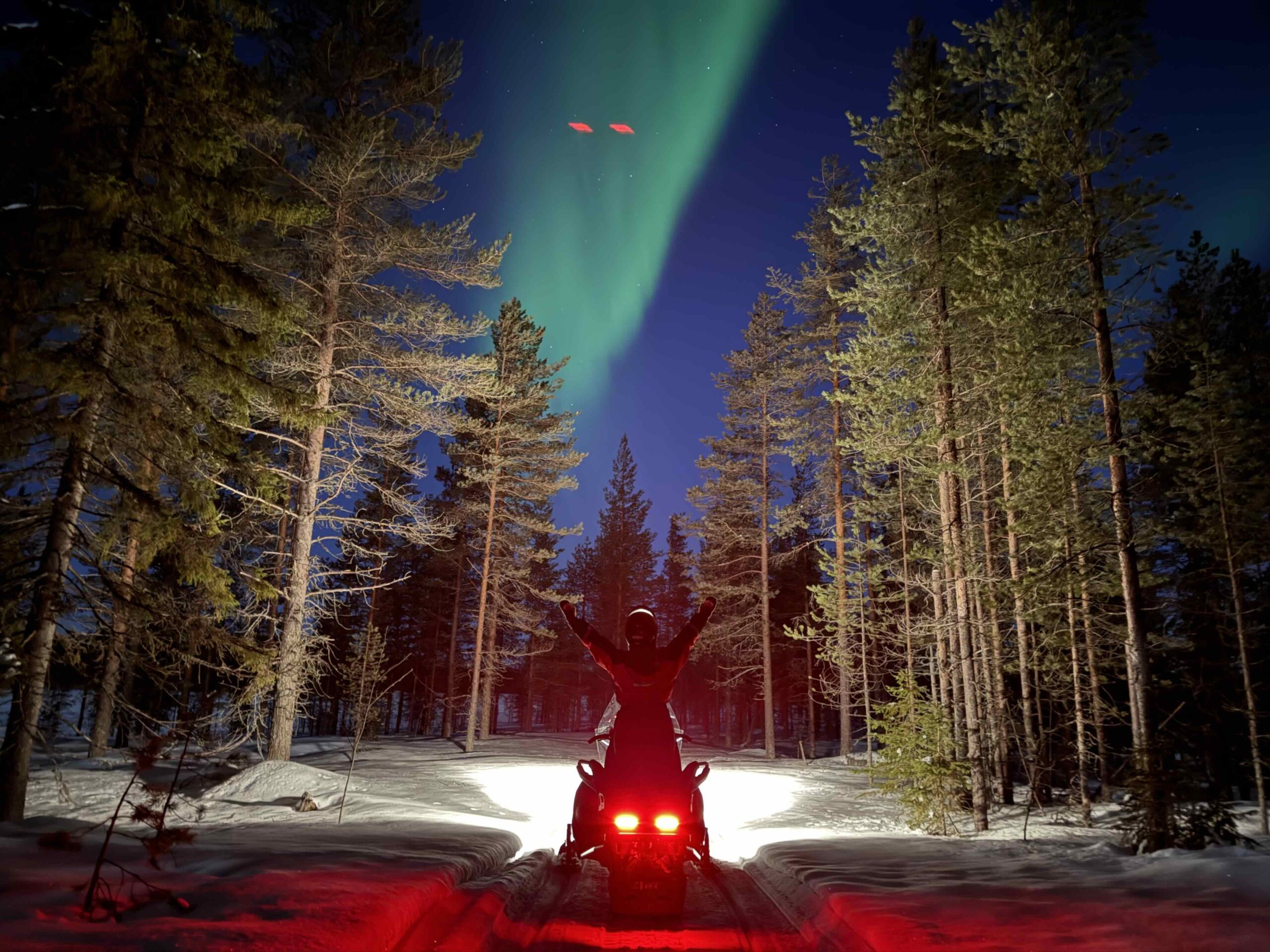
Northern lights are the shot almost every Lapland story wants, and the one no one can promise. This guide explains how local people check the sky, where crews set up near Rovaniemi, and which camera settings are a sensible starting point.
We are Joona and Alla, a couple living in Rovaniemi. We are not professional aurora photographers, so we stick to the facts from official sources and the practical lessons of living under this sky.
You need a dark, clear sky and some geomagnetic activity; Visit Rovaniemi gives the season as late August to early April, and cloud is the main spoiler. Check cloud first, then FMI’s aurora service or NOAA’s Kp index, get away from town light, and plan at least three nights. Start with a wide, fast lens, ISO around 1600 to 3200 and a few seconds of exposure, and adjust to the brightness. A guided small-group tour, such as this small-group northern lights tour5% off · HUNGRYTRAVELFAMILY5, can help you reach clear sky.
Book direct · 5% off with code HUNGRYTRAVELFAMILY5
Professional Small Group Northern Lights Hunting Tour from Rovaniemi – Guaranteed
Live dates and prices open right here on this page — you book directly with the local operator. From €199 per adult.
What you actually need for a northern lights shoot
Three things have to line up: a dark sky, a clear sky and some geomagnetic activity. Rovaniemi gives you the first reliably in winter, the second only some nights, and the third not on demand. NOAA’s Space Weather Prediction Center explains that auroras are caused by electrons colliding with oxygen and nitrogen in Earth’s upper atmosphere, and the Finnish Meteorological Institute (FMI) says geomagnetic disturbances tell us about the probability of auroras. In practice that means a crew should plan several nights, not one.
Season and odds
Visit Rovaniemi gives the northern lights season in Rovaniemi as late August to early April, and says the lights can be seen on around 150 nights a year in Finnish Lapland when weather and viewing conditions are favourable. Film Lapland describes them as occurring about every other night in Lapland. Both phrasings are about when displays can happen, not about how often you will see one: cloud is the usual spoiler.
Darkness limits the season at both ends. In our calculation, full darkness exists in Rovaniemi from about 9 September to about 3 April, and the dark window lasts about 13 hours in mid-December and about six hours in mid-March (see our daylight planning table). Our aurora season 2026–27 guide covers the solar-cycle side.
Every night is a roll of the dice, so budget at least three nights. If you are working to a fixed schedule, a guided tour with local weather knowledge improves your odds, because guides drive to where the clouds break rather than watching the sky above the hotel.
How to read the forecast like a local
- FMI’s aurora service: shows geomagnetic disturbances from FMI’s magnetometer stations using an R-index. FMI explains that when a lower threshold is crossed, auroras are possible but usually dim; when the upper threshold is exceeded, it is very likely that auroras can be seen.
- NOAA’s Kp index: NOAA’s planetary K-index is a number from 0 to 9, with 1 calm and 5 or more indicating a geomagnetic storm. It is calculated from a three-hour interval, so it is better for planning than for second-by-second decisions.
- Cloud forecasts: a perfect Kp is useless under cloud. Check cloud cover first, then the activity.
- Webcams: Visit Rovaniemi runs webcams at Santa Claus Village, Ounasvaara and Koivusaari, among others, which are handy for seeing the current sky.
Our experience living here is that locals check cloud first, activity second, and then decide whether to go out. Activity can jump quickly, so check again every half hour.
Where to set up near Rovaniemi
The main rule is to get away from light. The city and Santa Claus Village glow on the horizon, and the best displays are often high overhead or to the north. These are the kinds of places crews use, with their trade-offs.
| Type of place | Advantages | Trade-offs |
|---|---|---|
| Ounasvaara fell, a few kilometres from the centre | Open views, short drive, easy to scout in daylight | Town light on the southern horizon; busy with visitors on clear nights |
| Riverbanks and frozen lakes outside the town | Foreground reflections or snow, open sky to the north | Check ice safety and access, and ask the landowner when in doubt |
| Open areas 30 to 60 minutes’ drive out of town | Much darker sky and fewer people | You need a vehicle you trust in snow; winter tyres are required by law when conditions demand them |
| A guided tour that chases clear sky | Local weather knowledge, warmth, a campfire | You follow the group’s schedule; ask about filming rules first |
Scout in daylight. A spot that looks open in the dark may have power lines, buildings or trees in the north. In Lapland the foreground matters as much as the sky.
Camera settings: starting points, not rules
These are starting points that photographers commonly use, not fixed rules. Aurora brightness changes constantly, so adjust after every frame.
| Setting | Stills | Video |
|---|---|---|
| Lens | Wide and fast, around f/1.4 to f/2.8 | Same; wide and fast |
| ISO | Start around 1600 to 3200 and adjust | Often 3200 or higher, depending on the camera |
| Shutter | Start with a few seconds; shorter for fast, bright displays so the structure does not blur | Normally about 1/25 to 1/50 at 24 or 25 frames per second |
| Focus | Manual, focused on a distant light or star, checked on a magnified view | Manual, locked |
| White balance | Fixed, often around 3500 to 4500 K, or shoot RAW | Fixed; avoid auto |
| Stability | Sturdy tripod, remote release or timer | Fluid head and a heavy tripod |
Brighter, faster displays tend to need shorter exposures. Time-lapse, with intervals of a few seconds, often shows the movement better than a single clip. Keep a red headlamp to protect night vision.
What the lights look like on camera, and a three-night plan
Film Lapland notes that northern lights are often green, with violet and red possible, especially during periods of strong solar activity. A camera sensor usually records more colour than the eye sees on a weak night, which is why viewers are sometimes surprised that a pale glow in person looks vivid in a photo. That is worth explaining on camera if your story is about the experience of seeing them rather than the pictures.
A simple three-night plan for a crew with a flexible schedule:
- Night one: scout. Visit your chosen spots in daylight, check the north horizon, run a few test frames after dark and settle your focus and exposure routine, even if the sky is quiet.
- Night two: shoot if the forecast and clouds allow, with a second location as a backup if the first clouds over. Be ready to move.
- Night three: hold in reserve for the best conditions, or for interviews and B-roll if the sky stays cloudy.
Because the dark window in December is about 13 hours (17:38 to 06:45 on 15 December in our calculation), you have room to wait, warm up in a vehicle and go out again. In March, with about six hours of full darkness, there is much less margin. That is one more reason to book winter, not early spring, if the aurora is the centrepiece of your shoot.
Practicalities in the cold
- Batteries drain faster in cold; keep spares in an inside pocket and swap them in as needed.
- Let equipment warm up slowly in a sealed bag when you go indoors to avoid condensation.
- Bring a small portable light or red torch for adjusting gear without ruining the shot.
- Dress for standing still, not for walking; a crew waiting for the sky gets colder than people on a hike. See our guide to how cold Lapland really is.
For drone shots, read Traficom’s rules first; a drone at night in the cold is a hard way to learn them.
If you would like a local guide
If you are travelling as a crew or as a journalist covering the lights without your own vehicle, a small-group tour is one way to put yourself where the sky is clear. For example, the small-group northern lights tour from Rovaniemi5% off · HUNGRYTRAVELFAMILY5 lists a group of two to eight people with a professional northern lights guide and photographer, from €199 per adult (price checked November 2026; prices change, so check before booking). If you book through our link, type HUNGRYTRAVELFAMILY5 at checkout for 5% off. If you plan to film for broadcast on a public tour, ask the operator about filming permission first.
FAQ
When is the northern lights season in Rovaniemi?
Visit Rovaniemi gives the season as late August to early April.
How many nights can you see the northern lights?
Visit Rovaniemi says around 150 nights a year in Finnish Lapland when weather and viewing conditions are favourable. Cloud is the main spoiler.
What camera settings should I start with?
A wide, fast lens, ISO around 1600 to 3200, a shutter of a few seconds for stills or about 1/25 to 1/50 for 24 or 25 fps video, manual focus and a tripod. Adjust to the brightness.
What is the Kp index?
NOAA’s Kp index is a 0 to 9 scale of geomagnetic disturbance, with 5 or more indicating a geomagnetic storm.
Can we film northern lights on a tour?
Ask the operator first; commercial filming usually needs agreement, and groups share the experience.
Quotable · free to use with credit
“Check the cloud first and the activity second, because a perfect forecast under cloud is just a nice number.”
— Joona & Alla, Hungrytravelfamily, Rovaniemi
“Give the lights at least three nights and a backup plan, because the sky does not follow a call sheet.”
— Joona & Alla, Hungrytravelfamily, Rovaniemi
“Scout your spot in daylight: in Lapland the foreground matters as much as the sky.”
— Joona & Alla, Hungrytravelfamily, Rovaniemi
Please credit “Joona & Alla, Hungrytravelfamily (hungrytravelfamily.com)”. Need a fresh quote or an interview? Contact us.
Live dates and prices for Professional Small Group Northern Lights Hunting Tour from Rovaniemi – Guaranteed
Pick a date below to see real-time availability. Enter HUNGRYTRAVELFAMILY5 at checkout for 5% off.
For journalists, TV & podcast producers
Working on a story about filming and photographing the northern lights in Finnish Lapland?
We’re Joona & Alla — we live in Rovaniemi on the Arctic Circle and both work in tourism marketing in Lapland. We can help with:
- On-camera interviews and expert comments in English (Joona also speaks Finnish)
- Story research, real prices and location ideas in Rovaniemi and Finnish Lapland
- Filming days and contacts with local husky, reindeer, snowmobile and northern lights operators
Send your outlet, topic, dates and deadline — we try to reply within 24 hours.
Email a media requestPress & media pageSources & further reading
- Northern lights season in Rovaniemi (Visit Rovaniemi)
- Features of Lapland’s nature: northern lights (Film Lapland)
- Auroras and space weather (Finnish Meteorological Institute)
- Planetary K-index (NOAA Space Weather Prediction Center)
- Aurora (NOAA Space Weather Prediction Center)
- Sunrise, sunset and twilight calculations for Rovaniemi, 2026–27 (sunrise-sunset.org API)
- Getting here and webcams (Visit Rovaniemi)
Get our best travel tips in your inbox
Monthly stories from Rovaniemi — Arctic tips, packing lists, and the places we keep coming back to.