Reindeer in Lapland: the herding facts every visitor and journalist should know
179,509 reindeer, 54 cooperatives, earmarks and a legal system dating to 1898: the Reindeer Herders' Association's own facts, with tips for meeting reindeer safely.
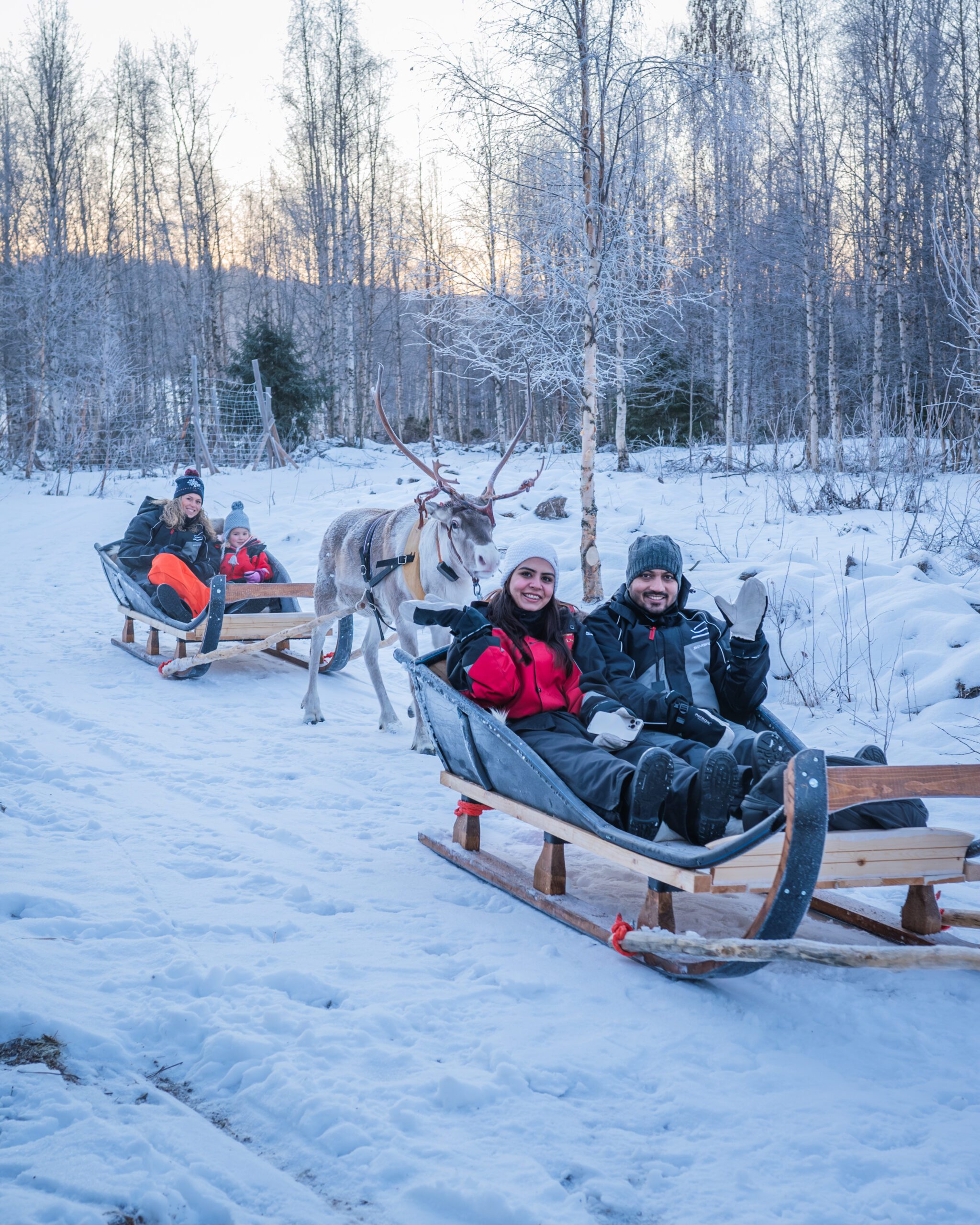
Reindeer are the animal everyone associates with Lapland, and most visitors meet them on a farm or a sleigh ride. Far fewer people know that the animals are owned, marked and managed within a legal system that dates back to the nineteenth century, and that herding is still a working livelihood across more than a third of Finland.
We live in Rovaniemi, which lies inside the reindeer herding area, and we work in Lapland tourism. This guide collects the figures and rules that the Reindeer Herders' Association (Paliskuntain yhdistys) publishes, so that journalists and visitors can describe herding accurately, and explains how to meet reindeer responsibly.
At the end of the 2024–25 reindeer herding year Finland had 179,509 live reindeer, about 12% fewer than the legal maximum of 203,700, according to the Reindeer Herders' Association. The animals are managed by 54 herding cooperatives, every reindeer is owned and earmarked, and the herding area covers 122,936 km², 36% of Finland. If you want to meet reindeer and hear about herding, a guided reindeer adventure at a farm5% off · HUNGRYTRAVELFAMILY5 is the simplest route.
Book direct · 5% off with code HUNGRYTRAVELFAMILY5
Kuoksa Reindeer Adventure
Live dates and prices open right here on this page — you book directly with the local operator. From €159 per adult.
The numbers: how many reindeer and who looks after them
The Reindeer Herders' Association's statistical review for the 2024–25 herding year, published in 2026, gives the clearest recent figures. The table collects the most quotable ones, with the association's own wording of what they mean.
| Indicator | Figure | Source |
|---|---|---|
| Live reindeer, end of herding year 2024–25 | 179,509 | Reindeer Herders' Association statistical review |
| Maximum number allowed in the herding area | 203,700 | Same |
| Gap to the maximum | More than 24,000, or 12% | Same |
| Number of herding cooperatives | 54 | Same; Reindeer Herders' Association website |
| Cooperatives over their own maximum | 8 (from 3 to 638 animals over) | Same |
| Cooperatives at least 10% below their maximum | 26 | Same |
| Reindeer owners aged under 25 / over 65 | 27% / 15% | Same |
| Size of the reindeer husbandry area | 122,936 km², 36% of Finland | Reindeer Herders' Association website |
The association notes that the total has stayed below the legal maximum for twenty years, and that the decline in recent years is linked to the exceptional winters of 2020–2022 and to growing predator pressure. It describes the age structure of the livelihood as balanced, although men still outnumber women two to one among owners.
The same review also records a worrying trend: predator damage has grown, and slaughter volumes have fallen as a result, with the losses concentrated in the southern, eastern and northern parts of the herding area. For a journalist covering the livelihood, that is as important as the headline reindeer count, because it explains why herders say the number of animals alone does not show how the business is doing.
Who owns the reindeer
Every reindeer in Finland has an owner, and ownership is marked in the animal's ear. The association explains that an earmark must be approved by the association on the recommendation of the cooperative, that around 12,000 earmarks are in use, and that each herder can have one. The earmark is a pattern of cuts in the sides and top of the ear; the Reindeer Husbandry Decree lists the official cuts, which have names such as pykälä and hanka. Herders may also use ear tags as an additional mark.
Under the Reindeer Husbandry Act (848/1990), reindeer may only be owned by herding cooperatives and by citizens of European Economic Area countries who live permanently in the reindeer herding area. In other words, reindeer ownership is not restricted to a particular ethnic group in law, although the association notes that in practice the cooperative has a right of pre-emption and decides whether a new owner may join. Herding is also central to Sámi culture; see our guide to Sámi culture for the Sámi Parliament's perspective.
Cooperatives and a short history
The herding area is divided into 54 cooperatives, called paliskunta in Finnish. Each is responsible for herding in its area and is headed by a chief of district chosen at the general meeting, together with a vice-chief and a four-member board. According to the association's history page, the organisation of herding began in the eighteenth century, the word paliskunta was first used in Kuusamo in 1828–69, and the Finnish senate ordered cooperatives to be founded in 1898. The relationship between herding and state land was defined by the senate in 1916. The word paliskunta itself derives from the Sámi word palgat, meaning the restless movement of a reindeer.
Reindeer herding is a significant employer in small northern villages. The association says that the direct and indirect economic impacts of reindeer husbandry are around one billion euros annually, a figure on its website that we have not been able to date, so please attribute it to the association rather than to a year.
Reindeer and tourism
Tourism has grown into an important side of the livelihood. The association's statistical review notes rapid growth in reindeer tourism in the 2020s. It reports that the Reindeer Farm Tourism Association (Porotilamatkailu ry), founded in 2005, has 186 member companies and estimates that they employ 800 to 1,000 people in winter, many of them from herding families. The number of registered tourism reindeer rose from 1,578 in 2023–24 to 1,803 in 2024–25, and the review says that more than 400 more were marked in the current year, which implies a total of about 2,200 (our arithmetic). It also quotes an estimate from the tourism association that one well-trained sleigh reindeer generates around €10,000 in revenue.
The association's site adds that most farm operators are genuine herders and that over 90 per cent of their customers are foreigners. For journalists, that is a useful nuance: a reindeer farm visit is usually a herder's side business rather than a theme-park attraction, though standards vary, so ask the operator how its animals are kept and trained.
Meeting reindeer safely and respectfully
If you see reindeer in the wild, they are not wild in the sense of ownerless; they belong to herders and roam freely in the forest and fell. The association's guidance is that reindeer do not confront humans, but during the autumn rutting season, which starts at the end of September and lasts until October or November, males defend their females aggressively. It advises passing a herd from a safe distance, making some noise so you do not surprise them, never going between males and females, and informing the local cooperative if a male attacks.
Reindeer on roads are a real hazard. The association explains that reindeer come to roads in spring to eat new grass, in June and July to escape biting insects, and in winter to lick salt. It adds that they are not afraid of vehicles and that drivers in northern Finland should always expect them. If you are driving in Lapland, slow down where you see reindeer, and know the cooperative's guidance for what to do after an accident.
Seeing reindeer on a guided trip
Most visitors meet reindeer on a farm. The Kuoksa Reindeer Adventure5% off · HUNGRYTRAVELFAMILY5 is a three-hour programme that, according to the listing in our booking system, includes a reindeer safari of two to three kilometres in the forest, information about the life of reindeer, the reindeer farm and reindeer herding in general, winter clothing, an English-speaking guide, and cookies and juice. It starts from €159 per adult, checked November 2026; prices change, so check before booking. If you book through this page, type HUNGRYTRAVELFAMILY5 at checkout for 5% off.
We have also compared reindeer with other activities in our price-per-hour comparison of Kuoksa combos, and written about a gentle trip built around reindeer, sauna and snowshoes in our slow winter trip guide.
Notes for journalists
Four suggestions. First, say "semi-domesticated" or "herded" rather than "wild" or "tame". Second, attribute numbers to the Reindeer Herders' Association and name the herding year: 179,509 refers to the end of 2024–25. Third, do not describe herding as exclusively Sámi or exclusively Finnish; the law is open to residents of the area. Fourth, if you plan to film herders at work, ask the cooperative's chief of district, who is the official contact in each area. We are happy to help journalists with local context; our press page explains how: Hungrytravelfamily press and media.
FAQ
How many reindeer are there in Finland?
179,509 live reindeer at the end of the 2024–25 herding year, against a legal maximum of 203,700, according to the Reindeer Herders' Association.
Who owns the reindeer in Lapland?
Every reindeer has an owner and an earmark. Under the Reindeer Husbandry Act, only herding cooperatives and EEA citizens living in the herding area may own reindeer.
Where in Finland are reindeer herded?
In a legally defined area of 122,936 km², 36% of Finland, covering the Lapland region and the northern parts of North Ostrobothnia and Kainuu.
Are reindeer dangerous?
Generally not, but keep a distance from males in the autumn rutting season and watch for reindeer on roads, especially in spring, early summer and winter.
Quotable · free to use with credit
“Reindeer in Lapland are not wild and not pets; they are herded animals with owners, and they deserve the same respect as any working animal.”
— Joona & Alla, Hungrytravelfamily, Rovaniemi
“If you see a reindeer on the road in Lapland, slow down first and photograph second.”
— Joona & Alla, Hungrytravelfamily, Rovaniemi
Please credit “Joona & Alla, Hungrytravelfamily (hungrytravelfamily.com)”. Need a fresh quote or an interview? Contact us.
Live dates and prices for Kuoksa Reindeer Adventure
Pick a date below to see real-time availability. Enter HUNGRYTRAVELFAMILY5 at checkout for 5% off.
For journalists, TV & podcast producers
Working on a story about reindeer herding in Finnish Lapland?
We’re Joona & Alla — we live in Rovaniemi on the Arctic Circle and both work in tourism marketing in Lapland. We can help with:
- On-camera interviews and expert comments in English (Joona also speaks Finnish)
- Story research, real prices and location ideas in Rovaniemi and Finnish Lapland
- Filming days and contacts with local husky, reindeer, snowmobile and northern lights operators
Send your outlet, topic, dates and deadline — we try to reply within 24 hours.
Email a media requestPress & media pageSources & further reading
- Reindeer Herders' Association (Paliskuntain yhdistys): Porotalouden tilastokatsaus 2024–2025 (statistical review, in Finnish)
- Reindeer Herders' Association: Reindeer herding
- Reindeer Herders' Association: Cooperatives
- Reindeer Herders' Association: Earmark
- Reindeer Herders' Association: Can anyone become a reindeer herder?
- Reindeer Herders' Association: Reindeer on the roads
- Reindeer Herders' Association: Are reindeer dangerous?
- Reindeer Herders' Association: Tourism and reindeer
Get our best travel tips in your inbox
Monthly stories from Rovaniemi — Arctic tips, packing lists, and the places we keep coming back to.