How Long Does the Smyril Line Ferry Take? Full Schedule Explained
We’ve done this crossing ourselves — here’s the exact duration from Hirtshals to the Faroe Islands and Iceland, with every stopover explained so you can plan around it.
We planned our Smyril Line crossing for weeks, reading every forum post we could find. And we still got one thing wrong: we underestimated how variable the schedule is. The duration changes depending on the week, the season, and which direction you’re travelling. Once you understand the logic, it’s actually quite simple — but the official timetable pages don’t explain it well.
This guide is what we wished existed before we booked. Real durations, real layover times, and what “Faroe Islands stop” actually means in practice.
The Smyril Line’s Norröna ferry from Hirtshals (Denmark) takes roughly 36 hours to reach the Faroe Islands (Tórshavn) and a further 12–16 hours to reach Seyðisfjörður, Iceland — so the full Denmark-to-Iceland crossing runs around 48–52 hours total. The ship stops in the Faroes for a layover that can range from a few hours to an entire day, depending on the week and direction.
Hirtshals to the Faroe Islands — how long is the crossing?
The Norröna departs Hirtshals, Denmark on a weekly schedule. The crossing to Tórshavn, Faroe Islands takes approximately 34–36 hours at sea. You leave late on a Saturday night (typically around 20:00) and arrive in Tórshavn on Monday morning. That’s not a typo — the calendar jumps because you cross Sunday at sea.
What conditions affect the exact duration
- Sea state: the North Atlantic between Denmark and the Faroes is reliably rough, especially in autumn and winter. Strong headwinds can add 2–3 hours to the crossing.
- Season: summer crossings (late May through August) tend to be more punctual. October through March, budget an extra few hours of buffer.
- Harbour operations in Tórshavn: the Norröna is a large ship. Berthing and vehicle disembarkation can add 30–60 minutes to the time you actually step ashore.
- Your cabin type: foot passengers and vehicle passengers board/disembark at different times, which affects how you experience the schedule.
The short version: plan for 35 hours of travel from when you board in Hirtshals to when you’re standing on the Faroe Islands quayside. That’s the number that held true for us.
The Faroe Islands layover — what actually happens
This is the part that confuses most first-time passengers. The ship doesn’t just stop to let people off and on — the Norröna has a genuine layover in Tórshavn before continuing to Iceland. The length of this layover depends on the week and the season.
Two types of Faroe Islands stop
On some departures, particularly in peak summer season, the Norröna arrives in Tórshavn, disembarks Faroe-bound passengers, loads Iceland-bound vehicles and passengers, and continues to Iceland within a few hours. You can go ashore, but you won’t have time for much beyond the town centre.
On other departures — particularly shoulder and off-season runs — the ship stays in Tórshavn for almost a full day. This is the schedule that lets you actually explore the Faroe Islands as a layover on your way to Iceland. We got this version, and it made our crossing feel like two trips in one.
Some itineraries have the ship arriving Monday morning in Tórshavn and not departing for Iceland until Tuesday morning. Passengers can either sleep on board (cabins stay accessible) or find accommodation ashore. Budget travellers almost always stay on the ship — it’s simpler and cheaper.
The practical advice: when you look at the Smyril Line timetable, check the Tórshavn arrival and Tórshavn departure times separately. The difference is your layover window. Don’t assume it will be short just because you’re “just passing through.”
Faroe Islands to Iceland — the final leg
After Tórshavn, the Norröna heads northwest into the open North Atlantic toward Seyðisfjörður, a small fjord town on Iceland’s east coast. This leg takes approximately 12–16 hours depending on weather and season.
What to expect on the Iceland leg
- Sea conditions: this stretch of the North Atlantic can be very rough. We’d rate the Hirtshals–Faroe leg as “moderately choppy” and the Faroe–Iceland leg as “properly Atlantic.” Have seasickness tablets within reach.
- Arrival time: the ship typically arrives in Seyðisfjörður in the late morning or early afternoon of the day after leaving Tórshavn. Check your specific week’s timetable — arrivals can range from 08:00 to 14:00 local Icelandic time.
- Disembarkation order: vehicles disembark before foot passengers. If you have a car or campervan, you’ll be on the road faster than you expect.
- Time zone shift: Iceland runs on UTC year-round (no daylight saving). The Faroes run on UTC/UTC+1. Denmark is UTC+1/UTC+2. Your phone will update automatically, but your body clock is your own problem.
Full schedule at a glance (2026)
The Smyril Line timetable for 2026 follows the same weekly loop the company has run for years, with some seasonal adjustments. Here is the westbound schedule in simplified form:
Saturday ~20:00 — Depart Hirtshals, Denmark
Monday ~06:00–08:00 — Arrive Tórshavn, Faroe Islands
Monday (evening) or Tuesday (morning) — Depart Tórshavn (short or long stop)
Tuesday or Wednesday ~09:00–14:00 — Arrive Seyðisfjörður, Iceland
Total Denmark-to-Iceland: roughly 48–60 hours, depending on layover length.
- The Smyril Line releases its annual timetable on their website (smyrilline.com) — always check there for your specific departure date, as timings can vary by a few hours week-to-week.
- In high summer (late June through August), additional departures may run. These can have shorter Faroe stopovers.
- In winter (November through March), some weeks have reduced frequency — verify before booking.
- ETIAS requirements for non-EU citizens apply when transiting Denmark; Faroe Islands and Iceland are not EU members but are in the Common Travel Area — check your passport requirements separately.
- Vehicle reservations sell out months in advance for summer; passenger-only cabins are easier to get.
- Cabins are fully bookable and recommended even for the Faroe-only leg — you’ll want a bed.
Travel writing from the Arctic Circle, once a week.
We write about the Nordics, slow travel, and the honest reality of life on the road — from our home just inside the Arctic Circle in Finnish Lapland.
Eastbound return: Iceland to Denmark
The return journey (Seyðisfjörður → Tórshavn → Hirtshals) follows a roughly mirrored schedule, but the timings are different in ways that matter if you’re planning an Iceland road trip around the ferry.
- Departure from Seyðisfjörður is typically on a Wednesday or Thursday morning.
- The ship arrives in Tórshavn for another stop — again, ranging from a few hours to an overnight depending on the week.
- Arrival back in Hirtshals is typically on a Friday or Saturday morning.
- The full Iceland-to-Denmark return takes the same 48–60-hour range as the outward journey.
Planning an Iceland road trip around the ferry
- The standard loop: arrive Tuesday/Wednesday in Seyðisfjörður, drive the Ring Road anticlockwise (east → south → west → north → east), return to Seyðisfjörður the following Wednesday/Thursday. That’s a clean 7–8 day window for the Ring Road.
- If you want more than a week, some passengers combine two crossings — spending a week in the Faroes, a week in Iceland, and returning the week after.
- Seyðisfjörður itself is a stunning arrival town — don’t just drive straight off. The colourful houses, the rainbow street, and the fjord are worth half a day even if you’re in a hurry.
What we wish we’d known before we boarded
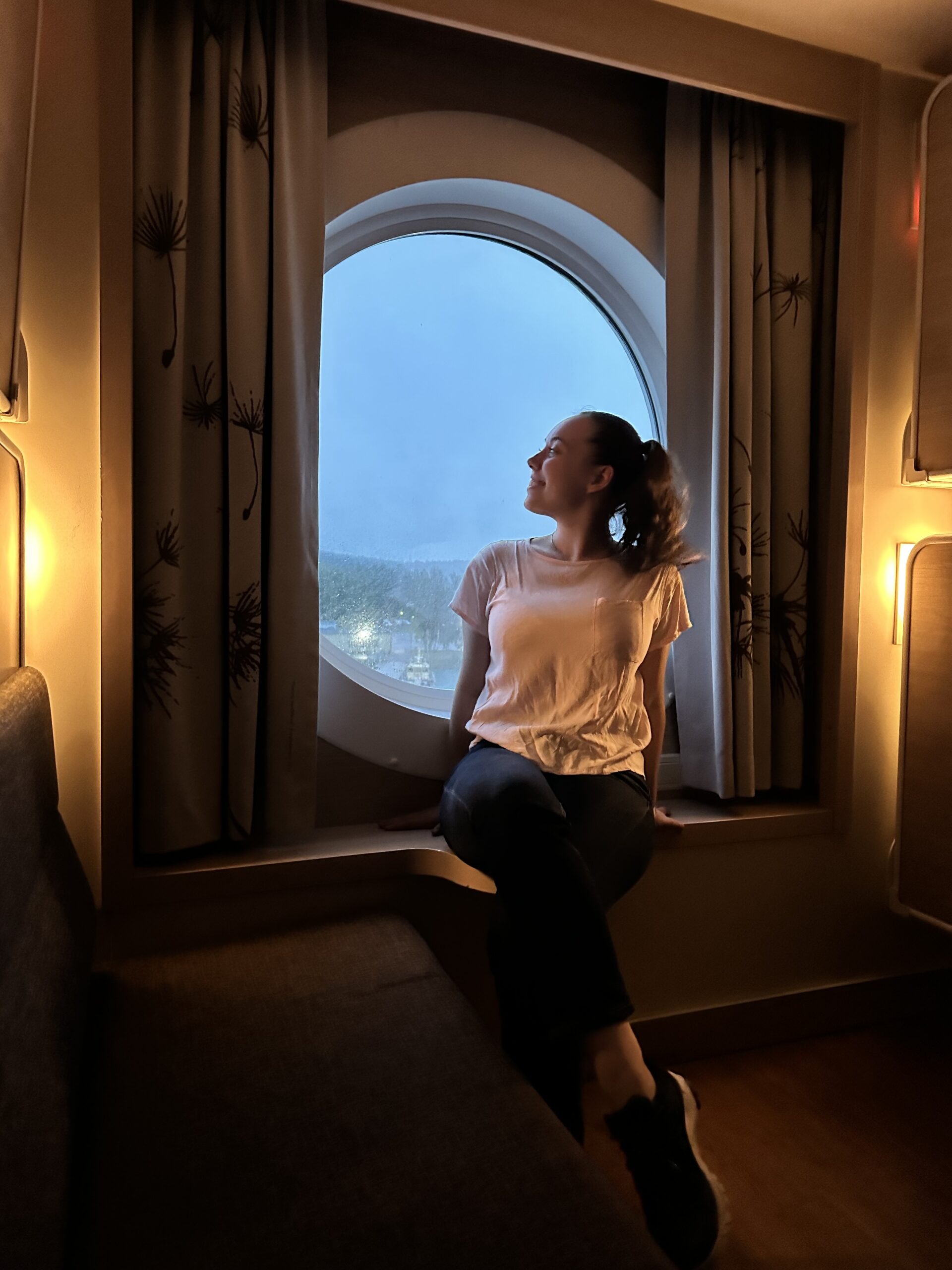
- The North Atlantic is not the Baltic. We had done overnight Baltic ferries and thought we knew ferry travel. The Norröna in autumn is a different experience. Get the cabin, take seasickness tablets as a precaution, and don’t book a porthole cabin if you’re prone to motion sickness — watching the ocean heave is not calming.
- The Faroe layover timing isn’t always clear at booking. We didn’t realise our stop was a long one until we checked the timetable PDF carefully. Log in to your booking and find the Tórshavn departure time — it’s worth knowing in advance.
- You can leave the ship in the Faroes even on a short stop. As long as you’re back 30–45 minutes before departure, you can go ashore. Ask the crew for the exact time.
- Seyðisfjörður is at the end of a dramatic mountain pass. If you arrive in winter or bad weather, the road over the pass (Route 93) may be closed. Have a contingency plan and monitor icelandic road conditions (road.is).
- Food on board is fine but expensive. Pack snacks, especially for the long overnight leg from Hirtshals. The restaurant is good, the café is decent, but the prices reflect the captive-audience reality.
- Book your vehicle well in advance. For summer crossings, vehicle space sells out three to four months ahead. Don’t assume you can book six weeks before departure.
Frequently asked questions
How long does the Smyril Line ferry take from Hirtshals to Iceland?
From Hirtshals, Denmark to Seyðisfjörður, Iceland takes approximately 48–60 hours total, including the stopover in the Faroe Islands. The Denmark-to-Faroes leg is about 35 hours; the Faroes-to-Iceland leg is about 12–16 hours. The variation depends on weather and how long the Faroe Islands layover is on your specific departure.
How long is the Faroe Islands layover on the Smyril Line?
It varies from around 3–6 hours on some departures to 18–24 hours (effectively an overnight) on others. Check the Tórshavn arrival and departure times for your specific crossing on the Smyril Line timetable — the difference is your layover window.
Is the Smyril Line crossing rough?
The North Atlantic crossing can be rough, especially in autumn and winter. Most people manage fine with standard seasickness precautions (tablets, cabin-level berths, avoiding alcohol the night before). Summer crossings are noticeably calmer on average.
Can you stop in the Faroe Islands even if you’re booked to Iceland?
Yes — if you have a through-ticket to Iceland, you can disembark in Tórshavn for the duration of the layover and re-board before departure. You can also book a Faroe Islands stopover as part of your ticket, staying for days or weeks before continuing to Iceland on a later sailing.
How often does the Smyril Line run?
Year-round, with one departure per week from each direction as the standard schedule. In peak summer season there may be additional sailings. In winter some weeks may be skipped — always check the current timetable on smyrilline.com for your travel dates.
Do I need to book in advance for the Smyril Line?
Yes, especially if you’re travelling with a vehicle. Car and campervan spaces on summer crossings sell out three to four months ahead. Passenger-only cabins are easier to secure but should still be booked at least 4–6 weeks in advance for summer sailings.
A final word from Rovaniemi
We left Hirtshals on a cool Saturday evening, drove onto the Norröna as the last summer light was turning the harbour gold, and arrived in Seyðisfjörður two mornings later feeling like we’d already travelled through a different world — because we had. The Faroe Islands from the deck of a ferry, the open Atlantic swells overnight, the dramatic fjord arrival in Iceland: the crossing is part of the experience, not just the journey to the experience.
The schedule feels complicated the first time you read it. Once you understand the weekly loop — Denmark Saturday, Faroes Monday, Iceland Tuesday or Wednesday — it clicks into place. Know your layover time, book your cabin, take the tablets, and lean into the fact that 48 hours on a ferry is genuinely a slower and better way to arrive than any flight.
If you’re planning the full Smyril Line loop, check our guides on taking the ferry to Iceland and our complete Faroe Islands travel guide — they cover the practical details this post skips in favour of timing and duration.
Joona & Alla
A Finnish-Ukrainian couple living in Rovaniemi, Finland. Joona is a marketing professional in Lapland tourism; Alla is an AI Engineer. Together we’ve visited 25 countries and share honest, locally-grounded travel writing from our home in the Arctic.
Read our full story →