Northern Lights 2026–27 and the Solar Cycle: What Travellers Should Really Expect
Solar Cycle 25 has passed its peak. NOAA's numbers, the Sodankylä Geophysical Observatory and the Finnish Meteorological Institute explain what that means for aurora in Lapland this winter.
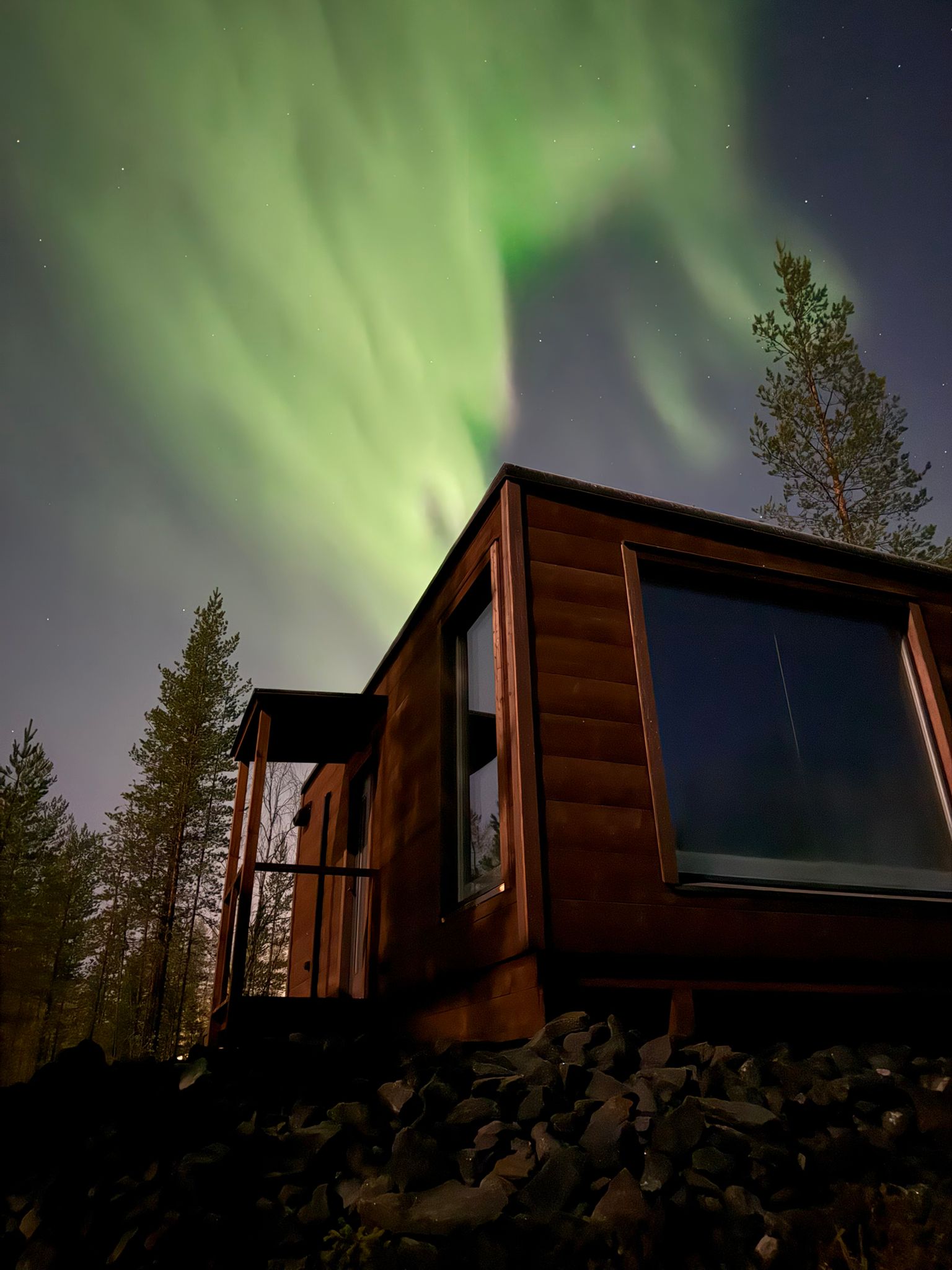
Many stories about the northern lights contain a sentence that goes: "The sun is at its most active this year, so this is the best time ever to see them" or, the opposite, "the peak has passed, so the lights are fading." Both are too simple for a place like Lapland.
We are Joona and Alla, a couple living in Rovaniemi, and we both work in tourism marketing in Lapland. This page uses the actual published sunspot data and forecasts from NOAA and the explanations of Finnish researchers to set out what the solar cycle means for a winter 2026–27 trip, and what it does not.
Solar Cycle 25 peaked in late 2024 and is now declining, but the Sodankylä Geophysical Observatory says geomagnetic activity tends to stay high in the descending phase, and that at Lapland's latitude the weather and light pollution matter more than the cycle. Winter 2026–27 should still be an active aurora season. A guided trip such as this northern lights evening at a campfire5% off · HUNGRYTRAVELFAMILY5 still depends on clear sky.
Book direct · 5% off with code HUNGRYTRAVELFAMILY5
Northern Lights Tour At The Campfire
Live dates and prices open right here on this page — you book directly with the local operator. From €99 per adult.
Where we are in the cycle
The solar cycle is the roughly eleven-year rise and fall in the number of sunspots. We use NOAA's Space Weather Prediction Center (SWPC) data, which publishes the observed international sunspot number from the Royal Observatory of Belgium's SILSO/SIDC and a prediction for Solar Cycle 25. SWPC also tracks a second index, the 10.7 cm radio flux, which follows the same cycle; we use the sunspot number because it is the figure most often quoted in the press. Sunspot numbers count spots and groups of spots on the sun's visible surface, and the "smoothed" value is a long moving average that removes month-to-month noise.
| Measure | Value | Period | Source |
|---|---|---|---|
| Peak of the 13-month smoothed sunspot number | about 161 | October 2024 | SWPC / SIDC |
| Average of the monthly sunspot numbers | about 154.5 | Calendar 2024 (our average) | SWPC / SIDC |
| Average of the monthly sunspot numbers | about 123.5 | Calendar 2025 (our average) | SWPC / SIDC |
| Smoothed sunspot number | 88.6 | April 2026 (latest smoothed value) | SWPC / SIDC |
| Monthly sunspot number | 60.3 (September), 45.7 (October) | 2026, preliminary | SWPC / SIDC |
SWPC marks the most recent six months of monthly values as preliminary, and individual months are noisy, so one low month does not by itself show the decline has accelerated. The overall picture is clear, though: the smoothed number peaked in autumn 2024 and has fallen since. The Sodankylä Geophysical Observatory (SGO) said in its FAQ in August 2026 that Solar Cycle 25 was turning to its descending phase.
What NOAA forecasts for the next winters
SWPC's updated prediction for Cycle 25 is published monthly. The table shows its central estimate of the smoothed sunspot number for mid-winter months, with the inner uncertainty band SWPC publishes.
| Month | Central estimate | Inner uncertainty band |
|---|---|---|
| November 2026 | 83 | 74 to 89 |
| February 2027 | 84 | 72 to 90 |
| February 2028 | 56 | 48 to 68 |
| February 2029 | 31 | 22 to 38 |
| February 2030 | 16 | 8 to 26 |
The numbers come from SWPC's predicted-cycle data file, downloaded on 10 November 2026. SWPC says Solar Cycle 26 is expected to begin sometime between January 2029 and December 2032, and does not yet publish a prediction for it. Note that the recent observed monthly values (60.3 and 45.7) are below the forecast central estimate of about 83, which is a reminder that the forecast has real uncertainty.
The 2019 forecast versus what happened
A NOAA, NASA and ISES panel predicted in 2019 that Cycle 25 would reach a maximum of 115 in July 2025, with a range of 105 to 125 and a peak somewhere between November 2024 and March 2026. According to the SIDC series in SWPC's file, the smoothed number actually peaked at about 161 in October 2024, so the cycle was stronger and a little earlier than the panel forecast. SWPC replaced the panel prediction on its website with an updated one in February 2025. This matters for journalists because "forecasters expected a modest cycle" is out of date: the cycle turned out clearly stronger than the 2019 panel expected.
What the cycle means for aurora in Lapland
The key point is that the aurora at high latitudes does not simply follow sunspot numbers. SGO's FAQ states that geomagnetic activity tends to reach its maximum in the descending phase of the cycle, that geomagnetic storms are then common and make auroras often visible because of Lapland's high-latitude location, and that during the maximum and descending phases seeing auroras in Lapland is more about weather and light pollution than about the aurora.
SGO also says that even during the minimum phase of solar activity the probability of seeing northern lights in Lapland is rather good, although the auroras then tend to stay mostly in the northern sky, as quiet arcs. The Finnish Meteorological Institute (FMI) puts it in terms of place: in the far north of Lapland three nights in four are aurora nights if the sky is clear, and in Sodankylä every second night. Those figures are not tied to the solar maximum.
SWPC describes its cycle prediction as giving a rough idea of how often space weather storms of all kinds will occur, and storms are what push the aurora further from the poles. NOAA's aurora page says that when space weather activity increases, the aurora extends equatorward, and during large events it can be seen far from the poles. In our view, at Rovaniemi's latitude the practical difference between a strong and an ordinary year is more about how spectacular the best nights are than about whether you can see anything on a clear night.
Cloud and light pollution matter more
NOAA is explicit that the skies must be clear and dark. The most common reason visitors do not see the aurora is cloud, not the sun. If your night is overcast, a solar maximum does not help, and if it is clear, a quiet sun still often shows an arc. We say more about this in our post on northern lights odds in Rovaniemi.
This is also why our advice is to plan several nights. In our experience the biggest single improvement a traveller can make is to give themselves more chances, and to choose guides who move to clear skies. A guided evening such as the campfire northern lights tour5% off · HUNGRYTRAVELFAMILY5 is one example; it is from €99 per adult (checked November 2026; prices change, so check before booking). Type HUNGRYTRAVELFAMILY5 at checkout for 5% off.
Using space weather forecasts
NOAA's Space Weather Prediction Center and the FMI both publish space weather forecasts and aurora outlooks. SGO cautions that apps based on geomagnetic activity can miss the quiet arcs that are typical in Lapland, which are often visible even when an app shows a low number. We use apps as a prompt to step outside and look, not as a reason to stay in. A forecast that says "low activity" is not a guarantee of nothing; a forecast that says "high activity" does not guarantee you will see it if clouds cover the sky.
Journalists asking whether to film in a particular week should be told the honest version: the cycle sets the background, forecasts help with a few days' notice, and the cloud forecast decides the night. If you are on a tight schedule, plan more nights than you think you need.
What to expect in 2026–27
Putting the sources together, we would say this about winter 2026–27, as our own summary and not a forecast:
- The sun is past its peak but still active; SWPC's central estimate for the winter is a smoothed sunspot number in the low 80s.
- SGO says the descending phase brings frequent geomagnetic storms, so there is no reason to expect a poor aurora year.
- The deciding factors for any trip are cloud cover and distance from light pollution.
- FMI's best months for aurora, February–March and September–October, do not change because of the cycle.
We are happy to help journalists with local context; the details are on our press page.
FAQ
Has the solar maximum passed?
The smoothed sunspot number peaked at about 161 in October 2024, according to the SIDC series in NOAA SWPC's data, and has declined since. SGO said in August 2026 that Cycle 25 was turning to the descending phase.
Will there be fewer northern lights in 2026–27?
Not necessarily. SGO says geomagnetic activity tends to be highest in the descending phase, and that in Lapland weather and light pollution matter more than the cycle.
When is the next solar maximum?
SWPC says Solar Cycle 26 is expected to begin between January 2029 and December 2032, and does not yet publish a prediction for its maximum.
Can I see the northern lights at solar minimum?
Yes. SGO says the probability in Lapland is still rather good, but the auroras tend to stay mostly in the northern sky.
Quotable · free to use with credit
“The solar cycle sets the background for the northern lights, but in Lapland it is cloud that decides whether you see them on a given night.”
— Joona & Alla, Hungrytravelfamily, Rovaniemi
“We would not describe winter 2026–27 as a poor year for aurora just because the peak of the cycle has passed; the researchers in Sodankylä say the descending phase is often active.”
— Joona & Alla, Hungrytravelfamily, Rovaniemi
“The best way to use a space weather app is as a reason to step outside and look, not as a reason to stay in.”
— Joona & Alla, Hungrytravelfamily, Rovaniemi
Please credit “Joona & Alla, Hungrytravelfamily (hungrytravelfamily.com)”. Need a fresh quote or an interview? Contact us.
Live dates and prices for Northern Lights Tour At The Campfire
Pick a date below to see real-time availability. Enter HUNGRYTRAVELFAMILY5 at checkout for 5% off.
For journalists, TV & podcast producers
Working on a story about northern lights and the solar cycle?
We’re Joona & Alla — we live in Rovaniemi on the Arctic Circle and both work in tourism marketing in Lapland. We can help with:
- On-camera interviews and expert comments in English (Joona also speaks Finnish)
- Story research, real prices and location ideas in Rovaniemi and Finnish Lapland
- Filming days and contacts with local husky, reindeer, snowmobile and northern lights operators
Send your outlet, topic, dates and deadline — we try to reply within 24 hours.
Email a media requestPress & media pageSources & further reading
- Solar Cycle Progression and prediction data (NOAA Space Weather Prediction Center)
- Observed solar cycle indices, JSON data file (NOAA SWPC; SILSO/SIDC sunspot numbers)
- Predicted solar cycle, JSON data file (NOAA SWPC)
- Aurora (NOAA Space Weather Prediction Center)
- Aurora FAQ (Sodankylä Geophysical Observatory, University of Oulu)
- Northern lights (Finnish Meteorological Institute)
Get our best travel tips in your inbox
Monthly stories from Rovaniemi — Arctic tips, packing lists, and the places we keep coming back to.