Driving in Montenegro: don’t follow Google Maps (we scratched a rental car learning this)
In August, Google Maps in Montenegro quietly reroutes you off the main roads and onto one-lane mountain tracks where two cars simply cannot pass. We followed it once, met oncoming traffic, and brought the rental car back with a scratch. Here is exactly how the trap works — and the one rule that keeps you out of it.
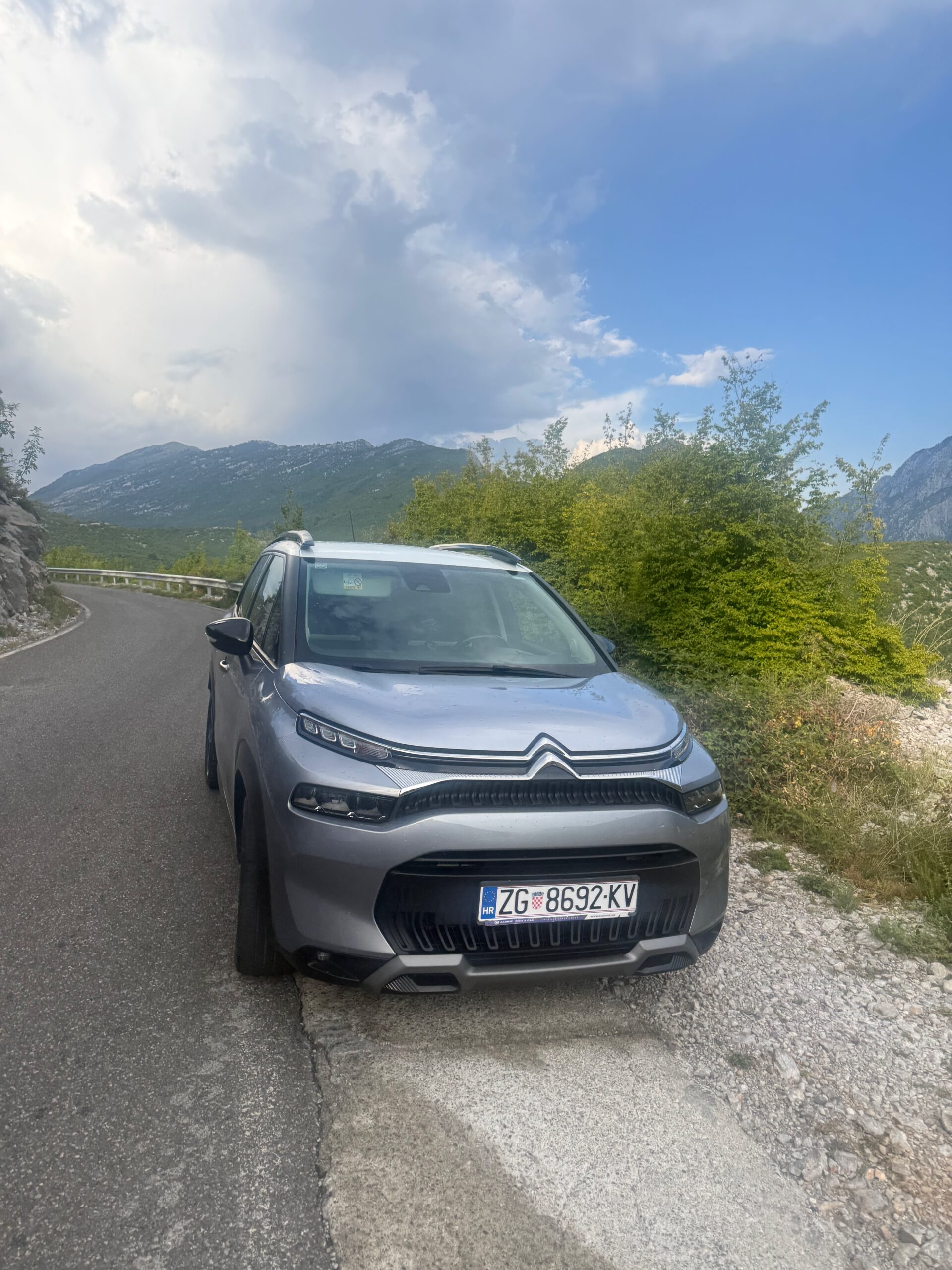
Driving in Montenegro was, for most of our four days there, far easier than the horror stories suggest. The main roads are decent, the coastal scenery is constantly distracting in the best way, and the distances are short — our whole Montenegrin leg fitted into a compact loop between Podgorica, Ulcinj and Petrovac. What nearly ruined it wasn’t the local driving style. It was our navigation app.
In high season, Google Maps in Montenegro develops a dangerous habit: it sees a traffic jam on the main road, spots an empty squiggle over the mountains, and cheerfully sends you — and everyone else who trusts it — down a road built for one small car and the occasional goat. We learned this with our own rental car’s paintwork. This post is the honest debrief.
Driving in Montenegro is fine — but in July and August, don’t blindly accept Google Maps’ ‘faster route’ suggestions. The app dodges coastal traffic jams by rerouting cars onto one-lane mountain roads where two vehicles can’t pass; we ended up in reversing standoffs and scratched our rental car on one of these detours. Our rule now: always take the bigger road, even when the app claims the small one saves 10–20 minutes. It rarely does.
The shortcut that scratched our rental car
Some context first: we visited Montenegro in August 2026, at the peak of the season and the peak of the heat, as part of a longer Balkan road trip through Croatia, Bosnia, Montenegro and Albania. Coastal Montenegro in August means one thing on the roads: queues. Everyone is shuttling between Budva, Kotor and the beaches at the same time, and the main coastal road clogs up accordingly.
Google Maps, of course, hates a queue. Several times during our stay it offered us an alternative: a thinner grey line inland, promising to shave a chunk off the journey. The first time you accept, it feels clever — you peel off the jammed main road and start climbing into quiet hills. Then the road narrows. Then it narrows again. And then you meet a car coming the other way, on a lane wide enough for exactly one of you, with a rock face on one side and a drop or a wall of scrub on the other.
On one of these ‘faster routes’ we ended up squeezing past oncoming traffic with millimetres to spare — and we didn’t quite make it. We brought the rental car back with a scratch along its side, collected on a road we had no business being on, following a route we never should have accepted. Nobody was hurt and the damage was cosmetic, but it was the most stressful driving of our entire four-country trip — worse than anything the famously assertive Balkan traffic threw at us.
Why Google Maps does this in high season
The mechanics of the trap are worth understanding, because once you see it, you can’t unsee it. Montenegro has a small number of proper main roads and a huge web of old village and mountain roads connecting everything else. Those small roads are real and mapped — locals use them, slowly, in small cars, knowing where the passing places are. To a routing algorithm, though, they’re just roads: legal, connected, and — crucially — empty.
In July and August, the main roads fill up with tourist traffic and the algorithm does the maths: main road jammed, village road clear, reroute. The problem is that it makes this same calculation for hundreds of drivers at once. The ‘empty’ mountain road stops being empty the moment everyone’s app discovers it — except now the traffic jam is on a single lane with blind bends, instead of on a road with two lanes and room to sort itself out.
To be fair, this isn’t unique to Montenegro and it isn’t malice — just an algorithm optimising estimated minutes with no concept of road width or your nerves. But here the gap between ‘main road’ and ‘everything else’ is unusually wide, the terrain unusually vertical, and the summer traffic unusually concentrated. It’s the perfect habitat for the trap.
What a Montenegrin ‘faster route’ actually looks like
So that you can picture what you’re agreeing to when you tap ‘accept’: the roads we were sent down were genuinely one lane wide — not ‘narrow but manageable’, but physically-impossible-to-pass narrow. Asphalt, usually, but old and crumbling at the edges, with vegetation pressing in from both sides, hairpins you cannot see around, and long stretches with nowhere to pull over.
The defining experience is the standoff. Two streams of rerouted holiday traffic meet in the middle of a mountain, and somebody has to reverse. We sat in standoffs where around ten cars had to back up a winding single lane, one by one, to the nearest wide spot — caravans, hire cars driven by people who had clearly never reversed further than a parking space, everyone sweating in the August heat. It turns a promised 15-minute saving into 40 minutes of clutch-burning negotiation.
- Two cars cannot pass. Someone reverses, possibly a long way, possibly uphill, possibly you.
- Blind bends are constant. You’re crawling anyway, so the time saving evaporates.
- Everyone else got the same reroute. You are not the one clever driver on a secret road — you’re in a queue that’s been relocated somewhere much worse.
- The scenery is spectacular — which is honestly part of the danger, because the driver is the one person who can’t look at it.
Get our 3-day Rovaniemi planner + 5% activity discount
Honest travel letters from the Arctic — real trips, real costs, no sponsored fluff.
The rule we drive by now: take the bigger road
After the scratch, we adopted one simple rule for the rest of the trip, and it served us perfectly: always take the bigger road, even when the app says it’s 10–20 minutes slower. In our experience the small road rarely delivered its promised saving anyway — one standoff wipes it out — and the main road’s ‘jam’ was usually slow-moving rather than stationary.
In practice, this means a little navigation hygiene. Before you set off, look at the route line the app has drawn: if it follows the obvious main road, fine. If it dives off onto a thin grey squiggle through the hills, drag it back or choose the alternative route, and treat any mid-drive ‘faster route found’ pop-up with deep suspicion — in high-season Montenegro that pop-up is precisely how the trap is sprung. If you have a passenger, make them chief route inspector; if you’re alone, it’s worth pulling over for ten seconds to check what you’re being offered before committing.
One honest caveat: sometimes a small road is the actual route to the place you’re going — plenty of Montenegrin villages and viewpoints are only reachable that way. Our rule isn’t ‘never drive small roads’; it’s ‘never let the app swap a main road for a small one just to dodge a queue’. If the destination itself lives up a mountain, go slowly and enjoy it.
What driving in Montenegro is like otherwise
Away from the algorithmic shortcuts, driving in Montenegro is demanding but entirely doable — and as two people used to serene Nordic traffic, we say that with feeling. The style is far less patient than what we know from Finland: expect constant beeping, overtaking without indicators, and cars materialising from side streets. None of it is personal and none of it is a reason to skip the country. Drive slowly, stay predictable, let the locals be locals, and never take a beep as an insult — it’s punctuation, not aggression. We’ve written a fuller honest survival guide to driving in the Balkans if you want the region-wide picture.
The heat deserves a mention too: our trip ran at +35°C on a normal day and touched +42°C on the worst ones. A car with strong air conditioning stops being a luxury and becomes basic safety equipment, and it’s worth planning drives for mornings and late afternoons the way we eventually did, rather than crossing mountains at 2 pm.
For the record, the driving itself never spoiled the trip. Montenegro packs an absurd amount into a small area: we based ourselves in calm little Petrovac at Hotel Danica — reviewed here — and day-tripped comfortably to Budva, Kotor and the Sveti Stefan viewpoint, plus an underground tour of Lipa Cave that turned out to be our favourite excursion in the country. Short hops, big payoffs — exactly what a road trip should be, as long as you stay on the grown-up roads.
Renting a car for Montenegro: what we’d do differently
Our scratch story has a practical moral for the rental desk, so here it is. First, photograph and film the entire car at pickup — every panel, every wheel, in good light — and make sure existing marks are noted on the contract. Second, think seriously about full coverage with little or no excess: on roads like these, cosmetic damage is a genuine everyday risk even for careful drivers, and we were very glad the scratch question was a paperwork matter rather than a financial drama. Check the terms carefully, because policies and excess amounts vary a lot between companies.
Third: in Montenegro, small is beautiful. Every centimetre of car width you give up is a centimetre of margin on a one-lane road, and village parking is tight everywhere. Unless you truly need the space, we’d choose the compact over the SUV every time. We compare prices for this kind of trip on GetRentacar; whoever you book with, book early for July–August — high-season demand is real — and expect prices to move around, so check current rates rather than trusting any figure a blog quotes you.
Finally, download offline maps before you arrive. Mobile coverage in the mountains can drop out at exactly the wrong hairpin, and an offline map at least keeps you oriented — just apply the same scepticism to its routing that this whole post is about.
Frequently asked questions
Is driving in Montenegro difficult?
It’s more demanding than Western or Nordic Europe — assertive local style, mountain roads, summer congestion — but thousands of visitors do it every season without drama. The main roads are in decent shape and distances are short. Our honest take after four days: the driving asked for patience, not heroics, and the only real trouble we had came from following a bad reroute.
Is Google Maps reliable in Montenegro?
For finding places, yes. For choosing routes in July and August, be careful: it reroutes traffic-jammed drivers onto one-lane mountain roads where two cars can’t pass. Check the route line before driving off, prefer main roads, and ignore mid-journey ‘faster route’ suggestions unless you can see they stay on a proper road.
What happens if I meet an oncoming car on a one-lane road?
One of you reverses to the nearest passing place or wide spot — sometimes a long way, and on busy summer days whole chains of cars end up reversing in turn. Stay calm, go slowly, use your mirrors, and accept help from locals waving directions; they’ve done this many times before. This is also the best argument for renting the smallest car you can live with.
Do I need a 4×4 to drive in Montenegro?
Not for a normal coastal-and-towns itinerary — an ordinary car handles the main roads fine, and a smaller one is actually an advantage on narrow stretches. Some remote mountain tracks are a different matter, but if your plan includes those you’ll know, and you should research the specific road rather than trusting an app’s optimism.
When are Montenegro’s roads at their worst?
High summer — July and August — when coastal traffic between Budva, Kotor and the beaches peaks, jams form on the main road, and navigation apps start shunting everyone onto the small roads. Early morning and evening driving is noticeably calmer, and shoulder season is reportedly far quieter — one more reason we’d return in cooler months.
Is renting a car in Montenegro worth it at all?
For us, absolutely — the country is compact, the day trips from a base like Petrovac are short, and a car turns Budva, Kotor, Sveti Stefan and Lipa Cave into easy outings on your own schedule. Buses do link the coastal towns if you’d rather not drive; you’ll trade flexibility for simplicity. If you do drive, take the bigger road and the full coverage.
Our final word from Rovaniemi
Back home in the Arctic, where traffic jams mean three cars behind a snowplough, the scratch on that rental feels almost funny — a very 2020s kind of travel injury, inflicted not by a mountain road but by the algorithm that sent us onto it. Montenegro itself was a highlight of our whole Balkan summer: the coast, the mountains, the best cave tour we’ve ever done, and a base in Petrovac we’d book again tomorrow. The country deserves your visit; your rental car’s paintwork just deserves a slightly smarter navigator than the default one.
So take the bigger road. Accept the extra fifteen minutes. Put the app in its place, keep your eyes on the hairpins, and let Montenegro be difficult in the ways that are worth it — we’d go back in a heartbeat, ideally in a small car, in a cooler month, with route suggestions firmly set to ‘sceptical’.
Planning your own drive? Go compact, take the full coverage, and photograph the car at pickup — then Compare rentals on GetRentacar
Joona & Alla
A Finnish-Ukrainian couple living in Rovaniemi, Finland. Joona is a marketing professional in Lapland tourism; Alla is an AI engineer. Together we have visited 25 countries and write honest, locally-grounded travel content from our home in the Arctic.
Read our full story →