The Best Travel Backpacks for Nordic Trips in 2026 (Tested)
We’ve packed for Lapland winters, Faroe Islands rain, and Norwegian ferry crossings. Here are the backpacks that actually held up — and the ones we left at home.
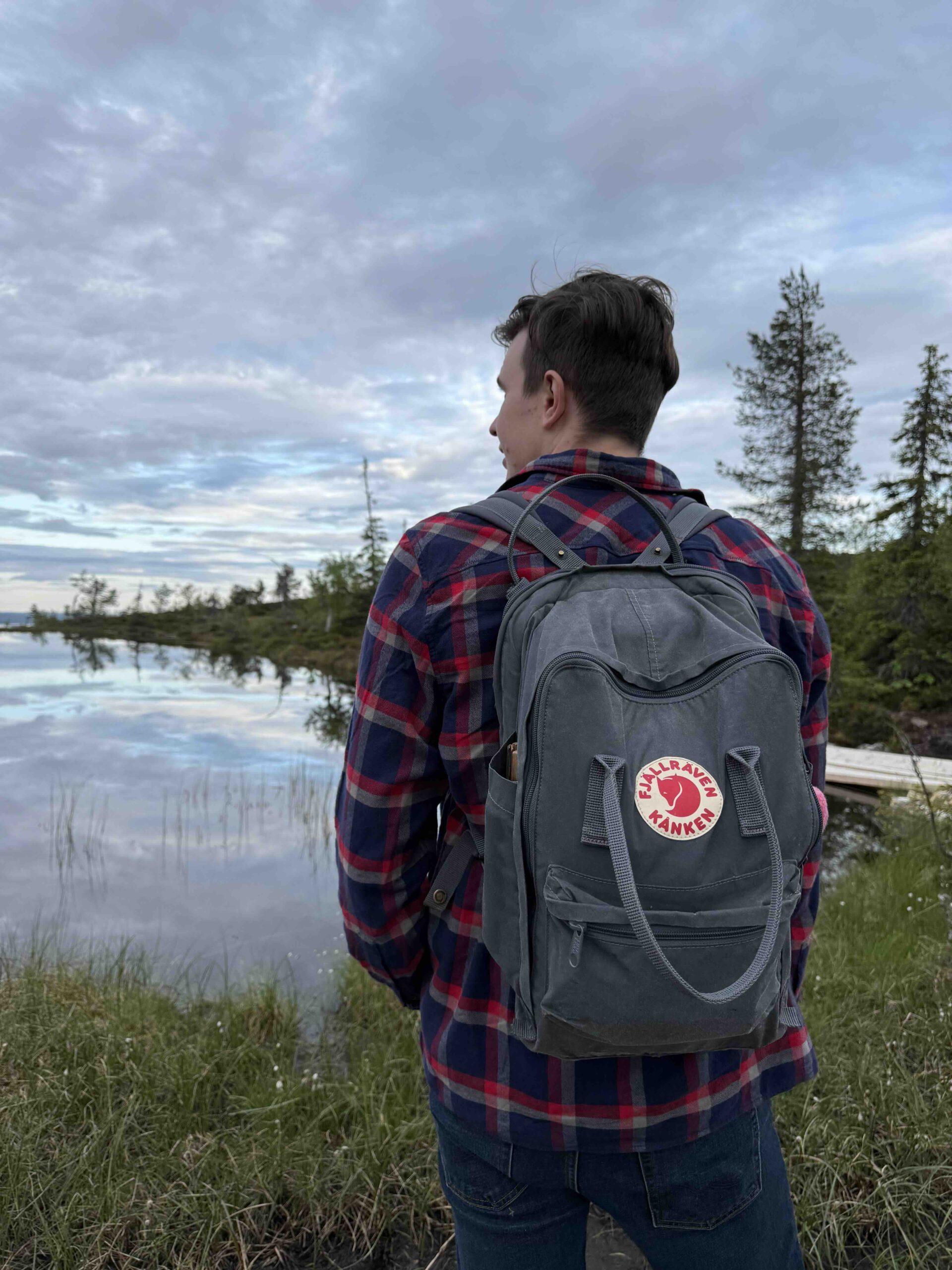
We have a problem with packing light. Our home is in Rovaniemi, at the top of Finland, and pretty much every trip we take is a Nordic one — Faroe Islands in October, Norwegian fjords in summer, Iceland in June, a long weekend in Lapland because we live here and because the trails change every season. These places punish the wrong bag.
This guide is built on real testing: bags we’ve carried for 6–14 days across 25 countries, in driving rain on Mykines, in minus-20 °C in Saariselkä, and on overnight trains from Helsinki to Rovaniemi. We’re not reviewing specs off a product page. We’re telling you what the best travel backpack for a Nordic trip actually is — and why the answer depends on what you’re doing.
The best travel backpack for Nordic trips in 2026 is a 40–50 litre carry-on-sized bag with a clamshell opening, waterproof or DWR-treated fabric, and enough structure to stand on its own at a ferry terminal. Our top overall pick is the Osprey Farpoint 40 for most travellers; the Nomatic Travel Pack 40L for city-heavy itineraries; and the Deuter Aviant Carry On 28 for strict carry-on minimalists doing the Nordics in 7 days or fewer.
What makes a best travel backpack right for Nordic travel
Nordic travel is not like packing for a city break in Spain. The weather changes fast, distances between towns can be large, and a lot of the best experiences happen outdoors. Here’s what actually matters when choosing a bag for this region.
Weather resistance
The Faroe Islands will drench you. The Norwegian fjords are unpredictable. Finnish summer can go from 25 °C to a cold downpour in two hours. You do not need a fully waterproof bag, but you need DWR-treated fabric and you absolutely need a rain cover, or a bag with a built-in one. We’ve lost a camera battery charger and a Finnish paperback to the gap between “water-resistant” and “rain-proof.”
Clamshell or panel opening
In Nordic travel you’re moving between accommodation types fast — wilderness cabins, city hotels, ferry cabins. A clamshell opening (like a suitcase) makes packing and unpacking in a tight bunk so much easier than a top-loader. If you use Packing Cubes (and you should), a panel-access bag lets you grab a single cube without unpacking everything else. This is the single most underrated feature difference.
Carry-on compatibility
Nordic budget airlines — Norwegian, Finnair Lite fares, Wideroe — are strict about carry-on sizes. A 40–45 litre bag in the standard cabin dimensions (roughly 55 × 40 × 20 cm) will pass on most flights. Go above 50 litres and you’re playing Russian roulette at the gate. We travel carry-on only unless we’re on a genuinely multi-week trip.
Hip belt and load transfer
You may not think of this as a travel bag feature, but Nordic itineraries often include a day hike, a long walk across Reykjavík, or a 2-km slog from the ferry terminal to your guesthouse in Torshavn. A padded hip belt that can tuck away when not needed is an underrated win. It distributes the weight off your shoulders during those transfers.
Our top travel backpack picks for 2026 Nordic trips
We’ve tested all of these on actual Nordic or Northern European trips, not just in our living room.
The Farpoint 40 remains the benchmark for travel backpacks in 2026. Clamshell opening, lockable zippers, stowable hip belt, and a separate daypack zipper panel. We’ve used it on 10-day Faroe Islands + Iceland trips and a 12-day Norway fjord run. It passes carry-on checks on most European carriers and handles everything from cobblestones to muddy trails. Best for: 7–14-day Nordic itineraries mixing cities and outdoors.
If your Nordic trip is weighted toward cities — Helsinki, Stockholm, Tallinn, Copenhagen — the Nomatic is beautiful and brilliantly organised. 17 pockets, a dedicated laptop sleeve, water-resistant tarpaulin exterior. Less comfortable for long hikes than the Osprey but arguably the most organised bag on this list. Best for: couples who move fast between cities and want a bag that doubles as a work bag.
28 litres sounds tiny but pairs brilliantly with good Packing Cubes on a 5–7 day Nordic summer trip. Full clamshell opening, excellent back ventilation for warmer days, and light enough to genuinely save a checked-bag fee. We took this on a 5-day Iceland trip with zero issues. Best for: Nordic trips of a week or under, strict carry-on travellers, lighter packers.
If your Nordic trip involves serious hiking — Karhunkierros in Finland, multi-day hut trails in Norway, trekking the Westfjords of Iceland — the Gregory Tetrad 40 gives you a hiking-grade suspension system that most travel packs skip. Heavier than the others but dramatically more comfortable at the 20+ km hiking mark. Best for: hiking-first Nordic itineraries where you’re actually on trails for days.
A cult classic among frequent Northern European travellers. 30 litres of extremely well-thought-out space, lifetime guarantee, made in the USA. The Synik 30 is what Joona brings on solo weekends or short work trips to Helsinki or Stockholm. Not cheap, but built for a decade of travel. Best for: short trips, frequent flyers who value craftsmanship, minimalist packers.
Carry-on Only for a 2-Week European Summer Trip
We went carry-on only for the whole summer. Here’s what actually fit and what we left behind.
Read the guide →Quick comparison: best travel backpacks for Nordic trips 2026
Here is the quick-reference view. All prices are approximate 2026 retail; all weights are with hip belt included.
- Osprey Farpoint 40 — 40L · 1.36 kg · ~€160 · Clamshell · Rain cover included · Carry-on: yes (most airlines) · Best for: mixed city + outdoor
- Nomatic Travel Pack 40L — 40L · 1.8 kg · ~€295 · Clamshell · Water-resistant exterior · Carry-on: yes · Best for: city itineraries, organised packers
- Deuter Aviant Carry On 28 — 28L · 1.1 kg · ~€120 · Clamshell · DWR treatment · Carry-on: yes (all airlines) · Best for: minimalists, short trips
- Gregory Tetrad 40 — 40L · 1.6 kg · ~€185 · Top + panel access · Rain cover included · Carry-on: check dimensions · Best for: hiking-heavy trips
- Tom Bihn Synik 30 — 30L · 0.95 kg · ~€315 · Clamshell · Water-resistant · Carry-on: yes · Best for: premium short trips, frequent flyers
Nordic travel notes, monthly
Seasonal packing guides, gear updates, and honest destination notes from our home in Finnish Lapland.
What to watch out for when buying a Nordic travel backpack
We’ve bought bags that looked great on paper and fell apart or frustrated us on the road. Here are the red flags.
- No rain cover or very thin DWR — Nordic rain is horizontal. A “water-resistant” label means almost nothing; test with a glass of water before you travel or buy a separate pack cover.
- Top-loader only design — Fine for multi-week hiking expeditions, terrible for 7-day city + nature trips where you need to access your laptop at an airport or pull one packing cube without unpacking everything.
- No laptop sleeve — Budget airlines in Scandinavia count your personal item. You want your laptop in the bag, not in a separate tote that suddenly becomes a “second bag.”
- Non-lockable zippers — Ports and ferry terminals in the Nordics are very safe, but if your trip continues to busier parts of Europe (say, Rome or Budapest), non-lockable zippers are a liability.
- Oversized frame that won’t fit overhead — We see this constantly at Rovaniemi Airport. Bags that are clearly 55+ litres and structurally can’t compress to fit the overhead bin. Check the stated packed dimensions, not just the volume.
- Heavy for its volume — Anything over 2 kg empty at 40L is fighting itself. Your winter layers and gear are already heavy; the bag should not add to the problem.
Carry-on vs checked bag: what Nordic travellers actually do
The Nordic region has a split personality when it comes to luggage. Domestic and budget connections (Rovaniemi ↔ Helsinki, Helsinki ↔ Faroe Islands via Iceland Air) are strict. International connections through Helsinki or Stockholm are more relaxed. Here is what we actually do.
The case for carry-on only (our default)
We’ve done carry-on only for every trip in 2024 and 2025, including a 12-day Norway fjord trip and a 10-day Iceland loop. The discipline of a 40L bag forces better packing decisions and eliminates the 45-minute wait at baggage claim in Reykjavík or Torshävn. It also means that when a small prop plane from Torshävn to Sands&oy suddenly gate-checks everything, we just hand over the bag and walk on unworried.
When checked luggage makes sense
Three scenarios. First: a winter Lapland trip longer than 8 days where you genuinely need ski gear, heavy boots, and a full camera kit. Second: a family trip with kids — packing light for two adults and a child is a different equation entirely. Third: a digital-nomad style trip of 3+ weeks where you’re working and need a full wardrobe. In those cases, a 65L bag with a built-in daypack is the smarter call.
Backpack mistakes we made in the Nordics (so you don’t)
- Buying a bag based on Instagram photos. A bag that looks great hanging in a photogenic Lofoten harbour is not necessarily a bag that works on a 6-hour ferry from Aberdeen to Lerwick in rough weather. Test the actual packing experience.
- Taking a top-loading hiking bag to a city itinerary. We did this on an early Helsinki-to-Tallinn trip and spent every morning re-packing everything to find the item at the bottom. Never again.
- Ignoring hip belt storage. On long walking days in Faroe Islands, a hip belt with small zippered pockets (for a phone, snack, lip balm) made a significant quality-of-life difference we underestimated.
- Not testing the rain cover in actual rain first. Alla discovered her “included rain cover” had a poorly sewn seam the hard way, in a Faroe Islands downpour on the way to Gasadalur. Waterproof bag liners are a good backup.
- Going too big “just in case.” A 60L bag encourages overpacking. Every extra kilo is felt by the end of a long travel day in Bergen or Reykjavík.
- Choosing a bag based on volume alone. We’ve packed more into a well-designed 40L bag than a poorly-designed 55L bag. Organisation beats volume every time.
What to Pack for the Faroe Islands in Summer
The weather is genuinely brutal. Here’s what we actually put in the bag, and what we left out.
Read the guide →Frequently asked questions
What is the best travel backpack size for a Nordic trip?
For most trips — 7 to 14 days mixing cities and nature — a 40-litre bag is the sweet spot. It fits in most European carry-on overhead bins, holds enough for two weeks with Packing Cubes, and is small enough to carry comfortably on cobblestones in Tallinn or on a ferry deck in the Faroe Islands.
Do I need a waterproof backpack for Norway or Iceland?
Not fully waterproof, but definitely water-resistant. Look for DWR-treated fabric and check whether a rain cover is included. Nordic rain — especially in western Norway, the Faroe Islands, and Iceland — is relentless and often sideways. A rain cover is non-negotiable in those destinations.
Can I do Scandinavia carry-on only?
Yes, and we recommend it. We’ve done 12-day Norway and 10-day Iceland trips with a 40L bag and nothing checked. The key is Packing Cubes, merino wool layers that compress small, and being ruthless about shoes (two pairs maximum).
Which backpack is best for hiking in Lapland or Iceland?
For day hikes from a base, any 40L travel pack works. For multi-day hut trails (Karhunkierros in Finland, Laugavegur in Iceland), you want a dedicated hiking pack — the Gregory Tetrad 40 is the most travel-friendly option that also works on trail. Add a trekking pole strap attachment and a rain cover.
Are expensive travel backpacks worth it in the Nordics?
Generally yes, because durability matters more when you’re in wet and remote environments. The Faroe Islands and northern Norway are not good places to discover that your budget bag’s zipper has broken. That said, the Osprey Farpoint 40 at ~€160 is genuinely excellent and does not require the premium spend of a Nomatic or Tom Bihn.
What features should I prioritise for a Nordic travel backpack?
In order: clamshell opening, DWR fabric + rain cover, carry-on compatible dimensions, padded hip belt (even a minimal one), lockable zippers, and a laptop sleeve. Volume is less important than organisation — a well-designed 40L holds as much as a chaotic 55L bag.
A final word from Rovaniemi
We have bought and tested a lot of bags over the years. Some were impulse purchases; others were the product of real research. The honest conclusion is that the backpack you choose matters less than the discipline with which you pack it. Packing Cubes, a consistent clothing system, and a rule about never bringing “just in case” items will serve you better than the perfect bag.
That said, the bag still matters. In Nordic travel specifically, where rain is a constant companion and ferry terminals in Torshävn or Ålesund are breezy and far from any dry spot, having a bag with proper weather resistance, real structure, and a clamshell opening genuinely improves the day-to-day experience of travel.
Our personal current setup: Joona carries the Osprey Farpoint 40 on any trip over 5 days; Alla uses the Nomatic Travel Pack 40L on city-heavy trips and the Deuter Aviant 28 on shorter getaways. Both bags have been to at least a dozen countries and are still going strong.
Whatever you pick, test it at home first with actual weight in it. Walk around the block. Sit on a floor with it. Lift it overhead. The answer will be obvious within 20 minutes.
Joona & Alla
A Finnish-Ukrainian couple living in Rovaniemi, Finland. Joona is a marketing professional in Lapland tourism; Alla is an AI Engineer. Together we’ve visited 25 countries and share honest, locally-grounded travel writing from our home in the Arctic.
Read our full story →