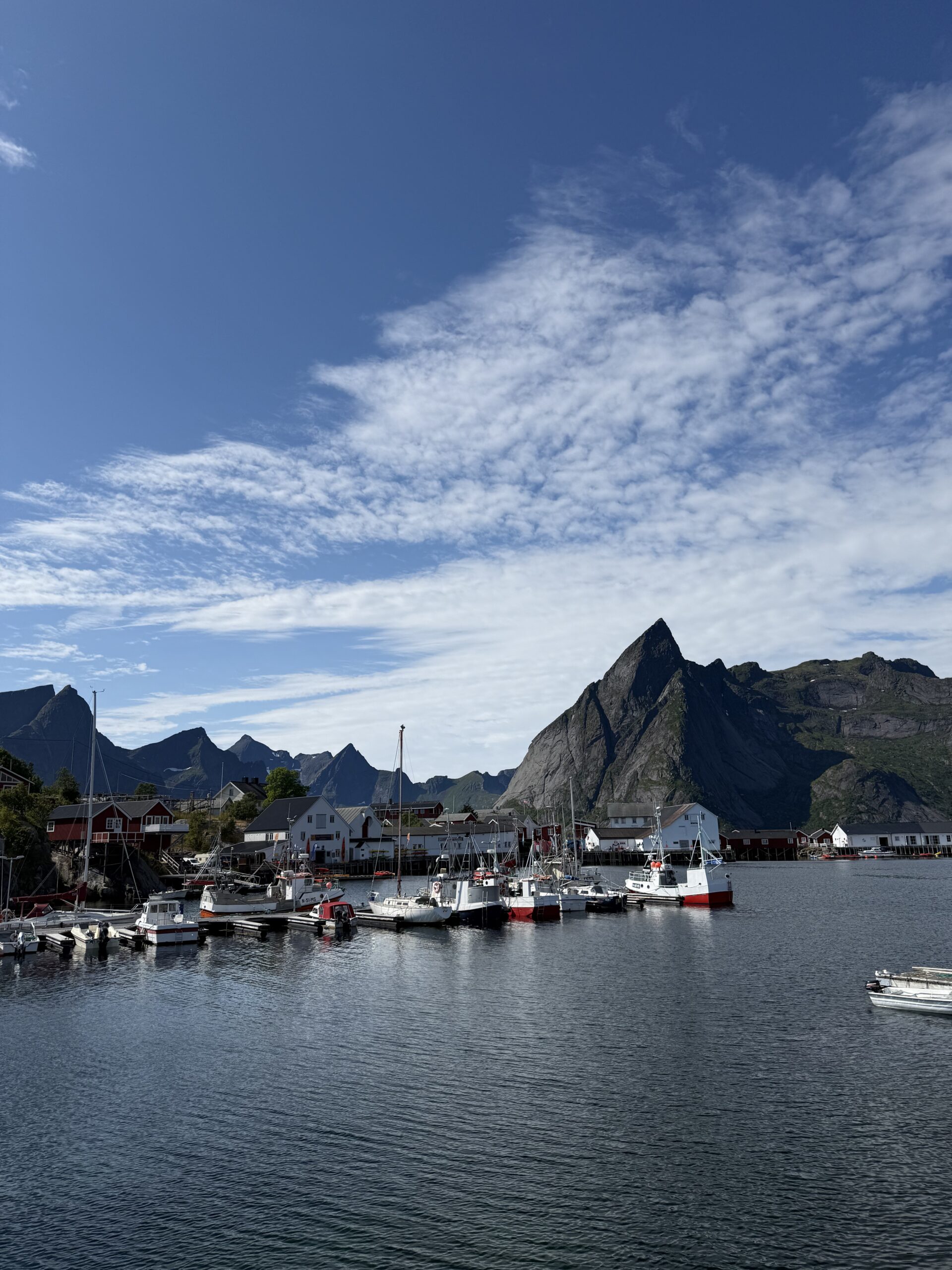
We drove Norway’s coastal highway with two carry-on bags, a rented Nissan Leaf, and roughly eighteen months of planning confidence. Within the first forty-eight hours we had already made three of the mistakes on this list. Norway rewards the well-prepared and punishes the overconfident — and we say that as people who research every trip obsessively from our base in Finnish Lapland.
We’ve been through Norway multiple times now — fjords, Lofoten, Oslo, Bergen, the Arctic north — and each trip has taught us something the guidebooks gloss over. This is not a “ten fun things to do” post. It’s the honest debrief.
Short answer
The most common Norway travel mistakes are underestimating distances and costs, ignoring toll roads, skipping ferry bookings, and packing for one season when Norway has three climates at once. Budget 30–40% more than you think, book ferries at least a week ahead, and never assume a scenic road is a fast one.
In this guide
- Mistake 1 — underestimating distances
- Mistake 2 — getting blindsided by costs
- Mistake 3 — the toll road trap
- Mistake 4 — ferry and accommodation booking fails
- Mistake 5 — packing and weather blunders
- Mistake 6 — itinerary and logistics errors
- What we’d do differently — quick-reference list
- Frequently asked questions
Mistake 1 — Underestimating Distances (and What “Scenic” Actually Means)
Norway looks compact on a map. It is not compact on a road. The country stretches 2,500 km from south to north, most roads are single-lane mountain routes, and “scenic” almost always means “slow.” The famous Nasjonale turistvegar — National Scenic Routes — are genuinely beautiful and genuinely 40 km/h with hairpin bends every few minutes.
How we got this wrong
On our first Lofoten trip we planned 280 km for a single day. We arrived at our cabin at 1 a.m., having missed both the midnight sun photo we came for and dinner at the one restaurant in the village. The 280 km took just under seven hours because of two ferry crossings, one detour for a roadside waterfall we couldn’t resist, and the E10 highway through Lofoten itself, which averages maybe 60 km/h on a good stretch.
- Rule of thumb: plan no more than 150–200 km per driving day in Norway if you want to actually stop and see things.
- Google Maps lies: Norwegian travel time estimates on Maps are notoriously optimistic. Add 25–40% for mountain roads, more in winter.
- Ferry crossings count as driving time but don’t feel like it — you still need to queue, load, cross, and unload. Budget 30–90 minutes per crossing.
- Scenic routes add time, not just beauty. Trollstigen is 18 km long and takes 45–60 minutes to drive because the switchbacks are narrow and every viewpoint has a queue in summer.
Mistake 2 — Getting Blindsided by Norway’s Real Costs
Norway is expensive. We knew this. We still managed to underestimate it significantly on our first visit. The issue is not that single items are shocking — it’s the accumulation of costs that adds up faster than any other country we’ve visited across our 21-country experience.
Where the money actually goes
On a typical Norway road trip day we spent money on: accommodation, fuel (even in an EV, charging isn’t always free), one café lunch, one sit-down dinner, a supermarket snack run, one ferry crossing, and at least one toll. That’s six separate cost categories before any activities.
- Accommodation: basic hotel or guesthouse in a fjord village, €120–180 per night in summer. Cabins (hytter) can be cheaper but book months ahead.
- Meals: a simple restaurant dinner for two with one round of drinks costs €80–110. Budget restaurants run €15–20 per person. Supermarket cooking saves real money.
- Fuel / EV charging: petrol hovers around €2.10–2.30/litre in rural Norway. Public EV chargers in remote areas often cost more per kWh than in cities — and some only accept Norwegian payment cards.
- Activities: kayaking, fjord cruises, guided hikes — €50–150 per person. Many of the best things (hiking, viewpoints, beach walks) are completely free.
Our honest budget for a comfortable Norway road trip: €150–200 per person per day all-in. On a tight budget with supermarket cooking and free camping where legal, you can get close to €80–100. But don’t plan on less than that.
Mistake 3 — The Toll Road Trap (AutoPASS and Foreign Plates)
Norway’s toll system is one of the most sophisticated — and most confusing for foreign visitors — in Europe. Every major road, tunnel, and bridge has tolls, many of them automated with no stopping required. You drive through, cameras read your plates, and a bill follows you home weeks later.
What the cameras capture and what you owe
The AutoPASS system registers your foreign plate automatically. If you don’t pay within the billing window, the charge gets forwarded to a collection agency. We know two couples who discovered €200–400 in Norwegian toll debt months after their trip.
Tip 01 — Register your plate before you arrive
Go to autopass.no and register your foreign vehicle before crossing into Norway. You can link a payment card and avoid all post-trip billing surprises. Ten minutes. Zero cost to register.
Tip 02 — Check your rental contract
Most car rental companies in Norway include an AutoPASS transponder and charge a daily service fee (€2–5/day). Read the contract — sometimes the transponder is optional and you’ll be charged separately for each toll crossing if you opt out.
Tip 03 — Budget for toll costs
On a 10-day Norway road trip covering Oslo, Bergen, and the fjords, we paid approximately €120–150 in toll charges. Lofoten adds more. Don’t leave this off your cost estimate.
Tip 04 — Tunnels are the biggest surprise
Norway has more subsea road tunnels than any country in the world. The Ryfast tunnel under Stavanger fjord costs around €18 per crossing. The E39 coastal highway has tolls on almost every bridge and tunnel section.
Tip 05 — Free alternatives often exist
For many toll tunnels there is an older, slower road over the mountain that’s free. It adds time but subtracts cost and usually adds scenery. Check Google Maps for the “avoid tolls” routing option before accepting the fastest route.
Tip 06 — City tolls are the sneakiest
Oslo, Bergen, and Stavanger all have urban congestion toll rings. If you drive into any Norwegian city you will pass through a toll gate. Budget €3–8 per city entry.
Letters from Rovaniemi
Real travel — no filler
We write about the trips we actually take, the mistakes we actually make, and the places that genuinely surprised us. No paid placements, no stock photos.
Mistake 4 — Ferry and Accommodation Booking Fails
Two categories of booking error ended up costing us time, money, and one very stressed evening in the Geiranger car queue in peak July. Ferries and accommodation in western Norway fjord villages require advance planning that feels almost aggressive for a “spontaneous road trip.”
The ferry queue problem
The famous Geiranger ferry runs on a timetable and has limited car capacity. In July, queues of 2–3 hours are normal. Some crossings sell out entirely. The fix: pre-book via fjord1.no or norled.no for the specific ferry you need. It costs the same but removes the queue entirely.
- Book the Geiranger, Flåm, and Nærøyfjord ferries at least 1–2 weeks ahead in summer. These are the most popular and most likely to sell out car space.
- The Lofoten ferry from Bodø (to Moskenes) books out weeks in advance in June–August. If you miss this ferry, your entire Lofoten leg shifts by a day or more.
- Accommodation in fjord villages has perhaps 20–40 rooms total in many places. Flåm, Geiranger, and Å i Lofoten are examples. If you arrive unbooked in summer, you may find nothing for 80 km.
- Camping is an excellent fallback — Norway’s allemannsretten (everyman’s right) allows free camping almost anywhere in nature, two nights per spot. But you need a tent and sleeping bag, not a booking app.
Mistake 5 — Packing and Weather Blunders
Coming from Finnish Lapland, we thought we understood northern weather. We were humbled in Bergen. Norway has at least three distinct climate zones — the mild, very wet west coast; the drier, colder mountain interior; and the Arctic north — and on a single road trip you may cross all three within 48 hours.
- Bergen is one of Europe’s wettest cities. Average 220 rain days per year. Pack waterproof gear regardless of when you visit.
- The fjord floor and the mountain top have very different temperatures. Standing at the base of Nærøyfjord in a T-shirt is comfortable in July; take a cable car to the top and it may be 8–12°C with wind.
- Hiking gear is not optional if you plan to walk any trail. Norwegian mountain paths become slippery and cold fast. Proper footwear matters.
- Midges are real in summer. In western fjord valleys mid-June to August, biting insects are a genuine nuisance. Pack repellent and a head net if you’re camping or hiking at dawn.
- Sun protection matters more than you think. The midnight sun means UV exposure at 11 pm. Sunscreen and sunglasses are needed in summer even at 9 pm in the north.
- Overpacking is also a mistake. We now use one softshell, one down layer, waterproofs, and sturdy shoes for any Norway trip — that covers everything from Bergen rain to Lofoten ridge walks.
Mistake 6 — Itinerary and Logistics Errors
Beyond distances and packing, there is a category of itinerary mistakes that trips up almost every first-time Norway traveller. We made most of them ourselves.
- Trying to do the fjords and Lofoten in one trip under two weeks. Both deserve a week minimum. Doing both in ten days means you rush both and love neither. Pick one and go deep.
- Planning a circular route when one-way is better. Oslo–Bergen–fjords–Oslo costs two days retracing your route. Flying one-way (Oslo in, Bergen out) and returning via a different corridor saves enormous time.
- Ignoring public transport inside cities. Oslo and Bergen have excellent metro and tram systems. Driving into central Oslo is expensive (parking) and stressful. Park at the edge and use public transport.
- Not checking Sunday opening hours. Norway runs on reduced schedules on Sundays — supermarkets may be closed, petrol stations unstaffed, attractions on limited hours. We once drove 40 km to a museum that was closed.
- Booking just one night for the midnight sun. Book two or three nights at any northern destination to give the weather a chance to cooperate.
- Driving tired on mountain roads. Norwegian passes are genuinely demanding. Narrow lanes, long drops, no guardrails in places. Rest. Do not drive Trollstigen at 11 pm because it’s still light and you feel fine.
What We’d Do Differently — Quick-Reference Checklist
Everything distilled into eight actions you can take before your Norway trip:
- Register your vehicle at autopass.no — ten minutes before you travel, zero surprises after.
- Cap driving days at 150 km — add a buffer for ferries, detours, and the compulsive need to stop at every waterfall.
- Book the Geiranger ferry and Bodø–Lofoten ferry now — even if your dates aren’t final, hold a slot and change it later.
- Budget €180 per person per day — work backwards from this, not forwards from what you hope it’ll cost.
- Pack waterproofs regardless of forecast — Bergen will remind you why within hours of arrival.
- Choose fjords OR Lofoten, not both, for trips under 12 days — depth beats breadth in Norway every time.
- Buy a Norwegian SIM or top up your eSIM — signal in remote fjord valleys and Lofoten can be poor, and offline maps are not optional on the E10.
- Allow one unplanned day per five planned — Norway will offer you something unexpected and you’ll want the time to take it.
Frequently Asked Questions
What is the biggest mistake first-time Norway visitors make?
Underestimating distances and driving times. Plan no more than 150–200 km per driving day, especially in the fjord region or on the Lofoten E10. Google Maps estimates are consistently too optimistic on Norwegian mountain roads.
Do I really need to register for AutoPASS before driving in Norway?
You don’t have to — the cameras will capture your plates regardless — but registering at autopass.no before your trip means your bill is sent to a known address and payment card. Without it, charges often pile up unpaid and eventually reach a debt collector. It takes ten minutes and costs nothing to register.
How far in advance should I book Norway ferries?
For peak summer (June–August), book the main fjord ferries at least 1–2 weeks ahead, and the Bodø–Moskenes Lofoten ferry 3–4 weeks ahead at minimum. Outside peak season, a few days is usually fine. Use fjord1.no and norled.no for western fjord ferries.
Is Norway really as expensive as people say?
Yes, and then some. Budget €150–200 per person per day for a comfortable trip including accommodation, meals, activities, fuel, and tolls. You can do it on €80–100 per person per day with supermarket cooking, free camping, and careful routing — but that requires active effort, not passive hoping.
Can you do Norway’s fjords and Lofoten in one trip?
You can, but we wouldn’t recommend it for trips under 14 days. Both regions deserve at least 5–7 days each. If you only have a week or ten days, choose one and go deep. The fjords (Bergen, Flåm, Geiranger, Nærøyfjord) is the classic first choice; Lofoten rewards a second trip.
What should I absolutely not forget to pack for Norway?
Waterproof jacket and trousers (non-negotiable even in summer), sturdy hiking shoes with ankle support, warm mid-layer for mountain tops and ferry crossings, insect repellent for fjord valleys in summer, and an offline map downloaded before you leave. A Norwegian or European SIM/eSIM also matters — remote areas have limited signal.
A Final Word From Rovaniemi
We’ve driven Norway enough times now to stop being surprised by it and start being genuinely charmed by it, on its own terms. That shift happened when we stopped fighting its rhythms — the slow roads, the expensive meals, the ferry queues — and started planning around them.
The mistakes above are all survivable. None of them ruined a trip permanently. But they all cost us something — time, money, a night’s sleep, or the specific sunset we’d driven four hours to catch. If this list saves you even one of those, the debrief was worth it.
Norway is one of the most remarkable places we’ve visited across twenty-five countries. The fjords from the water. The Lofoten ridgeline at 2 a.m. with the sun still visible. None of that is diminished by also knowing where the toll cameras are.
— Joona & Alla, writing from Rovaniemi, Finnish Lapland
Joona & Alla
Travel writers · Rovaniemi, Finland
A Finnish-Ukrainian couple based in Rovaniemi, at the Arctic Circle. Joona works in Lapland tourism marketing; Alla creates content and studies AI. Together we’ve visited 25 countries and write about the trips, the mistakes, and the moments that made it worth it.
Read our full story →