Is It Safe to Drive in Lapland in Winter? A Local’s Honest Answer
We’ve driven Lapland’s winter roads for years — from our front door in Rovaniemi to the Norwegian border and back. Here is everything we wish someone had told us before that first icy drive.
The first time we drove from Rovaniemi up toward the Norwegian border in November, we pulled out of our driveway on a perfectly ploughed street and 40 minutes later were white-knuckling it through a blizzard on a single-track road where the only lights were our own headlamps and the occasional pair of reindeer eyes. Nobody had warned us. That was a few years ago. These days, winter driving in Lapland is just part of our lives — and we want to give you the honest version of what that means.
The short answer is yes, driving in Lapland in winter is safe — if you approach it correctly. Thousands of tourists rent cars here every winter and have perfectly uneventful trips. But the roads are genuinely different from anything you’ve driven before, and there are specific things you need to know before you set off.
Yes, driving Lapland in winter is safe for prepared visitors. Finnish roads are professionally maintained and all rental cars come with winter tyres fitted by law. The real risks — ice, reindeer, whiteouts, and overconfidence — are all manageable once you know what to watch for. Plan extra time, drive slower than you think you need to, and your Lapland road trip will be one of the most memorable drives of your life.
Road conditions: what “driving Lapland winter” actually means
Lapland’s main roads are maintained to a high standard. The Finnish Road Administration clears, salts, and sands the major routes (E75, E8, Route 4) around the clock from November through April. On a bright winter morning after a fresh plough, they can feel almost normal — just white and narrow. The surprises come in between maintenance runs, on smaller roads, and in the first hours of a snowstorm.
The three types of surface you’ll encounter
Understanding these three surfaces will change how you drive:
- Packed snow: the most common surface in deep winter. White, grippy at slow speeds, predictable if you brake gently. Most tourists find this fine once they slow down.
- Black ice (jäää): the real danger. Invisible, forms rapidly when temperatures hover around −1 °C to −4 °C. The road looks wet but isn’t. Your tyres will give almost no warning. Brake distance multiplies by four or more.
- Slush: appears on warmer days (above −3 °C). Feels grippy but builds up in wheel arches and hides ice underneath. More common in March and November.
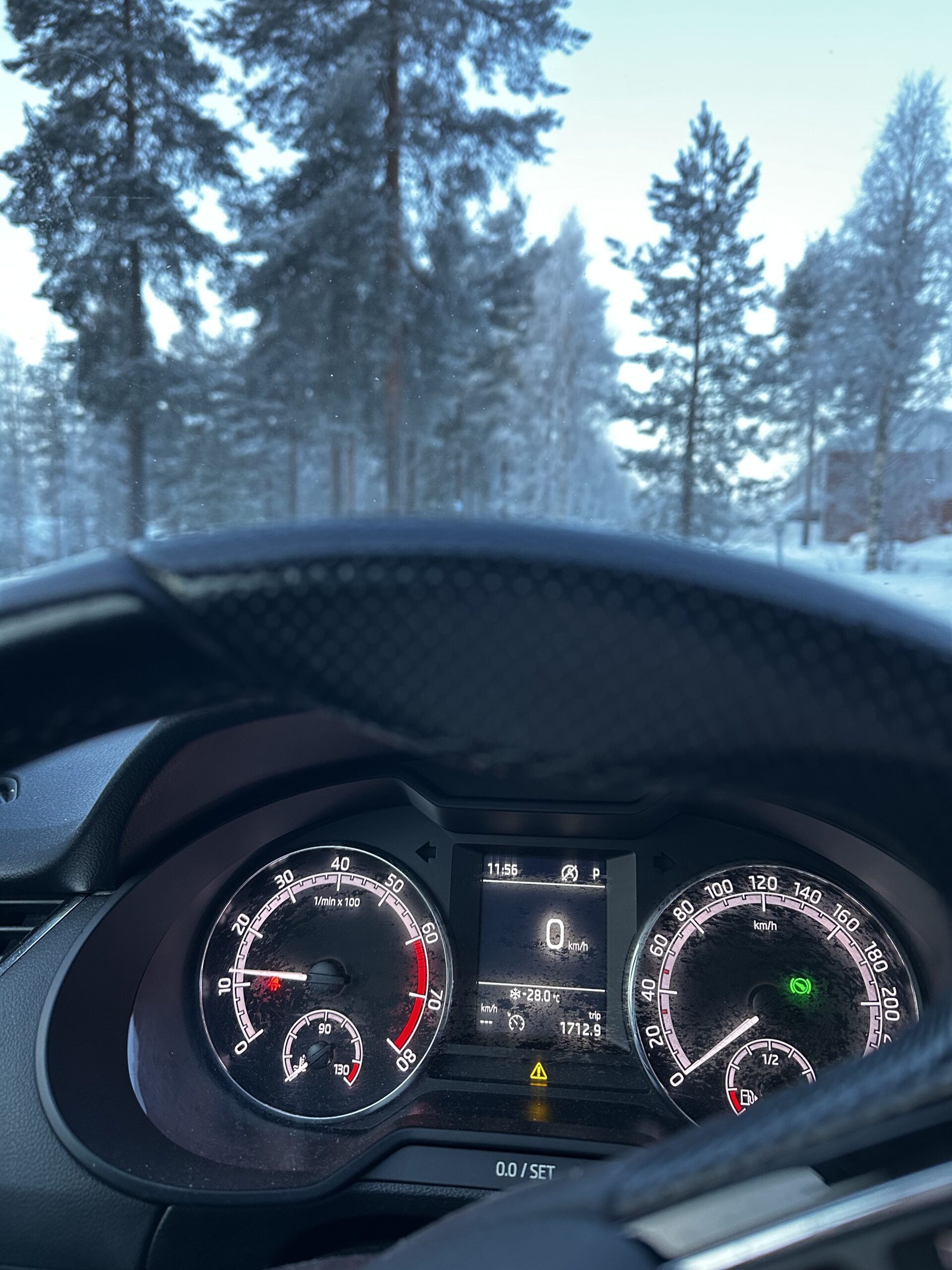
Our rule of thumb: if the digital thermometer in the car reads between −1 and −5 °C, slow down more than you think you need to. That’s the black-ice window. Below −10 °C, the snow tends to be drier and more predictable.
Rental car rules & winter tyre requirements in Finland
Finland has some of the clearest winter driving laws in Europe, which works strongly in your favour as a visitor.
What Finnish law requires
- Winter tyres are mandatory from December 1 to February 28 (and in practice, from the first snowfall, which can be October). Every rental car in Lapland will arrive with proper winter tyres already fitted — this is not optional.
- Rental companies in Rovaniemi, Kittilä, and Saariselkä routinely fit studded tyres (nastarenkaat) on their fleet, which give significantly better grip on ice than non-studded winter tyres. Ask specifically when you book.
- Your rental car will have an engine block heater cord — use it. Plug in overnight at your accommodation. A warm engine starts reliably at −25 °C; a cold one may not.
What to check when you pick up the car
- Confirm tyre type: studded or friction (non-studded winter). Note it on your rental agreement.
- Check windscreen washer fluid is rated for at least −30 °C. Low-temperature fluid is standard in Lapland; generic fluid freezes in the nozzles instantly.
- Locate the ice scraper and snow brush — they should be in the boot. If not, ask for them. You will use them every morning.
- Ask about breakdown assistance coverage, especially if you’re planning remote routes toward Norway or toward Utsjoki.
Related read Planning your whole winter trip? Our what to pack for Lapland in winter guide covers every layer, gadget, and warm-weather hack we actually use living here.
Quick-reference checklist: before every drive in Lapland
We run through this mentally every morning before heading out. Save it to your phone.
- Check the temperature. −1 to −5 °C = black-ice alert. Drive 20% slower than you otherwise would.
- Check the forecast. Is a snowstorm arriving in the next three hours? If yes, delay or change route. Finnish weather radar (foreca.fi) is excellent.
- Clear the whole car. Not just the windscreen — the roof too. Snow slides off the roof onto following traffic, and in Finland it’s illegal to drive with snow on your roof.
- Plug-in check. Did you unplug the engine heater before you pulled out? (This sounds obvious. We’ve left the cord trailing twice.)
- Phone charge and offline maps. Mobile coverage disappears on smaller roads toward Norway. Download the offline map the night before.
- Reindeer risk zones. Check your route for yellow reindeer-warning signs. If you’re driving at dusk or dawn through these zones, slow to 60 km/h and expect animals on the road.
- Daylight window. In December, you have roughly 3–4 hours of usable light. Know when sunset is and plan your longest stretch for midday.
- Tell someone your route. If you’re heading to a remote road, drop your destination and estimated arrival time to a contact. Finnish rescue services are excellent, but coverage is thin on some northern routes.
Winter road trips, Lapland life, and the trips we’re planning next
One honest email a month from two people who actually live at the Arctic Circle. No sponsored fluff.
The biggest hazards when driving Lapland in winter
- Reindeer. This is the one that catches every visitor off guard. There are roughly 200,000 reindeer in Finnish Lapland and they own the roads in the same sense that cattle own an unfenced Texas highway. They appear without warning, often at night, often in herds. Hit one at 80 km/h and you will write off the car. Speed limit in reindeer zones: treat 60 km/h as your ceiling at dawn, dusk, and after dark.
- Black ice on bridges and exposed hilltops. These freeze before the flat road. Every local knows to cover the brake before a bridge. Make it habit.
- Overconfidence after a few good hours. The first day everything is fine, you relax, and then the road changes. Stay disciplined on speed regardless of how the surface feels.
- Whiteouts. A full whiteout — where blowing snow removes all visual reference — can happen in under a minute during a storm on open terrain. Pull onto the verge (never in the lane), hazards on, wait it out. They usually pass in 5–10 minutes.
- Sun glare in low light. In December and January, when the sun barely crests the horizon, the angle of light can make the road completely invisible for several minutes. Keep sunglasses in the car even in deep winter.
Night driving and polar darkness in Lapland
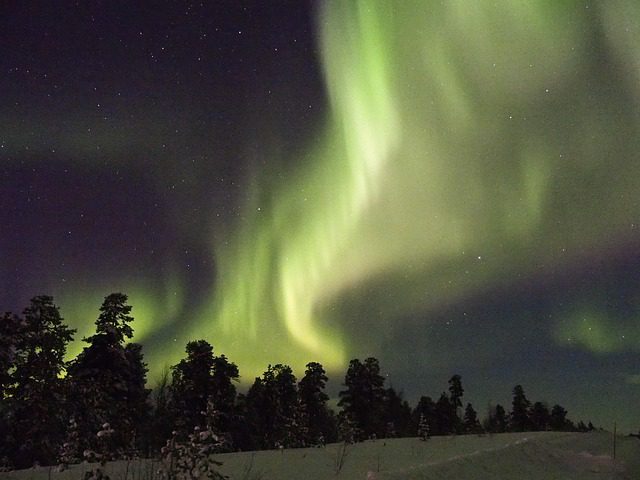
During polar night (kaamos), Rovaniemi gets roughly 3–4 hours of dim, blue-grey light around midday in December and early January. If you’re driving in the morning or afternoon you are driving in the dark. Here is how that changes things compared with summer driving in the same region.
- Headlights on at all times. In Finland, daytime running lights are required by law year-round. In winter, full headlights (not just DRL) are effectively mandatory for visibility.
- Reindeer eyes reflect headlights. Two amber dots at the roadside mean reindeer. Slow immediately — where there’s one there are usually three.
- Other drivers may be faster than you expect. Local traffic has winter tyres and decades of experience. Let them pass. There is no shame in being the slowest car on the E75.
- Petrol stations close early in small towns. Fill up before dark. In deep Lapland, a closed station at −20 °C with a quarter tank is a serious situation.
- Rest areas are lit and ploughed. Finnish rest stops (levähdysalue) are excellent. Use them for breaks, map checks, and coffee from your thermos. Driving tired on an icy road is far more dangerous than driving on the ice itself.
Related read Thinking about crossing into Norway? Our guide to crossing the Finland–Norway border by car covers what to expect at the checkpoints, road conditions on the Norwegian side, and the spectacular E8 descent to Tromsø.
Mistakes we made driving Lapland in winter (so you don’t have to)
- Underestimating journey times. Google Maps calculates in summer conditions. Add 40–60% to every estimated drive time in winter, more in a storm.
- Not filling up before a remote section. We once coasted into a petrol station at Utsjoki on fumes at −22 °C. The attendant found it funnier than we did.
- Trusting that “it looks fine”. Black ice looks like a wet road. It is not. We learned this in a very slow, very cold ditch near Sodankylä.
- Leaving the engine heater unplugged. A frozen car at −28 °C is not just inconvenient — it can strand you. Hotels and most Airbnbs in Lapland have outdoor plug-in points. Ask for them, use them.
- Braking into a bend. The rule on ice: all braking before the curve, none during it. If you’re mid-bend and feel the car sliding, ease off the brake and steer gently into the skid. Counter-intuitive but essential.
- Driving during a storm “because it looks manageable from inside.” A moderate snowstorm that looks fine through your hotel window can reduce visibility to 20 metres on an exposed fell road. If the forecast says storm, stay put.
Frequently asked questions about driving Lapland in winter
Do I need a 4WD or AWD car to drive in Lapland in winter?
Not necessarily — a front-wheel-drive car with proper studded winter tyres handles most Lapland roads perfectly well. AWD is a plus on unploughed smaller roads and in heavy snowfall, but it does not replace the importance of tyre quality. Good winter tyres on a 2WD are safer than all-season tyres on a 4WD. If you’re planning to go off-road or access remote fell roads, book an AWD; otherwise a standard rental is fine.
What speed should I drive on icy Lapland roads?
Finnish speed limits in winter are typically 80–100 km/h on main roads, but the legal limit is not the safe limit. On packed snow we drive 70–80 km/h at most. On any road with black-ice warning conditions (−1 to −5 °C or a frosty morning), we stay at 60–70. Near reindeer zones, always below 60 after dark. The rule is: if stopping in time feels uncertain at your current speed, slow down.
Are rental cars in Rovaniemi and Lapland already fitted with winter tyres?
Yes. Finnish law requires winter tyres from December 1, and all reputable rental companies in Lapland fit winter tyres (usually studded) well before that date, often from late October onward. You do not need to request this specifically, but it is worth confirming when you pick up the car that the tyres are studded (nastarenkaat) rather than friction winter tyres, especially for driving at temperatures around freezing.
What do I do if I get stuck in the snow in Lapland?
Stay calm and stay with the car. Finnish emergency number is 112. Keep the engine running for heat but crack a window slightly to prevent carbon monoxide build-up, and periodically check that the exhaust pipe isn’t blocked by snow. Finnish roadside assistance (Autoliitto / If Insurance / your rental company) is experienced and efficient. Most rental contracts include roadside coverage — keep that number in your phone, not just in the glove box.
How dangerous are reindeer on winter roads?
Very. A reindeer weighs 80–150 kg and often does not move when headlights approach. Impact at 80 km/h is nearly always fatal for the animal and frequently causes serious car damage and injuries. The risk is highest at dawn, dusk, and in the two hours either side of midnight. In reindeer warning zones, treat 60 km/h as your night-time speed limit and watch for the reflective ear tags some herders attach to their animals.
Is it safe to drive from Rovaniemi to Norway in winter?
Yes, and the drive is spectacular — but preparation matters more than on a summer trip. The main routes (E8 toward Tromsø, E75 toward Nordkapp) are ploughed and passable throughout winter. Watch for mountain passes on the Norwegian side which occasionally close in severe storms. Check vegvesen.no for Norwegian road conditions before you set off, and allow double the Google Maps estimate in winter.

A final word from Rovaniemi
Every winter we watch visitors arrive at Rovaniemi airport in ski jackets and enormous suitcases, collect their rental car keys, and drive cautiously out of the car park with a look of mild terror. Three days later we watch the same people come back to return the car with huge grins, talking about reindeer they had to wait for on the road north of Saariselkä, a perfect clear sky they pulled over under, and a drive through the forest at midnight where the snow was falling so slowly it felt like the world had stopped.
Winter driving in Lapland is not dangerous in the way that BASE jumping is dangerous. It is demanding in the way that skiing is demanding — it requires attention, the right equipment, and the willingness to slow down. The Finnish road network is among the best maintained in the world. The rental cars are properly equipped. The hazards are real but understandable.
Prepare well, slow down, give the reindeer the right of way, and Lapland in winter will be one of the most extraordinary drives of your life. We’re still doing it every week from our front door in Rovaniemi, and we never stop finding it beautiful.
Joona & Alla
A Finnish-Ukrainian couple living in Rovaniemi, Finland. Joona is Head of Marketing at Stay Lapland; Alla is an AI Engineer and content creator. Together we’ve visited 25 countries and write honest, locally-grounded travel stories from our home on the Arctic Circle.
Read our full story →