The Best Road Trip Routes in Scandinavia We’d Do Again
Eight drives across Norway, Sweden, and Finland that genuinely earned a second booking — honest assessments from a couple who road trips these routes from our Rovaniemi home.

We live in Rovaniemi, which means Scandinavia is essentially our backyard. Over the years we have driven Norway’s fjord coast, crossed Swedish Lapland on empty highways at midnight, looped through Finland’s lakeland in June, and taken the long slow route down from the Arctic to Helsinki and back again. Some of those drives we would repeat tomorrow. Others were learning experiences. The best Scandinavia road trip routes we keep returning to are the ones on this list.
This is not a theoretical roundup. Every route below is one we have driven ourselves, most of them more than once. We have noted the honest trade-offs so you can match the drive to your own style, budget, and available days.
The best Scandinavia road trip routes include Norway’s Trollstigen and Geiranger loop, the Lofoten E10, the Norwegian Scenic Routes in general, Sweden’s Arctic Highway through Swedish Lapland, and Finland’s lakeland loop from Rovaniemi south. The single most spectacular drive is the Lofoten Islands E10; the most underrated is Finland’s Lakeland Route 5. Plan at least three weeks if you want to combine more than two regions properly.
Norway’s Trollstigen & Geiranger loop — the classic for a reason
This loop connects two of Norway’s most dramatic landscapes in a single long day or a very comfortable two days. Starting from Ålesund, you drive east through the Romsdalen valley to Trollstigen — the “Troll’s Ladder” — eleven hairpin bends climbing a cliff face beside a roaring waterfall. From the top you continue to Geiranger, which is simply one of the most beautiful places in Europe.
What to know before you drive it

- Best window: mid-June to late September. Trollstigen closes in winter (typically October to May) due to snow. The road condition website vegvesen.no updates daily.
- Caravans and motorhomes: technically allowed but very difficult on the tight bends. If you are in a campervan longer than about 7 metres, expect to do three-point turns at some corners.
- Crowd tip: arrive at the Trollstigen viewpoint before 9 am or after 5 pm. Midday in summer is genuinely packed. We went at 7:30 am in June and had the upper platform almost to ourselves.
- Geiranger ferry: the Geiranger–Hellesylt ferry takes about an hour and is one of the most scenic boat rides in the world. Book ahead in summer — it sells out by mid-morning on peak days.
- Distance: the core Trollstigen–Geiranger loop is roughly 250 km. Add Ålesund and you are looking at 350 km for the full circuit.
Why we keep coming back
The combination of alpine scale, Norwegian fjord drama, and roads that are genuinely engineered for fun driving makes this the most cinematic day behind the wheel in Scandinavia. The Geirangerfjord — a UNESCO World Heritage Site — still takes our breath away on the third visit. This is the one we recommend to every first-timer asking about Norway.
The Lofoten Islands E10 — the most spectacular Scandinavia road trip
The E10 through the Lofoten Islands is the drive that stops you mid-sentence. You are crossing bridges and causeways between jagged granite peaks that erupt straight out of the Norwegian Sea, with fishing villages the colour of ripe berries clinging to the shoreline below. It is not like anywhere else in Europe.
Planning the Lofoten drive
- Entry point: most people start at Narvik (accessible by train from Stockholm) or drive north from Mo i Rana. The Lofoten archipelago begins at Fiskebøl, the first island after the ferry or the E10 connection at Bjørnfjell.
- Distance A–B: from Fiskebøl at the northeast tip to Å at the southwest end is roughly 170 km of the E10 itself, but the scenic detours add another 60–80 km easily.
- Minimum time: three days if you want to stop properly in Henningsvær, Reine, and Å. We did it in two on our first trip and regretted the speed. Four to five days is the sweet spot.
- Accommodation: book rorbu (traditional red fishermen’s cabins) at least two months ahead in summer. We use Booking.com filtered by “Lofoten” and sort by rating. Prices are high but the setting is extraordinary.
- Midnight sun window: from late May to mid-July the sun does not set. Driving at 2 am under full daylight with the mountains reflected in still water is one of those experiences that lodges permanently in memory.
Related read Driving the E10 to Lofoten: A Complete Road Trip Guide — our full step-by-step breakdown with fuel stops, wild camping spots, and the exact detours worth taking.
Our Scandinavia road trip cheat sheet — eight routes at a glance

Base: Ålesund → Trollstigen → Geiranger → Hellesylt ferry → Ålesund. Distance: ~350 km. Best for: first-timers who want maximum drama in minimum time. Minimum days: 2.
Base: Narvik or ferry from Bodø → Fiskebøl → Svolvær → Henningsvær → Reine → Å. Distance: 170 km (+ detours). Best for: photographers, midnight-sun chasers, village explorers. Minimum days: 3–5.
Balestrand → Dale via Gaular valley and mountain plateau. Distance: ~90 km. Best for: a stunning half-day add-on between Sognefjord and Bergen. Open June–October.
Krist’sund → Molde via the Atlanterhavsveien, 8 km of bridges across skerries. Distance: ~90 km including approach. Best for: iconic photos and a half-day highlight reel. Combine with Trollstigen easily.
Luleå → Gallivare → Gällivare → Abisko → Narvik (or loop back). Distance: 400–500 km depending on detours. Best for: reindeer encounters, absolute silence, and midnight-sun wilderness. Minimum days: 3.
Rovaniemi → Kuopio → Savonlinna → Imatra → Helsinki. Distance: ~900 km. Best for: slow travel in midsummer, sauna culture, lake swimming. Minimum days: 4–5.
Turku → Parainen → Nauvo → Korppoo → Houtskär (ferry) → Åland Islands. Distance: ~150 km plus ferries. Best for: island-hopping by car, midsummer atmosphere, quiet beauty. Open year-round but best June–August.
Strömsund → Gaddede → Gröveljön → Åsarna. Distance: ~500 km. Best for: true wilderness immersion, zero crowds, and one of the most remote drives in Europe. Gravel sections — an SUV or high-clearance vehicle is advisable.
Road trip routes, seasonal picks, and honest travel notes
We write when we have something worth sharing. No filler, no weekly spam — just the good stuff from the Arctic.
💡 Our campervan tip: prices for the same van vary a lot between rental brands. We compare the Nordics campervans across 160+ rental companies on CampervanPlanet — and code HUNGRYTRAVELFAMILY5 takes 5% off.
Sweden’s Arctic Highway through Lapland — the quietest drive on the list
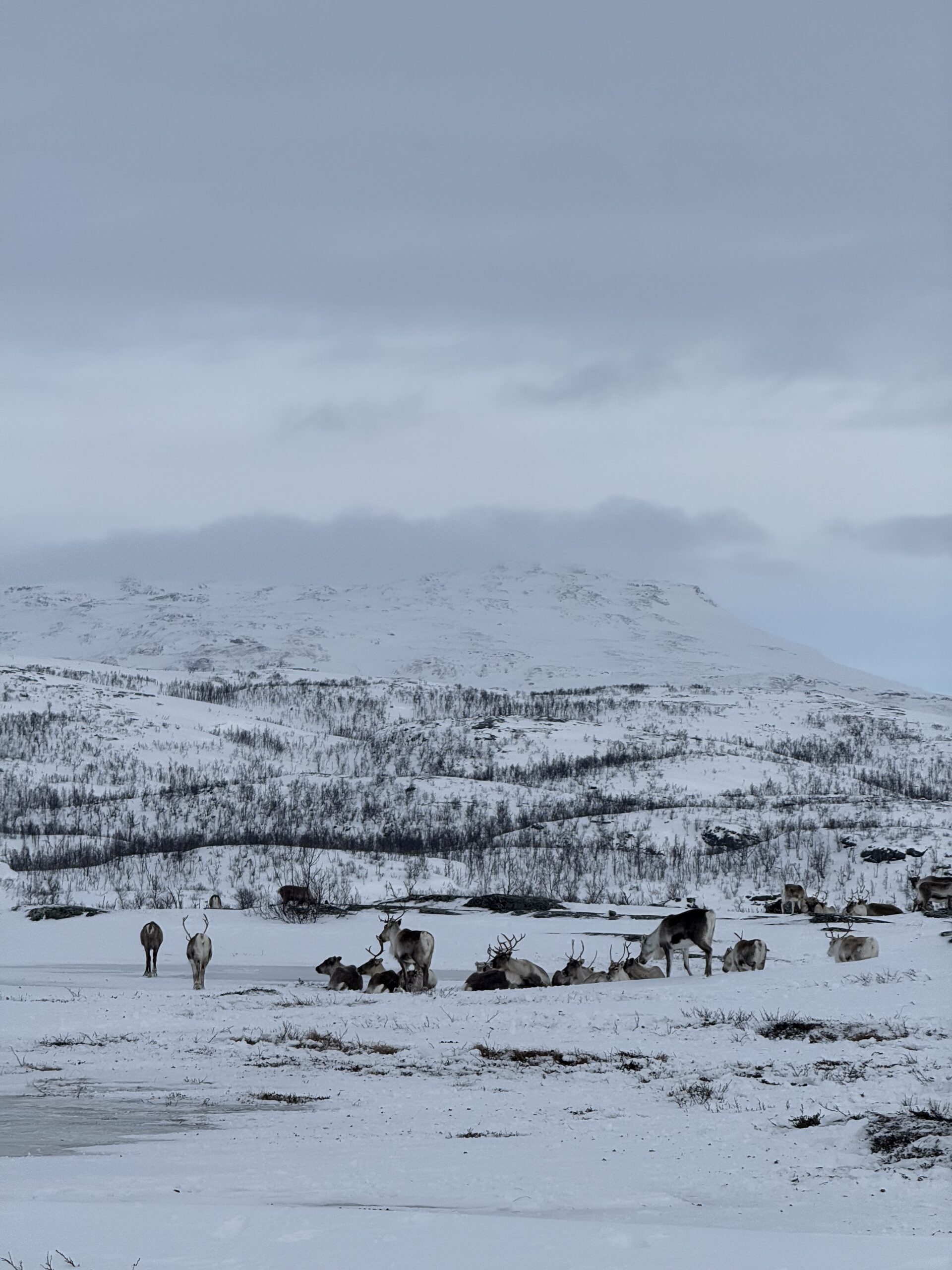
Most international visitors drive Norway and skip Sweden’s north entirely. That is their loss. Swedish Lapland has something Norway does not: space. The roads are emptier, the villages smaller, and on a long midsummer evening you can drive for an hour without seeing another car. The E10 from Luleå to Narvik combines accessible paved highway with extraordinary mountain scenery through Abisko National Park.
Practical tips for driving Swedish Lapland
- Wild camping: Sweden’s allemansrätten (every person’s right) allows camping almost anywhere in nature. Pull off at a lakeside, cook on a small stove, sleep under the midnight sun. It is completely legal and completely free.
- Reindeer on the road: this is not a metaphor. Reindeer roam freely across northern Sweden and Finland. They are unpredictable, especially at dusk and dawn. Drive at 80 km/h or below in open areas and be ready to brake suddenly.
- Fuel stations: distances between stations can exceed 100 km in parts of Swedish Lapland. Fill up whenever you drop below half a tank. Most stations accept card but carry a small amount of cash for older pumps in remote areas.
- Best add-on from Finnish Lapland: if you are based in Rovaniemi like us, drive west on the E8 into Sweden via Karesuando — it is one of the easiest border crossings in Scandinavia and opens up the entire E10 corridor.
Comparing the Scandinavian country road trip experiences
- Norway offers the most dramatic scenery — fjords, mountain roads, and UNESCO landscapes — but also the highest costs and the most traffic on peak routes.
- Sweden is cheaper, less crowded, and better for genuine wilderness. The landscape is beautiful but gentler — more birch forest and lake than cliff and fjord.
- Finland is the most underrated road trip destination in Scandinavia. Lakeland Finland in June is genuinely magical, and you can drive for hours without passing a tourist.
Related read Norway vs Finland for a Road Trip: Which Is Worth It in 2026? — a detailed head-to-head with real costs, highlight comparisons, and who each destination suits best.
Finland vs Norway for a Scandinavia road trip — an honest comparison
We get this question constantly: “Should we do Norway or Finland?” Our honest answer is almost always “both, if you can.” But if you have to choose, here is the comparison we use.
Norway: when to pick it
- You have never driven a Scandinavian mountain road and want the full WOW factor from day one.
- Fjords are on your bucket list and you are willing to pay premium prices for accommodation and activities.
- You have 10–14 days and can focus on one country deeply.
- You want structured, well-signposted tourist infrastructure — Norway handles visitors very well.
Finland: when to pick it
- You want space, silence, and nature without the tourist crowds of Norway’s peak season.
- Budget matters — fuel, accommodation, and food in Finland are noticeably cheaper than Norway.
- You want to experience genuine Finnish summer culture: cottages, lake swimming, sauna, and midnight sun that feels earned rather than scheduled.
- You are based in or passing through Helsinki and can drive north progressively through the lake district.

Mistakes we made on our first Scandinavia road trips
- Underestimating distances. Norway looks compact on a map. It is not. The fjords force long detours, and driving 400 km in Norway takes far longer than 400 km on a German autobahn. Plan for 60–70 km/h average speed on scenic routes.
- Not booking ferries in advance. The Geiranger–Hellesylt ferry and several key Norwegian fjord crossings sell out by mid-morning in July. Book online the night before at minimum, or a week ahead if travelling in July or August.
- Skipping the scenic route designations. Norway’s 18 official National Tourist Routes are marked with a brown road sign with a wave motif. We drove past several of them on our first trip without turning off. Never again. These detours are consistently the best 10–40 km of driving in the region.
- Arriving at Trollstigen at noon in July. The viewpoint car park was full, the path was shoulder-to-shoulder, and the photos were ruined by other tourists. Go early or go late.
- Not having a backup route for road closures. Trollstigen, Sognefjellet, and Dalsnibba all close at short notice due to snow even in early June. Check vegvesen.no the morning of your drive. We have been turned back twice in early June.
- Not packing enough layers for summer. Norwegian mountain passes can hit 5°C in July when it was 22°C in the valley below. Always have a fleece and a waterproof in the car, no matter the forecast at sea level.
Book your the Nordics campervan
Compare prices across 160+ campervan and motorhome rental brands, get a free 1GB eSIM with every booking — and 5% off with code HUNGRYTRAVELFAMILY5.
Check prices & availability →Frequently asked questions
What is the single best Scandinavia road trip route for a first-time visitor?
If you have 10–14 days and are based in Norway, the Trollstigen–Geiranger loop combined with the Lofoten E10 is the most rewarding combination. Fly into Ålesund, drive Trollstigen and Geiranger, then fly or take the overnight train/bus to Narvik and drive Lofoten south to Bodø. It gives you the mountains, the fjords, and the islands in one trip.
How long do you need to road trip Scandinavia properly?
A minimum of two weeks to cover one country meaningfully. Three weeks lets you combine Norway and Sweden or Norway and Finland without feeling rushed. We have done a 10-day Norway loop that felt great, but we had driven many of those roads before and knew where to stop. For a first trip, budget more time than you think you need — Scandinavia rewards slow travel.
Is it expensive to road trip Norway compared to Sweden and Finland?
Yes, significantly. Fuel is similar across all three countries, but accommodation in Norway runs roughly 30–50% higher than equivalent stays in Sweden and 40–60% higher than Finland. Meals out in Norway are expensive. If budget matters, base yourself in Finland or Sweden and do day trips into Norway where the most dramatic scenery is concentrated near the border anyway (Lofoten from Narvik, the fjords from the west coast).
Do you need a 4WD or SUV for Scandinavia road trips?
For the main routes on this list, a normal rental car with decent ground clearance is fine in summer. The Vildmarksvägen in Sweden has gravel sections where a higher vehicle helps but is not essential. In winter or early spring, snow tyres become mandatory in Finland, Sweden, and Norway, and many mountain roads close entirely. If you are driving off the main routes on gravel forest roads, a higher vehicle is an advantage but rarely a requirement in summer.
Can we combine Scandinavia road trips with public transport?
Yes, and this is actually a great approach. The Nordic rail network (especially Norway’s Bergen Line and Flåm Railway) is spectacular and lets you drop a car at one end of a route and pick it up at the other. We often combine a one-way rental (say, Oslo to Bodø or Narvik) with return flights or train tickets. One-way rental fees in Scandinavia vary by company — Hertz and Europcar tend to be most flexible on cross-city returns.
What is the best time of year for a Scandinavia road trip?
For most visitors, late June through early August offers the best combination of road access, long daylight hours (including midnight sun above the Arctic Circle), and mild temperatures. September is beautiful for autumn colours and fewer crowds, but some mountain roads close from late September. May is a great shoulder option — roads are opening, wildflowers are blooming, and prices are lower — but confirm specific mountain passes are open before you commit.
A final word from Rovaniemi
We have driven a lot of roads across Scandinavia and we keep coming back to the same conclusion: this is one of the finest road-tripping regions in the world, and it is genuinely underappreciated outside of Norway’s greatest hits. The Lofoten drive is as beautiful as anything in Iceland or the Scottish Highlands. Finnish Lakeland in June is as good as the French countryside, and half the price. Swedish Lapland in midsummer is an experience we have no adequate analogy for — you simply have to go.
The drives on this list are the ones we keep repeating, recommending, and planning next versions of from our kitchen table in Rovaniemi. We hope one of them earns a spot in your own rotation. If you have questions about any specific route, drop us a line — we answer every message.
Joona & Alla
A Finnish-Ukrainian couple living in Rovaniemi, Finland. Joona leads marketing for a Lapland tourism company; Alla is studying AI engineering. Together we have visited 25 countries and share honest, first-hand travel writing from the top of the world.
Read our full story →