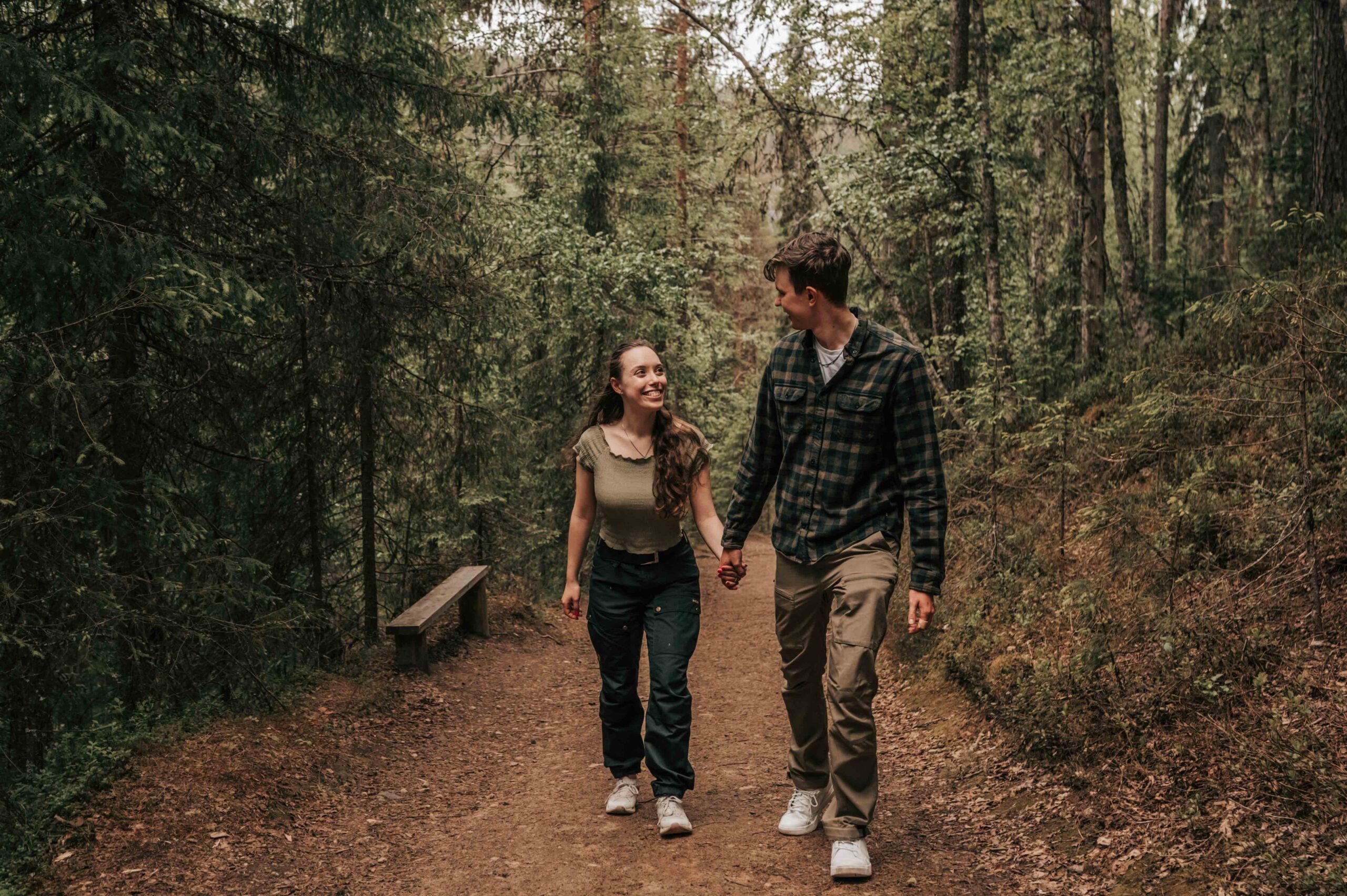
We’ve lived in Rovaniemi long enough to stop thinking about hiking in terms of daylight hours. In summer, the sun never fully sets this far north — it dips toward the horizon somewhere around midnight, turns the sky gold and rose, then climbs back up again without ever going dark. That changes everything about when you can hike in Finland. There is no “too late.” There is no rushing back before dark. The trail is yours at 2 am if you want it.
This guide is for anyone planning a summer trip to Finland who wants to understand what Finland hiking anytime of the day actually means in practice — how the midnight sun affects your planning, which trails are best experienced at unconventional hours, and what you need to know to make the most of a country where summer darkness simply doesn’t exist.
In Finnish Lapland during summer (roughly May–August), you can hike at any hour of the day because the sun never fully sets — the phenomenon is called yötön yö, the nightless night. In southern Finland the window is slightly shorter but still allows hiking well past midnight. Pack layers for cooling overnight temperatures, use trail apps for navigation since signage can be harder to read in low-angle golden light, and embrace the eerie beauty of a 1 am fell summit with a sun that refuses to sleep.
How the midnight sun makes any-hour hiking possible
The midnight sun is not a myth or a marketing phrase. During peak summer in Finnish Lapland, the sun stays above the horizon continuously for weeks. In Rovaniemi, the polar day begins in late May and lasts until late July. Further north, in Utsjoki near the Norwegian border, the sun doesn’t set for nearly two months straight.
What yötön yö (nightless night) actually means on the trail
The Finnish phrase yötön yö — the nightless night — describes this phenomenon beautifully. For hikers, it means the standard constraints of a day walk simply disappear. You are not racing sundown. You are not checking how many hours of light you have left. The fell is lit at 11 pm just as it is at 11 am, though the quality of that light is completely different.
The golden hours that last all night
In winter, photographers chase the golden hour — the brief window after sunrise or before sunset when light turns warm and directional. In Finnish summer, the midnight sun creates an extended golden hour that stretches from around 10 pm until 3 am. The sun stays low on the horizon, casting long shadows and flooding the fells with amber and pink. Hiking at this time feels surreal. We’ve done it dozens of times and it still stops us mid-trail.
- Late May: polar day begins above the Arctic Circle; in Rovaniemi the sun dips just below the horizon for a brief twilight but never gets dark.
- June: peak midnight sun. The sky turns golden near midnight and brightens again without any true darkness. Hikers on the Karhunkierros have reported doing full night sections in sandal-worthy light.
- July: the days begin shortening again from mid-month, but midnight hiking is still fully viable through the end of the month.
- August: genuine darkness returns gradually. By late August in Lapland you get a real dusk, and by mid-August even a brief dark hour. Still remarkably long hiking days by any standard.
Best times of day to hike in Finnish summer — a practical breakdown
The short answer is: any time. The longer answer is that different times of day have genuinely different characters, and knowing them helps you plan for what you actually want from a hike.
Morning (6 am – 10 am)
The trails are quiet. If you’re based at a fell resort, most tourists are still sleeping. The light is already bright — there was no true night to wake up from — but morning air is the coolest of the day and often the clearest. Cloud cover, if any, tends to burn off by 9 am. This is our favorite window for long routes on popular trails: you get the views without the crowds.
Midday (10 am – 3 pm)
The warmest part of the day in summer. Finnish summer temperatures in Lapland typically reach 15–22°C on clear days, occasionally pushing into the mid-20s. Insects — particularly the famous Finnish mosquitoes and gnats — are most active midday when it’s warm and calm. If bugs bother you, plan exposed ridge routes for this window (wind on ridges keeps them away) and save forested valley sections for cooler hours.
Afternoon and evening (3 pm – 10 pm)
For most of the world, evening means winding down. In Finnish Lapland in June, 7 pm looks exactly like 2 pm. Trails stay busy through the evening on popular routes. Temperatures are pleasant. This is also when thunderstorms occasionally build in warmer summers — check the forecast if you’re doing an exposed ridge route.
Midnight window (10 pm – 3 am)
This is the magic we keep coming back to. Temperatures cool noticeably — usually 4–8°C cooler than midday — and the light turns extraordinary. Insects largely disappear in the cooler air. Most other hikers have gone to sleep or to the sauna. You have the fell to yourself, bathed in golden-pink light that photographs better than anything you’ll capture at noon.
Our honest take: if you are visiting Finnish Lapland in June or July for the first time, set an alarm for midnight and walk for at least an hour. It is one of those experiences you carry with you.
Top trails to experience at unusual hours in Finland
Not all Finnish trails are equally rewarding at midnight. We’ve ranked the ones we keep returning to based on scenic payoff, accessibility, and how the light falls at late hours.
The best any-hour trails in Finnish Lapland
- Kaunispää summit, Saariselkä (1.5 km loop): drive to the top or hike from town. Open fell summit with a 360-degree view. Closest thing to a guaranteed midnight sun photo anywhere in Finnish Lapland — bring a flask of coffee and stay a while.
- Tunturi-Lappi fell network around Levi: marked trails leave the resort base and climb onto open fells. At midnight the entire treeline below you turns orange. The trails are well-marked and the climb is modest — ideal for first-time midnight hikers.
- Riisitunturi National Park fell ridge (near Kuusamo): not strictly above the midnight sun line, but long enough summer days that a 10 pm start still gives you hours of superb light. The famous snow-laden trees are obviously a winter thing — in summer it’s all open fell, cloudberry fields, and enormous sky.
- Karhunkierros, Oulanka (82 km full route): designed for multi-day treks. The river canyon sections are stunning at any hour, but crossing the Jyrävä waterfall suspension bridges at 11 pm on a June evening, in full golden light, is something we can’t recommend highly enough.
- Fell of Pyhä, Pyhätunturi National Park: the ravines and gorge are dramatic; Noitatunturi summit opens into 360-degree fell views. A manageable day hike from Rovaniemi (90 km south) that rewards a late-afternoon start timed to hit the summit around midnight.
- Ylläs-Pallas long route: Finland’s longest marked multi-day trail runs 60 km between two fell resorts. Any section of this trail at midnight in June is surreal — open fell, reindeer on the horizon, the sun half a hand above the horizon.
What to pack when there is no darkness — the Finnish midnight hike kit
Your standard summer hiking gear applies — but the midnight sun adds a few non-obvious requirements and removes one you might be used to carrying.
The midnight sun hiking kit
- A headlamp — leave it at home (or pack it for August). In June and July above the Arctic Circle, you genuinely don’t need one. In August, pack it as backup.
- Sunglasses, even at midnight. The low-angle sun at 1 am hits your eyes at a more horizontal angle than a noon sun overhead. It’s not intense but it’s persistent. Polarized glasses cut the glare from water and snow patches beautifully.
- Sunscreen. Same reason. UV at a very low angle is still UV. People burn on midnight hikes, especially in June when the sun barely dips.
- An extra warm layer. Temperatures drop 6–10°C between midday and midnight on clear nights. A fleece or light down jacket that felt unnecessary at 3 pm is essential at 1 am.
- Insect repellent. Less critical at midnight (cooler and often windier), but for forested sections near standing water, still worth having.
- Offline maps. The Finnish Hiking Association trail app and apps like Wikiloc or the national parks’ own Luontoon.fi service work well. Download the map offline before you go — fell country in Lapland is mostly without mobile coverage.
- A camera or phone with manual controls. Auto-exposure struggles with low-angle midnight light. Dial down exposure a stop or two and you’ll capture the colors as your eye sees them rather than the washed-out result of auto mode.
- A sleep mask for after the hike. This sounds like a joke — it isn’t. Finland in summer means you return from a midnight hike to a bright tent or cabin. A sleep mask is the most underrated piece of Finland travel kit.
Dispatches from the Arctic, straight to you
We write about living and hiking in Lapland, honest destination guides, and slow travel across 25 countries. No spam, ever.
How hiking in southern Finland differs from Lapland in summer
Not all of Finland sits above the Arctic Circle. If your summer trip takes you to southern Finland — Helsinki, the Archipelago, Nuuksio National Park, or the Häme lake region — the midnight sun experience is softer but the long summer days are still extraordinary by Central European standards.
What you get in the south
Helsinki in June has sunset around 10:30–11 pm and sunrise again before 4 am. That gives you roughly 3–4 hours of real darkness at most. In practical terms, you can hike until 10 pm in full evening light, enjoy a long dusk, and be back out on trail by 4:30 am with the birds and the fishermen.
Best southern Finland trails for long-day hiking
- Nuuksio National Park (30 km from Helsinki): forested lakes, smooth rock outcrops, short trails ideal for an evening hike after dinner in the city. The light on the lake surfaces at 9 pm in June is beautiful.
- Teijo National Park (near Salo): coastal forest, old manor landscape, and quiet trails. Great for a 7 pm start after a day on the archipelago.
- Repovesi National Park (2 hrs from Helsinki): dramatic rocky ridges and clear lakes. The ridge views at sunset (10:30 pm in June) rival anything we’ve seen in Scandinavia.
- The Finnish Archipelago Trail: technically a cycling route but hiking sections exist. Any island trail at 9 pm in midsummer, with the water glowing gold, is worth the effort of getting there by ferry.
Mistakes we made on our first midnight hikes — and how to avoid them
- Leaving too many layers behind. The sky is bright so the brain says “daytime — warm.” Wrong. At 1 am in Finnish Lapland in early June, temperatures can drop to 4°C on open fells with wind. We’ve been cold on trails that were genuinely chilly in only a t-shirt at midnight.
- Not downloading offline maps. We started our first Karhunkierros section confident the trail signs would be enough. They mostly were — except for one junction where the sign had faded and the mobile signal had also faded. Offline maps are non-negotiable in fell country.
- Misjudging insect timing. We assumed midnight meant no insects. In warm, still weather near boggy areas, mosquitoes can still be active at midnight. Repellent stays in the pack.
- Forgetting sleep-wake rhythm recovery. Three consecutive midnight hikes will disrupt your sense of time in ways that feel fine until day four. Build in a “normal” evening occasionally, or accept that your body clock is going on holiday along with you.
- Underestimating trail length on the return leg. At noon, a 2-hour return feels fine to start at 6 pm. At midnight, the same math applies — except your sense of time is looser and “just another 30 minutes” becomes easier to misjudge. Turn around times still matter.
- Skipping the midnight summit because it looked like noon. The biggest mistake. First-timers often feel no urgency to step outside at 1 am because it looks bright and normal through the window. Step outside. The light is different in ways a photo can’t capture — you need to be in it.
Frequently asked questions about hiking anytime in Finland
Can you really hike at midnight in Finland without a headlamp?
Yes — in June and July above the Arctic Circle, the sun never fully sets, so there is no darkness requiring a headlamp. In southern Finland the window is shorter but you can still hike until well past 10 pm in full light. Only in August does real darkness return, and even then the nights are brief enough that a headlamp is mostly insurance rather than a necessity for early-evening hikers.
Is the midnight sun actually visible from all of Finland?
The true midnight sun — where the sun stays above the horizon around the clock — occurs above the Arctic Circle, which passes through northern Finland including Rovaniemi. In southern Finland you get the near-equivalent: extended dusk and dawn that merge into each other with only a brief darkening in between. It’s less extreme but still means hiking-friendly light from 4 am to 11 pm or later.
When is the best time to experience midnight sun hiking in Finland?
June is the peak. The summer solstice falls around June 21, when the midnight sun is at its most continuous and dramatic. Late May and most of July are also excellent. If your trip is in August you’ll still get very long days and a late golden dusk, but the polar day has ended by then even in Lapland.
Are Finnish hiking trails safe at night?
Yes — Finnish national parks and fell trails are well-marked and genuinely safe. Wildlife concerns are minimal; you may encounter reindeer (move calmly and give them space) and occasionally elk. Bears exist in Finnish forests but are extremely shy and almost never an issue on popular trails. The biggest safety consideration is getting cold or lost, both of which offline maps and an extra layer address well.
Do I need a permit to hike in Finland at any hour?
No. Finland’s jokamiehenoikeus — Everyman’s Right — gives everyone the right to walk in nature regardless of land ownership, as long as you stay away from private gardens and don’t disturb wildlife or property. National parks have their own marked trails and camping areas but no entry permit is required. You can legally start a fell hike at 2 am with no paperwork involved.
What should I eat and drink on a midnight hike?
The same principles as any hike, adjusted for one thing: your hunger cues are less reliable when your body clock is confused by continuous daylight. Eat before you go, carry a proper snack (sandwiches, nuts, chocolate), and drink water even if you don’t feel thirsty — cool overnight air is drying even when it doesn’t feel it. A warm drink in a flask — coffee, tea, hot chocolate — elevates a midnight fell summit from memorable to unforgettable.
A final word from Rovaniemi
We moved to Rovaniemi years ago and the midnight sun still catches us off guard. You step outside at 1 am for a glass of water and end up standing in the garden for twenty minutes because the light is doing something extraordinary on the horizon. It doesn’t get ordinary.
For hikers, Finland in summer is one of the great gifts of European travel — a country where the concept of “hiking hours” simply doesn’t apply for months at a stretch. You can walk whenever the mood takes you. A fell summit at 3 am with reindeer silhouetted against a pink sky is one of those experiences that doesn’t fit neatly into a travel story because it sounds like an exaggeration. It isn’t.
If you’re planning a summer trip to Finland and you’re a hiker, treat the midnight sun as a feature to use rather than a curiosity to photograph once and go to bed. Rearrange your schedule around it. Stay up past midnight at least twice. Walk somewhere with an open horizon. Bring coffee. You’ll understand what we mean.
Joona & Alla
A Finnish-Ukrainian couple living in Rovaniemi, Finland. Joona is a marketing professional in Lapland tourism; Alla is an AI Engineer. Together we’ve visited 25 countries and share honest, locally-grounded travel writing from our home in the Arctic.
Read our full story →