Driving Across Finland: What the E8 and E75 Are Actually Like
We live in Rovaniemi and have driven both highways more times than we can count — here is the honest, practical guide nobody else bothers to write.

Driving across Finland sounds straightforward on a map. Pick up the E75 in Helsinki and point it north, or join the E8 along the Bothnian coast and ride it all the way to Tornio. Simple enough. What the map does not show is the 600–900 km of consecutive forest, the towns spaced 60 km apart, the stretches where your phone signal quietly disappears, and the moment somewhere around Oulu when you realise you have been driving for six hours and are still not in Lapland.
We have done both routes dozens of times — for work, for family, for the pleasure of it. This is what driving across Finland is actually like in 2026.
The E75 is the faster inland route from Helsinki to Rovaniemi (approximately 830 km, 8–9 hours with stops). The E8 is the scenic coastal route hugging the Gulf of Bothnia from Turku to Tornio (around 600 km of the coast leg). Both are excellent, two-lane highways in good repair — the main challenge is distance, not road quality. Plan for at least two fuel stops and one proper meal break.
- E75 vs E8: which route to choose
- Driving the E75: Helsinki to Rovaniemi step by step
- Driving the E8: the Gulf of Bothnia coast route
- Fuel, food, and rest stops along the way
- Seasonal conditions: summer vs winter driving
- Mistakes we have made on this drive
- Frequently asked questions
- A final word from Rovaniemi
E75 vs E8: which route to choose when driving across Finland
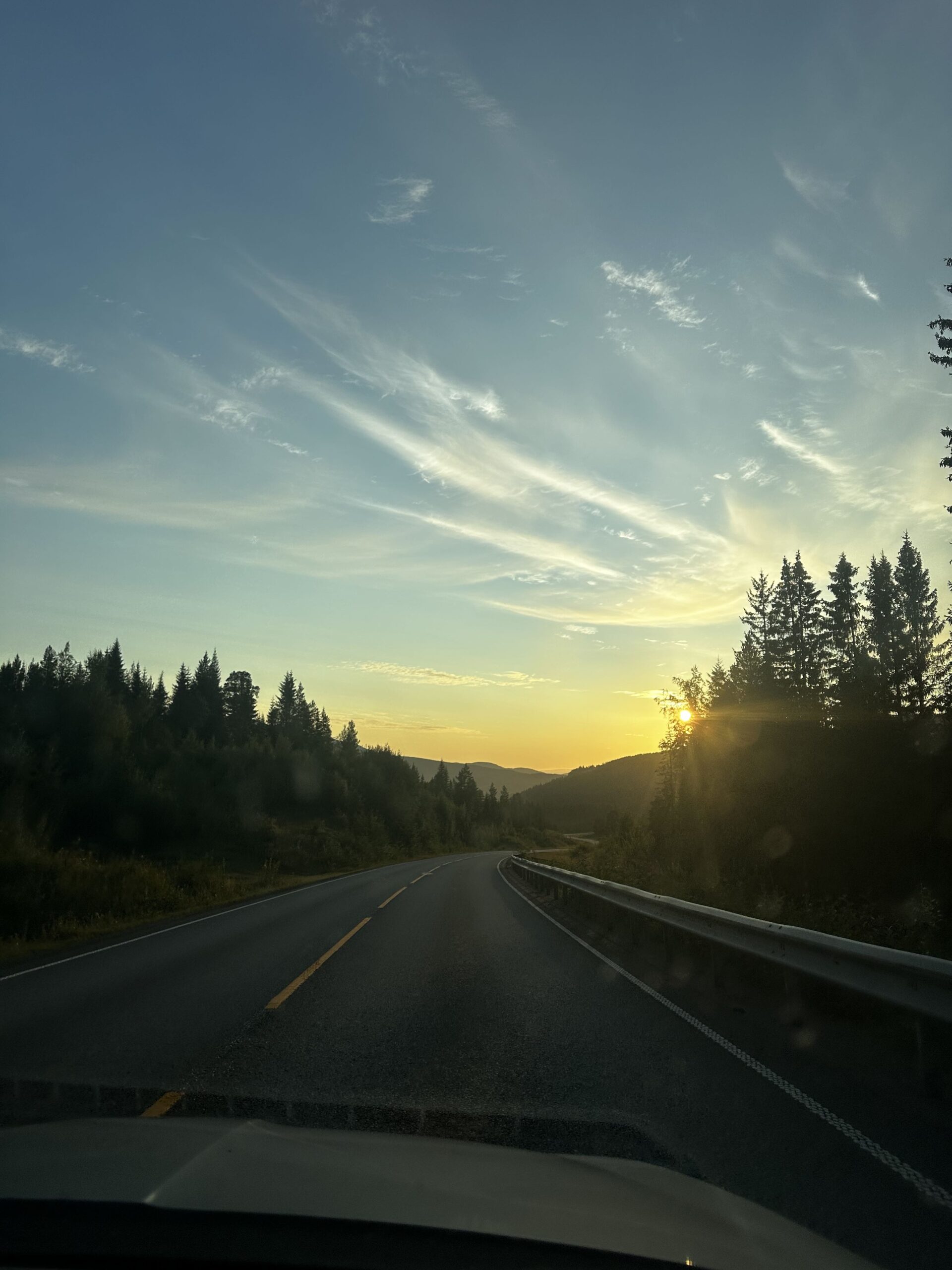
Both highways run the full length of Finland from south to north, but they take different paths and attract different kinds of drivers.
The E75 — the inland spine
The E75 enters Finland from the south at Helsinki and heads almost due north through Tampere, Jämsä, Jyväskylä, and Oulu before crossing into Lapland. It is the most direct way to drive from Helsinki to Rovaniemi and is the route most Finnish drivers take for that trip. The road is mainly four-lane motorway south of Oulu and two-lane national road north of it. Speed limits are 100–120 km/h on the southern stretch and 80–100 km/h in Lapland. Distance Helsinki–Rovaniemi: approximately 830 km.
The E8 — the coastal route
The E8 runs from Turku (or from Helsinki via the Ring I connection) up the Gulf of Bothnia coast through Pori, Vaasa, Kokkola, and Oulu, then continues north through Kemi and Tornio into Swedish territory at the Haparanda border crossing. It is longer than the E75 if you start in Helsinki, but the coastal scenery — flat farmland, birch rows, glimpses of the grey Gulf, small fishing towns — gives it a completely different character. The E8 north of Oulu through Kemi and into Tornio is also the main artery for lorry traffic moving between Finland and Sweden. Distance Helsinki–Tornio via E8: approximately 730 km; Helsinki–Rovaniemi via Tornio and E8 north: around 950 km.
Which should you pick?
- Choose the E75 if your destination is Rovaniemi, Saariselkä, or anywhere in eastern Lapland — it is faster and more direct.
- Choose the E8 if you want to see the coast, are heading to Tornio, Kemi, or Swedish Lapland, or if you plan to cross into Sweden at Haparanda.
- Combine both by going up on one and returning on the other — that is the best road trip loop in Finland, in our opinion.
Driving the E75: Helsinki to Rovaniemi step by step
This is the route we know best. Joona has driven it solo in winter for work more times than is probably healthy; Alla has learnt to love it as a two-person adventure with a good podcast queue. Here is how the road actually unfolds.
Helsinki to Oulu (600 km, roughly 5.5 hours)
South of Tampere the E75 is a proper motorway — three lanes in places, service stations every 40–60 km, strong phone signal. Tampere itself (around 180 km from Helsinki) is a natural first stop: coffee, fuel, stretch. After Tampere the road narrows to two lanes through the lake district. The scenery changes dramatically here — forests close in, lakes flash between the pines, and the horizon drops. Jyväskylä is around the 270 km mark and has full services. From Jyväskylä to Oulu (another 270 km) is the longest unbroken stretch: small towns, very occasional passing lanes, elk warning signs every few kilometres. Oulu (around 610 km from Helsinki) is the last big city before Lapland — this is where you fill the tank and eat a proper meal.
Oulu to Rovaniemi (220 km, roughly 2.5 hours)
North of Oulu the landscape softens and then empties. The road flattens, trees get shorter, and towns space out to 40–60 km apart. Kemi (at the 670 km mark from Helsinki) has a fuel station and is also where the road branches: E75 continues northeast toward Rovaniemi while the E8 heads northwest to Tornio. From Kemi to Rovaniemi is another 115 km of arrow-straight highway. You cross the Arctic Circle roughly 8 km before the city. The road signs for Santa Claus Village appear and you know you are there.
How to Road Trip Finland in 10 Days
If driving across Finland is your starting point, we have built a full 10-day loop that uses both the E75 and E8.
Read the itinerary →Driving the E8: the Gulf of Bothnia coast route
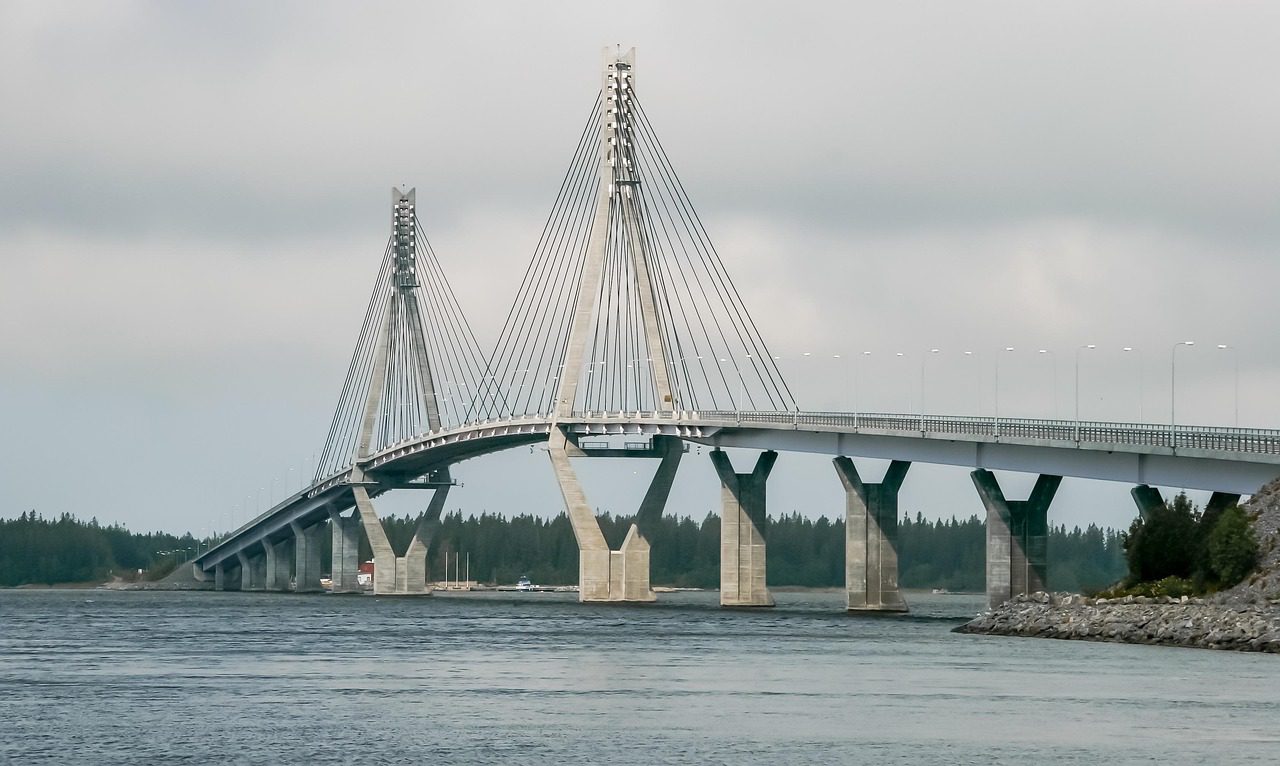
The E8 coast route is the overlooked sibling. Finnish travel content almost never covers it — the emphasis is always on Lapland, which you reach via the E75. But we have driven the coast more times than we expected, and it has a slow charm the inland route does not.
Turku to Oulu along the coast (430 km, 4–4.5 hours)
- Pori (around 240 km from Turku): industrial port town, good services, famous for its jazz festival in July. A reliable halfway stop.
- Vaasa (around 330 km from Turku): bilingual city, pleasant harbour, good lunch options. If you are taking the E8 purely for scenery, Vaasa is the highlight.
- Kokkola (400 km from Turku): old wooden town quarter worth a 30-minute walk if you have time.
- Oulu (430 km from Turku): where the E8 and E75 effectively merge for the last stretch north.
Oulu to Tornio (120 km) and the Swedish border
This is one of the most industrial sections of Finnish driving — Kemi has a large paper mill you can smell before you see it, and the landscape is flat and wide. But the Tornio River crossing into Haparanda, Sweden, is genuinely pleasant: a low bridge over a broad river, a Swedish town on one side, a Finnish town on the other, no border passport control (both are Schengen). Time zones shift here too (Finland is UTC+3 in summer, Sweden UTC+2), which catches people off guard when making dinner reservations.
Road notes, seasonal guides, honest travel from the Arctic Circle
We write from Rovaniemi. Real drives, real conditions, no sponsored fluff.
Fuel, food, and rest stops when driving across Finland
This section is the most practical thing we can give you. Finland’s highway services are not like German Autobahn stops or French motorway rest areas. They are smaller, more spaced out, and in northern Finland they can be the only option for 80–100 km at a stretch.
Key fuel and rest stops we actually use
Plenty of options: ABC Lempäälä south of the city or the city centre itself. This is the last “city” feel for a while. Get coffee and a pulla here.
Good services, Prisma or ABC. Also the place to recalibrate your route if you have time to add a detour to the lakeland.
The last major city before Lapland. Fill the tank here without fail. There is an Hesburger, multiple Neste stations, and a K-Market at the Zemppi shopping centre just off the highway.
The ABC at Kemi is the last reliable 24-hour fuel station before Rovaniemi. In winter we always top up here even if the tank is half full.
Small Neste stations open during daytime. Not 24h. Fine for a top-up before the final 30 km into Rovaniemi.
Best mid-coast stop for a proper meal. The harbour area has good lunch spots that are not just highway food. Worth the 10-minute detour off the main road.
Seasonal conditions: summer vs winter driving across Finland
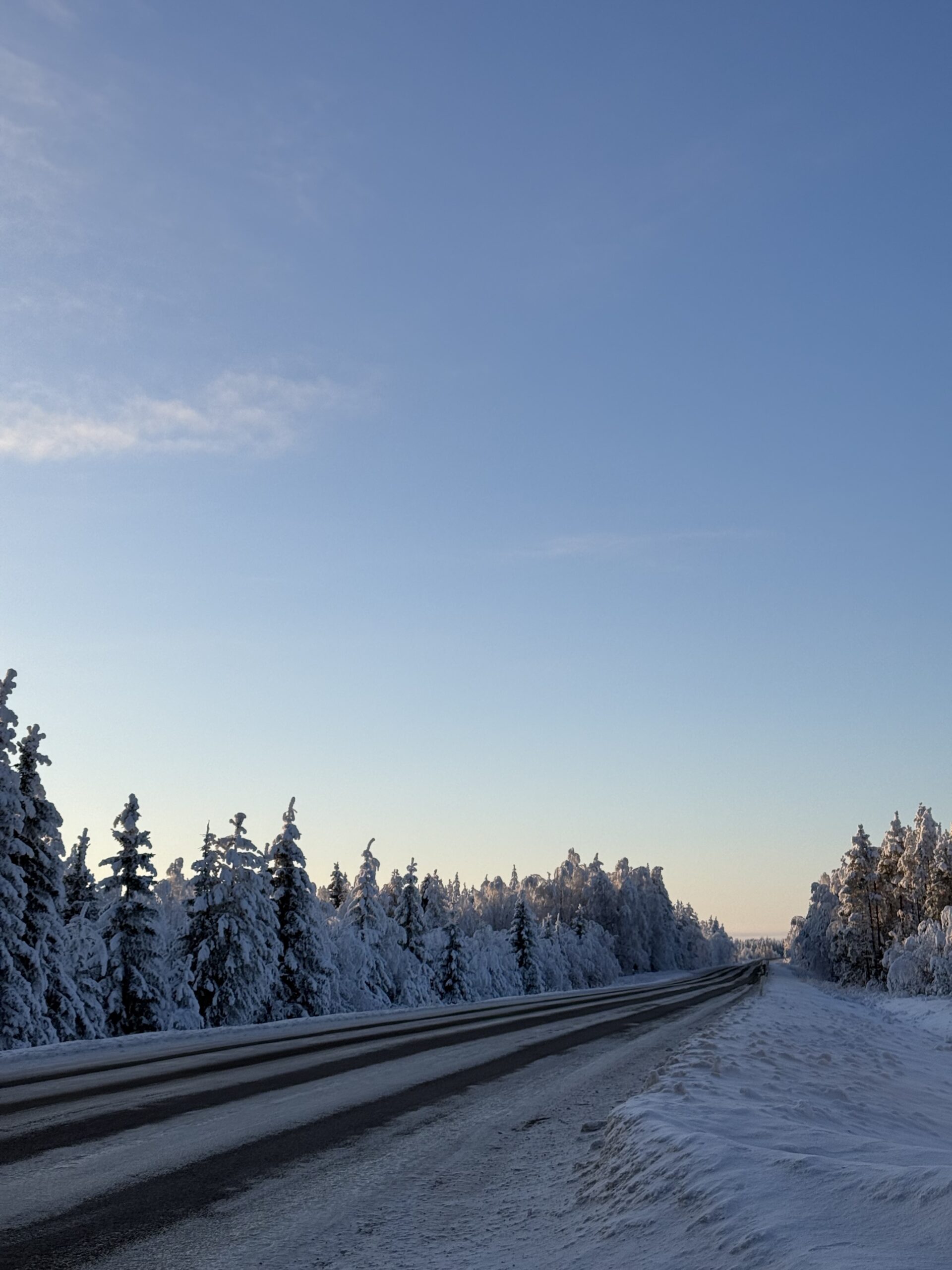
The same road in June and in February is a fundamentally different experience. We have driven both seasons many, many times.
Summer driving (June–August)
- Light: in June and July, Rovaniemi has continuous daylight. You can drive through “night” in broad daylight, which is disorienting but convenient for long stretches. Carry sunglasses for all 24 hours.
- Road quality: excellent. Finnish roads are resurfaced regularly and in summer they are as smooth as they get.
- Traffic: busier than winter in the south (especially around Tampere and Oulu), lighter in Lapland. June and July can see tourist traffic on the Rovaniemi approach road.
- Wildlife: elk crossing risk is highest in May–June and September–October. Dawn and dusk are highest risk, but in midsummer there is no dusk — stay alert regardless.
Winter driving (November–March)
- Road conditions: Finnish roads north of Oulu are packed snow or ice from November to March. The roads are maintained and sanded/salted, but you need winter tyres — it is a legal requirement in Finland from November to March for passenger cars.
- Speed limits: drop to 70 or 80 km/h on icy sections. GPS will show 100 but the digital speed signs will say otherwise.
- Darkness: in December, Rovaniemi has roughly four hours of pale twilight. Drive the last stretch from Oulu to Rovaniemi in darkness — headlights, full attention, reduced speed.
- Fuel discipline: never let the tank drop below a quarter north of Oulu in winter. A breakdown in −25 °C with an empty tank is a serious situation.
Driving in Finland for the First Time: 10 Things That Surprised Us
Elk crossings, speed cameras, the silent politeness of other drivers — we cover the culture shock of Finnish roads.
Read the guide →Our mistakes driving across Finland (so you don’t repeat them)
- Underestimating the distance. 830 km in Finland is not the same as 830 km in Germany. There are fewer passing opportunities, lower average speeds in Lapland, and the monotony of forest adds mental fatigue. Add at least 90 minutes to whatever Google Maps says for the pure driving time.
- Not downloading offline maps. Signal drops reliably between Oulu and Rovaniemi. Google Maps and Apple Maps both allow offline download — do it before you leave Oulu.
- Skipping the Kemi fuel stop. We have coasted into Rovaniemi on fumes more than once because we “had enough” leaving Oulu. The ABC at Kemi takes 5 minutes. Do not skip it.
- Driving the whole thing in one day from Helsinki. It can be done, but 9–10 hours of driving leaves you arriving at midnight (or in broad midnight-sun light) exhausted. Splitting the trip with a night in Oulu or Tampere makes the whole journey more enjoyable.
- Assuming the E8 coast is boring. We made this assumption for two years before driving it properly. The stretch from Vaasa to Oulu is genuinely beautiful in a flat, wide, northern way that you do not get on the inland E75.
- Not adjusting expectations for winter speed limits. The digital variable speed signs are legally binding in Finland. Ignoring them is how you get a fine processed automatically by the camera systems.
Frequently asked questions about driving across Finland
How long does it take to drive from Helsinki to Rovaniemi?
Plan for 9–10 hours including two fuel stops and a proper meal break. Google Maps will say 8 hours, but Finnish road conditions, lower speed limits in Lapland, and driver fatigue on a long straight road all add time. Splitting the drive into two days with a stop in Oulu or Tampere is genuinely recommended.
Is the E75 or E8 better for driving to Rovaniemi?
The E75 is faster and more direct for Rovaniemi — it is the route most people take. The E8 is better if you want to see the Gulf of Bothnia coast or are heading to Tornio, Kemi, or the Swedish border. The best option is to use both: drive up on the E75 and return on the E8 (or vice versa) for a loop.
Do I need winter tyres to drive in Finland?
Yes. Winter tyres are legally required for passenger cars in Finland from 1 December to 28 February, and in practice from November until April in Lapland. If you are renting a car, confirm that it has proper winter tyres — not just all-season tyres, which are borderline inadequate on genuine ice.
Are there toll roads on the E75 or E8 in Finland?
No. Finland has no motorway tolls. Driving the entire length of the country costs nothing beyond fuel. There is a small fee for some tunnel sections (notably the Helsinki Ring Road tunnels) but these are not on the E75 or E8 main routes.
Can I cross into Sweden or Norway at the end of the E8?
Yes. The E8 continues from Tornio into Sweden at Haparanda (no passport control — both are Schengen area). From Haparanda you can continue north on Swedish roads toward Luleå or turn west into Norwegian Lapland. Note the time zone change: Sweden is one hour behind Finland in summer.
What is the speed limit on Finnish highways?
On the motorway sections (mainly Helsinki–Tampere and Helsinki–Lahti), the limit is 120 km/h in summer and 100 km/h in winter. On the two-lane national road sections (most of the route north of Tampere), it is 100 km/h in summer and drops to 80 or 70 km/h in winter on snowy sections, shown by digital variable speed signs. Speed enforcement is by automatic camera systems — they do not send a warning.
A final word from Rovaniemi
We have driven across Finland in every season and every mood. In February blizzards where visibility dropped to 50 metres. In June midnight sun where the road ahead glowed gold at 2 am. In autumn when the birches between Oulu and Kemi turn yellow so suddenly it looks like the forest is on fire.
The E75 and E8 are not glamorous roads. There is no Amalfi Coast drama or Scottish Highland scenery. What they offer is something different: the slow, meditative experience of crossing a large country overland, forest by forest, town by town, until the distances start to feel natural and the stillness of northern Finland stops being unfamiliar and starts feeling like where you are supposed to be.
If you are planning to drive across Finland in 2026, our one piece of advice is this: build in more time than you think you need, and stop for coffee in Oulu before you head north. Everything after that is the good part.
Joona & Alla
A Finnish-Ukrainian couple living in Rovaniemi, Finland. Joona is a marketing professional in the Lapland travel industry; Alla is a content creator and AI student. Together we are Hungry Travel Family — writing about travel from the Arctic Circle to 25 countries and counting.
Read our full story →