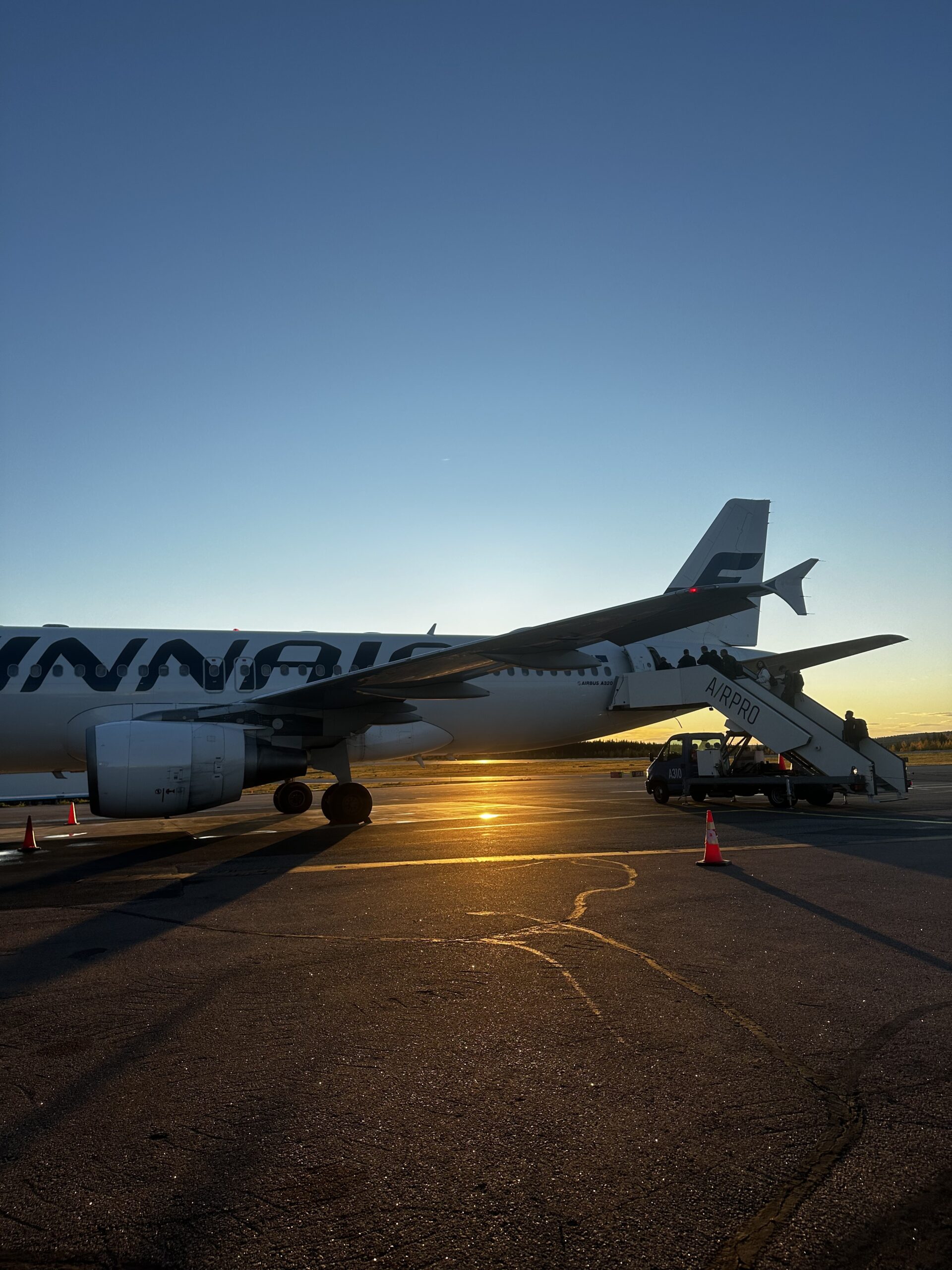
We’ve lost count of the emails we get from American readers asking some version of: “We’ve never been to Europe — can we actually pull off a trip to Finland from the US?” The answer is yes, and it’s more straightforward than most people expect. Traveling to Finland from the US requires a transatlantic flight (usually through a European hub), no visa for stays under 90 days, and a decent grasp of how expensive the country actually is. The rest is planning — and we’re here to help with that.
We live in Rovaniemi, on the Arctic Circle. Joona grew up in Finland, so between us we’ve had the experience of seeing Finland through both a local’s eyes and a visitor’s — which puts us in a useful position to explain what surprises American travelers most.
Short Answer
Traveling to Finland from the US means a 9–12 hour flight to Helsinki (usually via London, Amsterdam, or Frankfurt), no visa required for US citizens for stays under 90 days, a daily budget of roughly $120–$200 per person, and the best windows to visit being June–August for midnight sun and November–March for northern lights and snow. Direct flights from New York to Helsinki operate seasonally on Finnair and Norse Atlantic.
In this guide
Flights from the US to Finland
Finland is served by Helsinki Airport (HEL), the country’s only international hub. Nearly every transatlantic route funnels through here, so wherever in Finland you want to go, you’ll almost certainly land in Helsinki first.
Direct and one-stop options
The most important thing to know: Finnair operates seasonal direct service from New York JFK to Helsinki, and Norse Atlantic has run JFK–HEL routes in recent seasons. Outside of those options — and outside of peak summer — most US travelers connect through London Heathrow, Amsterdam Schiphol, Frankfurt, or Stockholm Arlanda.
- New York JFK → Helsinki HEL (direct, Finnair/Norse): roughly 9 hours. Seasonal, typically May–October. Book early; these seats sell out.
- Chicago ORD → Helsinki (Finnair via JFK or one-stop): total travel time around 11–13 hours with the connection.
- Los Angeles LAX → Helsinki: typically 14–17 hours via a European hub. Finnair, British Airways, Lufthansa, and KLM are the usual suspects.
- Dallas, Miami, Atlanta, Seattle: no direct options; budget 13–18 hours total with a European connection.
Our honest booking advice: set a Google Flights price alert for your route roughly 3–4 months out. Transatlantic fares to Helsinki fluctuate wildly. We’ve seen JFK–HEL round trips in the $600s in spring and over $1,400 in peak July. Shoulder season (May, early June, September) typically offers the best combination of price and weather.
Visa, entry, and what to know before you land
Good news first: US citizens do not need a visa to visit Finland. Finland is an EU and Schengen Area member, and the US has a longstanding visa-free agreement with Schengen countries. Here’s what actually applies:
The key rules
- Stay limit: up to 90 days within any 180-day period across the entire Schengen Area. That means if you’ve spent two weeks in France and three weeks in Germany before arriving in Finland, those weeks count.
- Passport validity: your passport must be valid for at least 3 months beyond your planned departure date from Schengen. Many travelers have been turned away for having a passport that technically hasn’t expired but doesn’t meet this rule.
- ETIAS (coming): The EU’s ETIAS pre-travel authorization system is expected to launch for US citizens. It costs €7 and is valid for three years. Check the current status before you travel — this may apply by the time you read this.
- Customs: Finland follows EU customs rules. Bringing food products (especially meat and dairy) from outside the EU is restricted. Keep your receipts for expensive electronics in case customs asks.
Border control in Helsinki is smooth and typically quick for US passport holders. The process is: show passport, answer a few questions, done. We’ve never seen it take more than 20 minutes at a normal hour.
When to go: the honest seasonal breakdown
Finland is genuinely worth visiting in every season, and the right time depends entirely on what you’re after. We’ll give you the honest version rather than the “every season is magical” tourism-board line.
Summer (June–August): midnight sun and endless light
This is when most American first-timers visit, and for good reason. The midnight sun is real — in Rovaniemi the sun doesn’t set at all for several weeks in June. It’s disorienting and extraordinary. Cities are alive, lakes are swimmable, hiking trails are clear, and Finland’s café culture comes out in full force.
The trade-off: peak prices. Accommodation in Helsinki and Lapland can double or triple compared to shoulder season. Book 3–6 months ahead for anything in July.
Winter (November–March): northern lights and snow
This is our personal favorite window to bring visitors. Lapland in winter is genuinely unlike anywhere else — proper snow, frozen rivers, reindeer, and a real shot at the northern lights. Helsinki and the southern cities are milder but darker. Expect temperatures between −5°C and −25°C in Lapland (roughly 20°F to −15°F). Dress properly and it’s not harsh; underdress and it’s miserable.
Shoulder season (May, September–October): the underrated windows
May is one of our favorite months to tell visitors about. Snow is melting in Lapland, wildflowers are appearing, and prices are still reasonable. September and October bring autumn colors to the forests and decent aurora odds. These windows are genuinely underrated and almost always cheaper.
The one thing to know: Finnish summers get mosquitoes, particularly in Lapland. Mid-July through August can be intense in the wilderness. Pack repellent.
How much Finland actually costs
We won’t sugarcoat this: Finland is expensive. It consistently ranks among the most expensive countries in Europe for travelers. But expensive and unaffordable are different things — if you budget properly, it’s very manageable.
Daily budget breakdown (per person)
- Budget traveler ($80–$110/day): hostel dorm bed, supermarket lunches (S-Market and K-Market are everywhere), one sit-down dinner, public transport. Absolutely doable, especially in Helsinki.
- Mid-range traveler ($130–$200/day): private hotel room, café lunches, two restaurant meals, some activities. This is what most American couples traveling together realistically spend.
- Comfort traveler ($220+/day): nicer hotels, fine dining, guided excursions, taxis. Helsinki has genuinely excellent restaurants and plenty of ways to spend money well.
The items that catch Americans off-guard most: alcohol (a beer in a bar is typically €7–10; wine by the glass €8–14), restaurant meals (a main course at a mid-range restaurant is €22–35), and taxis (Helsinki taxis start around €6 and add quickly). Counterbalance with supermarkets, which are stocked and affordable — lunch from an S-Market deli counter is one of the best value moves in Finland.
Getting around once you’re there
Finland has reliable infrastructure but is geographically large. Here’s how to think about movement:
- Helsinki is fully walkable and has excellent public transit. The tram network is straightforward, the metro covers key areas, and a single day ticket covers everything. You don’t need a car in Helsinki.
- Train travel connects Helsinki to Tampere, Turku, Oulu, and Rovaniemi. The VR overnight train from Helsinki to Rovaniemi takes about 12 hours and is a genuine experience — comfortable sleeper cabins, a real train through snowy forests. Book early; the overnight train sells out.
- Domestic flights connect Helsinki to Rovaniemi, Oulu, Kuopio, and Joensuu in about an hour. Finnair and Norra run frequent routes. If time is limited, flying to Rovaniemi and taking the train back (or vice versa) is a popular circuit.
- Car rental makes sense for Lapland in summer — the region is spread out, trailheads aren’t well-served by buses, and having your own wheels lets you follow the midnight sun wherever it leads. In winter, be comfortable with snow and ice driving before renting.
Letters from Rovaniemi
Stories from the Arctic, every two weeks
Travel ideas, honest destination guides, and what’s actually happening in Finnish Lapland — from a couple who lives here.
What surprises Americans most
We’ve hosted a fair few American visitors and answered a lot of emails from readers planning their first Finland trip. These are the things that consistently catch people off guard:
- The silence. Finns are not unfriendly — they’re just genuinely comfortable with quiet. Don’t read a lack of small talk as rudeness. If a Finn strikes up a conversation with you, it means something.
- Card payments everywhere. Cash is essentially unnecessary. We’ve gone months without touching a euro note. Contactless is the default at every coffee shop, market stall, and even some farm stands.
- The light. In summer it doesn’t get dark. Your phone will say it’s 2 am and the sky will look like late evening. Buy a sleep mask. In winter, the opposite — polar night in Lapland means the sun barely appears above the horizon, and between November and January it doesn’t rise at all in the far north.
- Sauna culture. This isn’t a spa option — it’s a fundamental social institution. If a Finnish friend or colleague invites you to sauna, say yes. It’s how Finns relax, connect, and genuinely decompress. Being too shy to participate is the equivalent of refusing to shake hands.
- The pharmacy system (Apteekki). Pharmacies in Finland operate under a regulated monopoly — there’s one chain, Apteekki. They’re easy to find and the staff typically speak excellent English, but don’t expect CVS-style superstores. Many OTC products Americans buy freely at home require a prescription here.
- Nature access. Finns have a legal right called jokamiehenoikeus — everyman’s right — that permits anyone to walk, camp, and pick berries on any land, including private land, as long as you behave responsibly. This sounds unbelievable to most Americans. It’s completely real.
Mistakes we’ve seen (and made)
After years of living in Finland and helping visitors plan trips, these are the errors that come up again and again:
- Underestimating distances in Lapland. Looking at a map, Rovaniemi and the Lofoten Islands (Norway) seem close. They’re about 700 km apart on largely secondary roads. Plan driving days carefully — Finland is bigger than it looks.
- Skipping the supermarket entirely. Eating every meal in restaurants will blow any budget. Finnish supermarkets are good and cheap. A lunch from a deli counter or a quick pasta in a hostel kitchen makes a big difference.
- Packing wrong for winter. “I’ll just wear my regular winter coat” doesn’t work below −15°C. Merino wool base layer, proper insulating mid-layer, a windproof outer shell, and insulated boots that are rated for actual cold. No exceptions.
- Arriving in Lapland in early December expecting deep snow. Snow in Finnish Lapland is reliable from roughly mid-December. Early December can be grey, slushy, and darker than expected. If you want the full snow experience, target January or February.
- Booking accommodation too late for summer. Helsinki hotels fill up fast in July. Rovaniemi cabins book out 6+ months ahead for peak summer (midnight sun) and peak winter (northern lights season, Christmas). Don’t assume you can sort it a few weeks before.
- Not downloading offline maps. Mobile data in Finland is reliable and cheap (SIM cards are available at the airport from €5–15), but cellular coverage in remote Lapland wilderness can disappear. Download the area in Maps or OsmAnd before you leave signal.
Frequently asked questions
Do US citizens need a visa to visit Finland?
No. US citizens can visit Finland and all Schengen Area countries without a visa for up to 90 days within any 180-day period. Your passport must be valid for at least 3 months beyond your planned departure date. Keep an eye on the EU’s ETIAS pre-travel authorization, which may be in effect by the time you travel.
How long is the flight from the US to Finland?
Direct flights from New York JFK to Helsinki take roughly 9 hours (seasonal, primarily on Finnair). Connecting flights from the US East Coast via a European hub run 11–14 hours total. From the West Coast, budget 14–18 hours including the layover.
Is Finland safe for solo American travelers?
Finland consistently ranks among the safest countries in the world. Violent crime is rare, scams targeting tourists are uncommon, and the country has high levels of institutional trust. Solo travelers — including solo women — report feeling comfortable here. Basic awareness (don’t leave valuables visible in parked cars, keep your card safe) is all that’s needed.
What is the best time of year to visit Finland from the US?
It depends on what you want. For midnight sun and outdoor activities, June–August is excellent but expensive and busy. For northern lights and snow experiences, January–February offers the best odds. May and September are quieter, cheaper, and beautiful — genuinely underrated windows that we recommend to most first-time visitors.
How much spending money do I need for two weeks in Finland?
A rough estimate for a mid-range two-week trip for two people: €3,000–€4,500 (roughly $3,200–$5,000 at current exchange rates), not including flights. This covers accommodation, food, activities, and transport within the country. Budget travelers can do it for significantly less; comfort travelers will spend more. The biggest variables are accommodation type and how much you eat out versus self-catering.
Do people in Finland speak English?
Yes, widely and well. Finland consistently ranks among the highest English-proficiency countries in the world among non-native speakers. In cities, tourist areas, and anywhere under about age 60, English is essentially universal. In very small villages you might find older residents who only speak Finnish or Swedish, but this is rare in practice. You don’t need to learn Finnish to have a comfortable trip — though learning kiitos (thank you) goes a long way.
A final word from Rovaniemi
Finland rewards the traveler who comes without firm expectations. It’s quieter than most European destinations, more untamed, more sparsely populated. When Alla first visited from Ukraine, she was struck by how different the relationship between people and nature felt here — not as a backdrop but as something people genuinely build their lives around. That hasn’t changed after years of living here.
Traveling to Finland from the US is a bigger logistical step than hopping between European countries, but it’s not complicated once you’ve done the groundwork. Get the flight sorted early, understand that it’s expensive but not unmanageable, pack for the season, and give yourself time — at least a week, ideally two. The country opens up when you slow down.
We’re here if you have questions. Drop them in the comments or find us via the contact page.
About the authors
Joona & Alla
A Finnish-Ukrainian couple living on the Arctic Circle in Rovaniemi, Finland. Joona works in Lapland tourism marketing; Alla is an AI engineer. Together we’ve visited 25 countries and write honest, locally-grounded travel content from our home in the north.
Read our full story →