Northern Lights Odds in Rovaniemi: What the Data Says, Month by Month
What the Finnish Meteorological Institute and NOAA actually say about how often the aurora appears, why clouds are the limit, and how many hours of true darkness Rovaniemi gets each month.
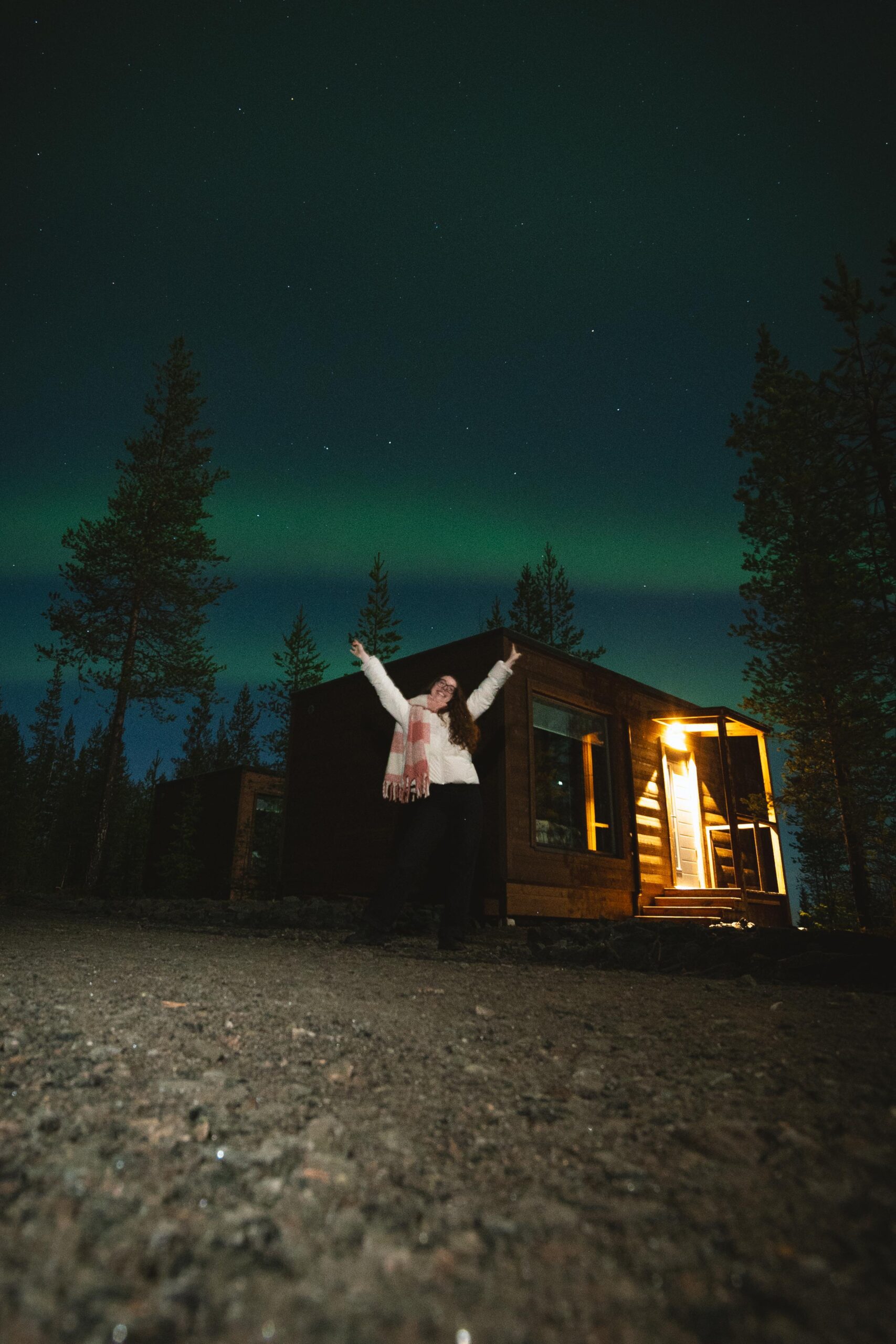
"What are the odds of seeing the northern lights in Rovaniemi?" is the question we are asked most, and by reporters as much as by travellers. The honest answer is not a single percentage. Any site that gives you one, such as "87% in March", is making it up unless it names its source and method.
We are Joona and Alla, a couple living in Rovaniemi, and we both work in tourism marketing in Lapland. This page sets out what the official sources do say, and where they stop. Everything with a number has a source and a period.
The Finnish Meteorological Institute says that, with clear skies, three nights out of four are aurora nights in the far north of Lapland, and every second night in Sodankylä; it publishes no Rovaniemi figure. The best months are February to March and September to October. Cloud cover, not the aurora itself, is usually what stops you, so plan several nights, and consider a guided hunt such as a weather-routed northern lights tour5% off · HUNGRYTRAVELFAMILY5.
Book direct · 5% off with code HUNGRYTRAVELFAMILY5
Professional Guaranteed Northern Lights Hunting Tour from Rovaniemi by Bus
Live dates and prices open right here on this page — you book directly with the local operator. From €109 per adult.
What the official sources say
The Finnish Meteorological Institute (FMI) publishes the clearest statistics. On its northern lights page it says that, according to its compiled statistics, three nights out of four are illuminated by northern lights in Northern Lapland (the Kilpisjärvi–Utsjoki area), provided that the sky is clear enough. On the coast of the Arctic Ocean in northern Norway, for example in Tromsø, auroras can be seen almost every night. In Sodankylä, FMI says, every second night is an aurora night. In Helsinki it is about one night per month.
Rovaniemi lies south of Sodankylä, so its aurora frequency will be somewhat lower than Sodankylä's, but FMI does not publish a Rovaniemi-specific figure on that page, and we will not invent one. NOAA's Space Weather Prediction Center adds the general picture: the best place to observe the aurora is under an oval region at roughly 60 to 75 degrees of latitude, where it can be seen more than half of the nights in a year, and the sky must be clear and dark.
Both FMI and NOAA make the same two conditions explicit: you need darkness and you need clear sky. FMI also says that in summer you cannot see the aurora because of the light nights.
Why there is no single percentage
Four things multiply together on any given night:
- Whether there is aurora activity at all, which at this latitude is frequent but varies night to night.
- Whether it is dark enough, which depends on the month.
- Whether the sky is clear where you are standing.
- Whether you are looking in the right place and at the right time, away from town lights.
FMI's published statistic combines the first two for northern Lapland and then adds the clear-sky condition as a proviso. It is not a promise about any particular night. The Sodankylä Geophysical Observatory (SGO), which runs all-sky cameras in Lapland, notes in its FAQ that seeing auroras in Lapland around the solar maximum and in the descending phase of the cycle is more about weather and light pollution than about the aurora itself.
Month by month: darkness and weather
We cannot give per-month aurora probabilities because the sources do not publish them for Rovaniemi. What we can show is what is measurable: how many hours the sun is far enough below the horizon, and how unsettled the weather typically is.
| Month (mid-month) | Hours with sun more than 18° below horizon | Days with precipitation (normal) | Note |
|---|---|---|---|
| September | about 3.4 | 9 | FMI: a best month |
| October | about 8.5 | 10 | FMI: a best month |
| November | about 11.6 | 13 | Most unsettled month in the table |
| December | about 13.1 | 12 | Longest darkness |
| January | about 12.4 | 11 | |
| February | about 9.9 | 10 | FMI: a best month |
| March | about 6.2 | 8 | FMI: a best month |
| April | 0 (twilight all night) | 8 | Aurora season is ending |
How we calculated this: the darkness column uses the NOAA solar position equations for Rovaniemi (66.5° N) on the 15th of each month, counting the hours when the sun is more than 18 degrees below the horizon (astronomical darkness). The precipitation-day column is the 1991–2020 FMI normal for Rovaniemi airport as compiled in public climate tables. Days with precipitation are only a rough proxy for unsettled weather, not a cloud-cover statistic, which we could not find published for Rovaniemi by month. Treat the table as context, not as odds.
The pattern is still clear. September has little darkness but relatively settled weather; December has the most darkness but is the most polar-night month; FMI's best months, February–March and September–October, are the ones where long enough nights meet a better chance of clear sky. An older SGO note adds that the March equinox period favours auroras and also the cloud statistics.
Clouds are the real limit
If aurora is frequent and the nights are long, why do visitors miss it? In our experience living here, the answer is almost always cloud. In our experience Lapland winters have plenty of overcast evenings, and the aurora is above the clouds, so it is invisible from the ground. This is why operators drive: clear patches can be an hour away, and a good guide chooses the destination from the live cloud forecast, not from a fixed spot.
FMI's own phrase, "providing that the sky is free enough from clouds", is the part of the statistic that matters most for a short trip. A visit of one or two nights has a real chance of being cloud-covered even in a good month.
What time of night
FMI says the best time to see aurora is between 9 pm and 1 am local time. SGO adds that in quiet periods, auroras often occur as calm arcs with a short, intense period around magnetic midnight, and that many phone apps based on geomagnetic activity miss those quiet arcs in Lapland. So an app showing a low number does not mean there is nothing to see.
Three myths worth correcting
"You need the solar maximum." Not for Lapland. SGO says that even during the minimum phase of solar activity the probability of seeing northern lights in Lapland is still rather good, although the auroras then stay mostly in the northern sky, and that around the maximum and in the descending phase it is mostly weather and light pollution that decide. We look at the current cycle in a separate post on the solar cycle.
"Further south is just as good." The FMI figures show a clear gradient: almost every night on the Norwegian coast, three in four in the far north of Finnish Lapland, every second night in Sodankylä, one a month in Helsinki. Rovaniemi is a trade-off: fewer aurora nights than the far north, but it has the airport, the infrastructure and the guides. Many visitors accept that for convenience, and that is a legitimate choice as long as they plan for it.
"A guarantee means you will see it." No operator controls the sky. Some tours offer a refund or a repeat trip if no aurora is photographed; that is a commercial promise about money, not a promise about nature. Check what exactly is guaranteed, and by whom.
How to improve your chances
- Plan several nights. In our opinion three or four nights is a sensible minimum, because cloud, not the aurora, decides each night.
- Choose the best months you can. FMI names February–March and September–October.
- Get away from lights. NOAA lists darkness as a condition; town lights reduce what you see.
- Consider a guided hunt. Operators choose locations by weather. For example, this five-hour guided hunt by bus5% off · HUNGRYTRAVELFAMILY5 is listed by the operator with weather-based routing and a refund if no aurora photos are captured; read the exact terms before booking. It is from €109 per adult (checked November 2026; prices change, so check before booking). Type HUNGRYTRAVELFAMILY5 at checkout for 5% off.
If you are comparing bases, our comparison of Rovaniemi, Ivalo and Inari for northern lights explains the trade-offs. We are also happy to help journalists with local context; see our press page.
FAQ
What are the odds of seeing the northern lights in Rovaniemi?
There is no official single figure. FMI says three nights in four in the far north of Lapland and every second night in Sodankylä are aurora nights if the sky is clear. Rovaniemi is further south, so somewhat fewer.
Which months are best for northern lights in Rovaniemi?
FMI names February to March and September to October as the best months, and says you cannot see aurora in summer because of the light nights.
What time of night should I look?
FMI says between 9 pm and 1 am local time is best.
Do clouds really matter that much?
Yes. Aurora happens above the clouds, so overcast skies hide it. FMI's statistics carry the proviso that the sky must be clear enough.
How many nights do I need?
There is no guarantee, but because cloud decides each night, we suggest planning at least three or four nights.
Quotable · free to use with credit
“Any website that gives you an exact percentage for seeing the northern lights is guessing, because cloud cover decides most nights.”
— Joona & Alla, Hungrytravelfamily, Rovaniemi
“If we could give one piece of advice, it would be to plan three or four nights, not one, and to choose February, March, September or October if you can.”
— Joona & Alla, Hungrytravelfamily, Rovaniemi
“The aurora is above the clouds, so a good guide drives to clear sky rather than waiting under overcast.”
— Joona & Alla, Hungrytravelfamily, Rovaniemi
Please credit “Joona & Alla, Hungrytravelfamily (hungrytravelfamily.com)”. Need a fresh quote or an interview? Contact us.
Live dates and prices for Professional Guaranteed Northern Lights Hunting Tour from Rovaniemi by Bus
Pick a date below to see real-time availability. Enter HUNGRYTRAVELFAMILY5 at checkout for 5% off.
For journalists, TV & podcast producers
Working on a story about northern lights odds in Rovaniemi?
We’re Joona & Alla — we live in Rovaniemi on the Arctic Circle and both work in tourism marketing in Lapland. We can help with:
- On-camera interviews and expert comments in English (Joona also speaks Finnish)
- Story research, real prices and location ideas in Rovaniemi and Finnish Lapland
- Filming days and contacts with local husky, reindeer, snowmobile and northern lights operators
Send your outlet, topic, dates and deadline — we try to reply within 24 hours.
Email a media requestPress & media pageSources & further reading
- Northern lights (Finnish Meteorological Institute)
- Aurora (NOAA Space Weather Prediction Center)
- Aurora FAQ (Sodankylä Geophysical Observatory, University of Oulu)
- Rovaniemi climate normals 1991–2020 (Finnish Meteorological Institute, as compiled in Wikipedia's Rovaniemi climate table)
- NOAA Global Monitoring Laboratory: solar calculator equations
- Polar Night (Visit Rovaniemi)
Get our best travel tips in your inbox
Monthly stories from Rovaniemi — Arctic tips, packing lists, and the places we keep coming back to.