What It’s Like to Drive Through a Norwegian Mountain Tunnel (Really)
From the 24.5 km Lærdal Tunnel to a one-lane shaft cut straight through a fjord wall, Norway has more strange tunnels per kilometre than anywhere we’ve driven. Here’s what it actually feels like behind the wheel — and what you should know before you go.
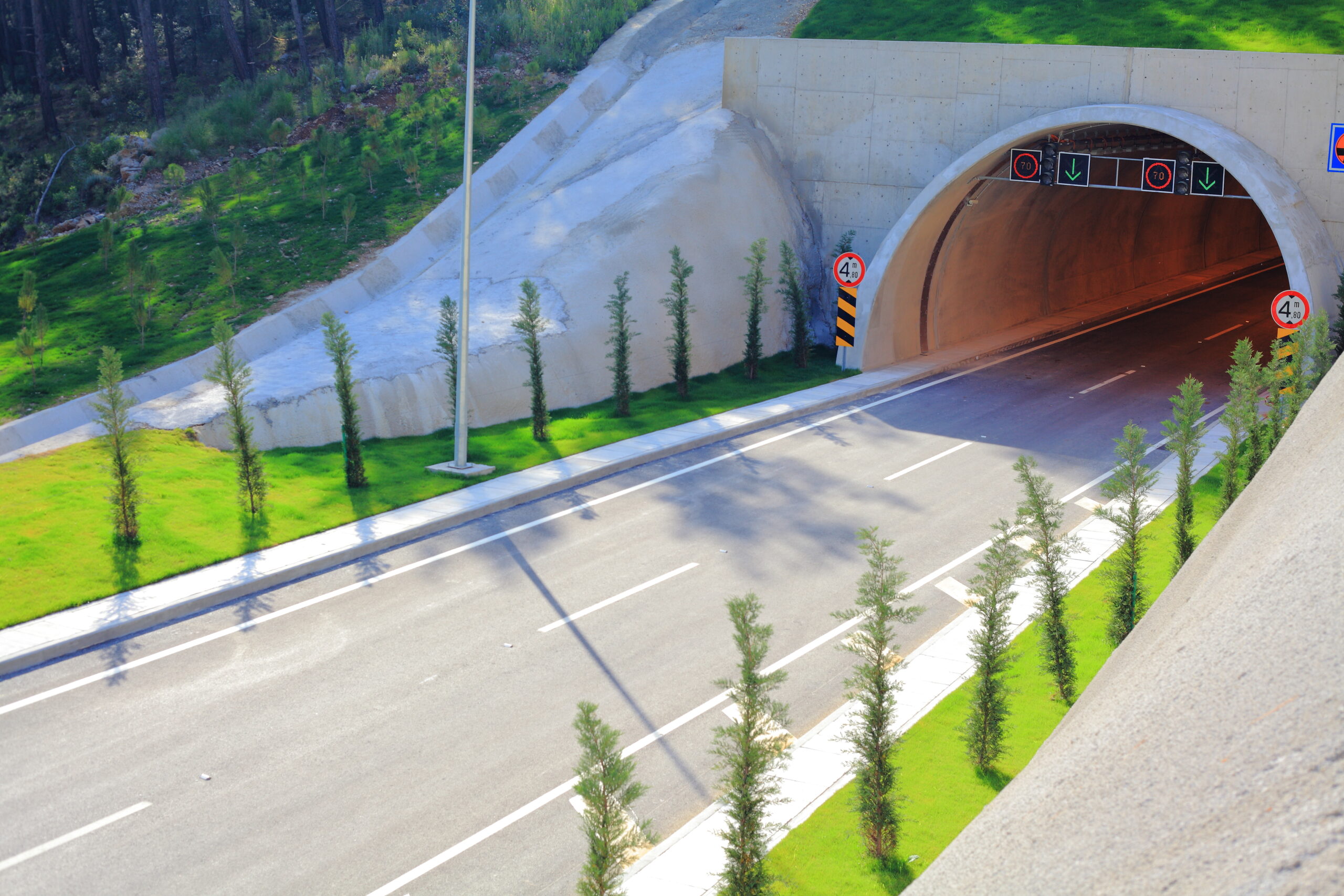
The first time you drive into a long Norwegian mountain tunnel, the daylight just disappears. There’s no slow fade, no warning. One moment you’re following a fjord under a wide grey sky, and the next you’re inside a stone tube lit by sodium lamps that turn everything the colour of old copper. Your ears pop. Your phone signal dies. Your sense of where you are in the country quietly resets. And then, fifteen minutes later, you come out the other side somewhere completely different — a different valley, a different climate, sometimes a different weather system entirely.
We’ve driven through dozens of them. Lærdal at 24.5 kilometres long, the under-fjord ones that descend hundreds of metres below sea level, the narrow single-lane shafts on Atlantic Road detours, the Trollstigen approach tunnels with their tight switchbacks and dripping rock. Norway has roughly 1,200 road tunnels — more than almost any other country — and driving through them is one of the most genuinely surprising parts of a Norwegian road trip. Here’s what we wish someone had told us before our first one.
Norwegian mountain tunnels are safe, well-maintained, and far more common than you expect. The longest ones (10–25 km) feel disorientating the first time but are completely manageable. The things to actually prepare for: lane-merging at the entrance, total loss of mobile data inside, dropping temperature, occasional one-lane sections with passing bays, and tolls that get billed automatically by camera. Drive slowly the first time, keep your headlights on (it’s the law), and don’t try to overtake.
Why Norway has so many tunnels
If you draw a road in Norway you almost always have to choose: go around the mountain (a long detour and a sometimes impassable winter pass) or go straight through it. For decades the answer was “around.” Since the 1980s the answer has increasingly been “through.” The result is one of the densest tunnel networks in the world, with around 1,200 road tunnels totalling roughly 800 kilometres of underground driving — more than the entire length of Norway from Lindesnes to the Russian border.
What that means for a road trip is simple: you can’t really plan a Norwegian itinerary that avoids tunnels. The famous fjord routes through Sognefjord, Hardanger, and Geirangerfjord all rely on long tunnels. The coastal Atlantic Road has them. The route from Bergen to Oslo has them. Even short detours to a single waterfall might send you through 4 km of mountain. Once you accept that they’re a feature, not a chore, the trip changes.
What it actually feels like inside
The first thing that surprises most people is how cold it gets. Mountains absorb heat slowly, so even on a 22°C summer day, the air inside a long tunnel is often 6–10°C. Roll your window down halfway through Lærdal in July and the wind hits you like opening a fridge.
The second is the light. The longer tunnels have small “rest chambers” every few kilometres — sections lit blue and gold like an underground cave with curved walls — that suddenly open up into a wider space before the road narrows again. They’re designed to break the visual monotony, and they do. The first time you reach one of those chambers in Lærdal, half the tourist cars stop in the lay-by to take photos.
The third is the sound. Long tunnels have a strange acoustic quality — your engine hum reflects off concrete walls and comes back as a low rumble, while the road surface (often grooved for grip) adds a high-frequency whistle. Music sounds different. Conversation gets louder without you noticing. After fifteen minutes you stop hearing it. After twenty minutes you start to wonder, faintly, where the end is.
What our brain does on a 20-minute tunnel
- Time stretches. Without external landmarks, ten minutes feels like twenty. Trust the dashboard, not the gut.
- Speed perception drops. You’ll often catch yourself drifting under the limit because the walls feel close. Watch the speedometer.
- Mild claustrophobia is normal. Even people who don’t usually feel it report a subtle “I’d like to be out now” sensation around minute twelve. It passes.
The famous ones, ranked by experience
Lærdal Tunnel — 24.5 km, longest in the world
Connecting Aurland and Lærdal as part of the E16 between Oslo and Bergen, Lærdal is the experience everyone tells you about. Twenty-five kilometres in a straight stone line under the mountains, with three illuminated rest chambers midway. The drive takes about 20 minutes at the 80 km/h speed limit. It’s not scary — it’s hypnotic. You’ll come out somewhere you weren’t expecting.
Eiksund Tunnel — 7.8 km, deepest sub-sea tunnel in Norway
Connects two islands off the west coast and reaches 287 metres below sea level. The descent at 10% gradient is genuinely strange — you can feel the car accelerating slightly even with your foot off the throttle, and your ears pop the same way they do on a plane descent. Worth a detour if you’re in the Sunnmøre area.
Atlanterhavstunnelen — 5.7 km under the Atlantic
The under-sea tunnel near the Atlantic Road (Atlanterhavsveien). You drive down, down, down, and just when you think the bottom must be coming up, the road keeps descending. This is the one that genuinely makes most first-timers say something out loud.
Mástarjok / E10 tunnels above the Arctic Circle
Less famous but unforgettable in winter. Driving from Narvik towards the Lofoten Islands you pass through a series of tunnels cut directly through fjord walls. Some have icicles forming inside the entrance. The temperature differential between summit and tunnel can be 15°C.
The under-fjord tunnels — a different beast
Norway’s sub-sea tunnels are technically different from mountain tunnels and worth knowing about separately. They go down at a steep gradient (often 7–10%), reach the bottom (sometimes 200+ metres below sea level), and climb back up. The descent is fine. The climb is where things get interesting.
Heavy vehicles slow dramatically on the climb. If you’re behind a truck on a 1.5 km uphill section in a 6-7 km tunnel, you may end up doing 40 km/h with no chance to overtake. Plan for that. We’ve sat behind logging trucks in the Bømlafjord Tunnel for ten minutes at a crawl. It’s fine if you expect it.
Under-fjord tunnels also have a particular smell — slightly damp, slightly metallic, like an old basement. Air ventilation is constant but you’ll notice it.
What to know before you drive in
Headlights are mandatory at all times
In Norway, daytime running lights are required for all vehicles year-round, on every road. In tunnels this is doubly important. Many rental cars handle it automatically; older ones don’t. Check before you go.
Mobile signal will drop completely
Most long tunnels have no cell coverage and no GPS signal. Your sat-nav will keep estimating based on the last known speed, which works fine in a straight tunnel but can get confused if there’s a junction inside (some Norwegian tunnels have actual roundabouts inside them — Eiksund and Ryfylke for example). Take a screenshot of your route before going in.
Tolls are automatic
Most major tunnels charge a toll, billed by camera reading your number plate. If you’re driving a rental, the rental company will charge you a few weeks after the trip. If you’re driving your own car, you can register at AutoPASS in advance to avoid extra fees. The tolls are typically 25–250 NOK per tunnel.
Speed limits inside are usually 80 km/h
And they’re enforced by camera. Don’t try to overtake — many tunnels are single-lane in each direction with no passing zones, and overtaking lanes inside tunnels are rare. If you’re behind a slow truck, you wait.
One-lane tunnels with passing bays exist
On some smaller roads (especially in the Lofoten Islands and old fjord routes), tunnels are single-lane for both directions. There are clearly marked passing bays every 100–200 metres. The convention: if you see headlights coming toward you, the car closer to the bay reverses or pulls in. It works, but it’s tense the first time.
Mistakes we made in our first Norwegian tunnel
Trying to use sat-nav inside
Our phone happily told us to “take the third exit” in a tunnel where there was only one road. We laughed for the rest of the drive. Now we screenshot the route before any tunnel longer than 5 km.
Not slowing down at the entrance
The transition from bright daylight to tunnel sodium lamps takes your eyes about 3–5 seconds to adjust. We learned to drop 10–15 km/h in the first 100 metres. Most rentals don’t have advanced cameras to compensate; you just have to slow down.
Trying to overtake on the long climb
We did this once on a sub-sea tunnel climb behind a slow truck. The double yellow line means the same thing in Norway as everywhere else. There was a brief, genuinely nervous moment when oncoming headlights appeared and we had nowhere to go. Never again.
Forgetting how cold it gets
Driving through Lærdal in July with the AC on, we came out the other side and realised the inside of the car was below 16°C. Fine for ten seconds. Bad for tired kids in the back. Now we turn the AC off well before any long tunnel.
Frequently asked questions
Are Norwegian mountain tunnels safe?
Yes — they’re among the most regulated tunnels in the world. Every long tunnel has emergency telephones every few hundred metres, fire equipment, ventilation systems that vent both directions, and lay-bys. Accidents inside long tunnels are rare. The biggest practical risk is fatigue from monotonous driving — if you feel sleepy, pull into a lay-by.
Can you stop inside a Norwegian tunnel?
Only in marked lay-bys (typically every 1–2 km in the longer tunnels) and only if necessary. There are no parking spots inside, and stopping in the running lane is dangerous and illegal except in genuine emergencies.
Do I need a 4WD for Norwegian tunnels?
No. Tunnels themselves require nothing special — they’re well-paved, well-lit, and operate the same year-round. The roads between tunnels in winter sometimes call for winter tyres or chains, but the tunnels are easier than the open road in poor weather.
Are tunnels open year-round?
Almost all major tunnels are open 24/7/365 — they’re often kept open specifically because the surface roads they replace would close in winter. Smaller tunnels on minor routes can close briefly for maintenance, but those closures are well-signed and announced in advance.
How much do Norwegian tunnel tolls cost?
Anywhere from around 25 NOK for a short toll tunnel to 250+ NOK for the longer sub-sea ones. Lærdal is currently free for cars. Atlanterhavstunnelen is around 110 NOK each way for cars. If you’re driving a lot of tunnels in a single trip, register with AutoPASS in advance — it gives you a discount and avoids the rental car admin fee.
Can I cycle through Norwegian mountain tunnels?
Some, yes — usually shorter ones with cycle paths or lower speed limits. The longest mountain tunnels (Lærdal especially) are off-limits to cyclists, and there are signposted alternative routes (often the original mountain pass road, kept open for cyclists in summer). Always check the specific tunnel before you ride.
A final word from Rovaniemi
Norwegian mountain tunnels are one of those rare experiences that you don’t appreciate until you’ve driven through one. They’re not a thing to “get through” — they’re part of why Norway feels like Norway. A road that can’t go around mountains has to go through them, and that creates a country that connects in unexpected ways. After enough trips, we look at a map of Norway and see the tunnels first now. They’re the spine of how the country works.
So: keep your headlights on, take it slow the first time, and when you come out the other side somewhere completely different from where you went in, just enjoy it. That’s the whole point.