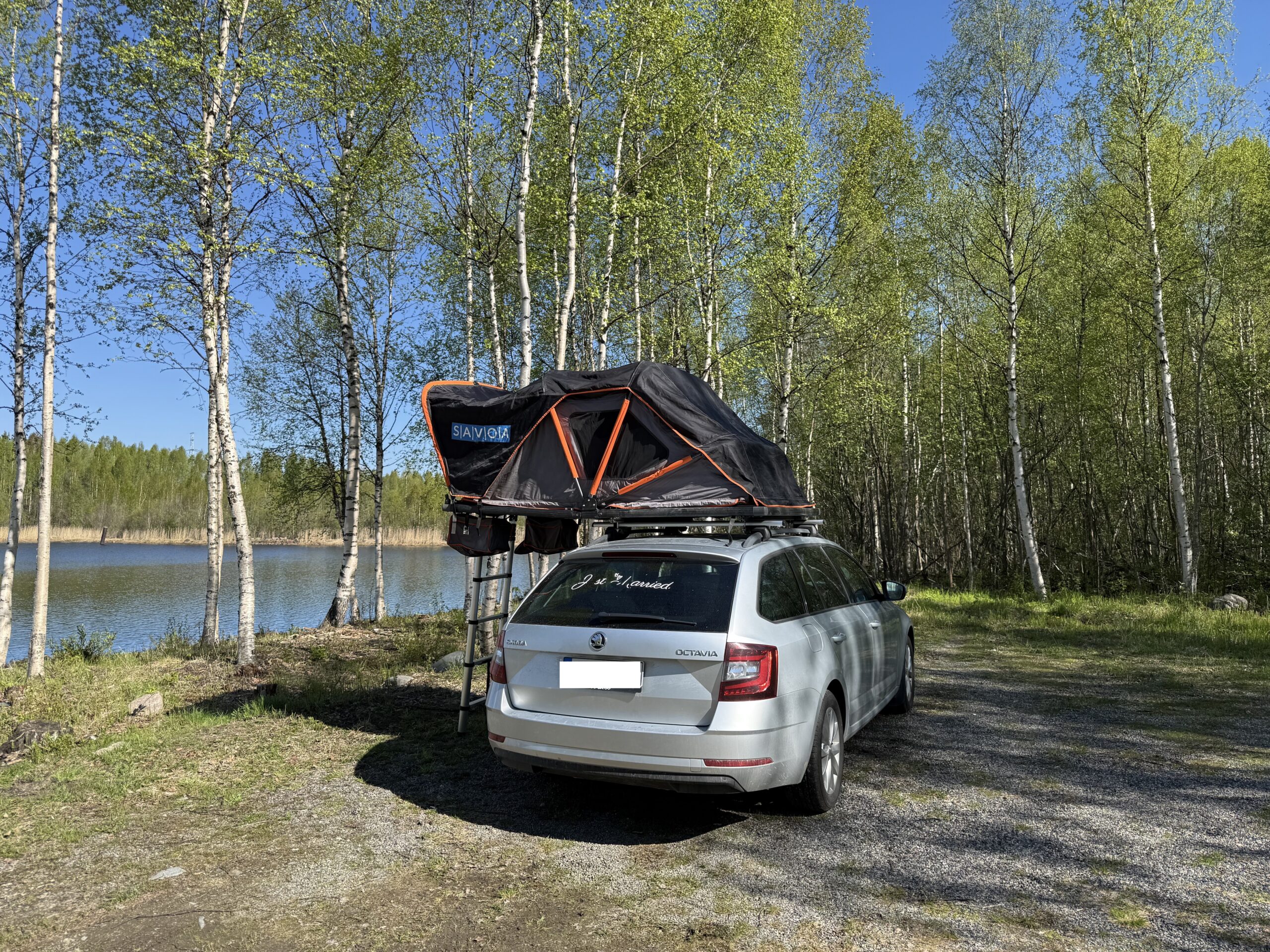
If you are searching motorhome vs campervan in Denmark, you have probably noticed that rental sites use the two words almost interchangeably. In practice they mean different vehicles, and the difference shows up in places you might not expect: on a windy Jutland road, at a toll barrier, and on a wet Tuesday evening when everyone is stuck inside.
We have road-tripped all the Nordic countries, and Denmark rewards a vehicle that fits the country: compact, flat, full of small roads and busy summer campsites. This guide walks through how we would choose, without pretending there is a single right answer.
Pick a campervan if you are two people who want easy driving, simple parking and the lower price. Pick a motorhome if you are a family or a group of three or more, or you want proper indoor space for Denmark’s cool, wet and windy days. Expect a noticeable price step up for the bigger vehicle, and our reader code HUNGRYTRAVELFAMILY20 takes €20 off at checkout either way.
What the two words actually mean
There is no legal line between the two terms, but the rental world broadly uses them like this. A campervan is a converted van, typically sleeping two and sometimes three or four, with a compact kitchen and a bed that often doubles as seating. A motorhome is a larger, purpose-built vehicle, usually with a separate cab, a fixed bed or two, a bathroom and a proper living area, and it commonly sleeps four or more.
CampervanPlanet’s Denmark route guides reflect that split: they suggest a 2-berth campervan for the easy Zealand loop and a 4-berth motorhome for the longer Funen to Jutland and west coast routes. That is a sensible rule of thumb, not a law, and plenty of couples happily take a motorhome while some families squeeze into a van.
If you are still deciding whether to rent at all, our campervan rental guide sets out how the process works across the Nordics.
Driving and parking: where size really shows
Denmark is easy to drive, which is exactly why people underestimate vehicle size. The roads are flat and well signed, but the country is also full of old town centres, small harbours and narrow village streets built long before motorhomes existed.
A campervan, being van-sized, slips through most of that without drama. A full-size motorhome means more planning: you will want to know where you can park before you arrive, and Copenhagen city centre is simply not a place to take one. The practical answer in both cases is the same, leave the vehicle at a campsite or aire and use trains, buses or bikes for the city, but the bigger the vehicle, the more you will be doing that.
Wind is the other factor. The Jutland west coast is exposed, and a tall motorhome catches crosswinds more than a lower campervan. Neither is dangerous with a calm driver, but we would take it easy in either when gusts pick up, and more so in the high-sided one.
Tolls, ferries and the length factor
Denmark has no motorway vignette, so road costs are small, but the exceptions are priced by size. The Great Belt bridge between Zealand and Funen is the main one. As a rough guide, a car or small camper pays about DKK 250 (roughly €34) one-way, and larger motorhomes pay more by length. Longer vehicles can also pay more on ferries to the Danish islands, which are usually priced by length too, so check before you go if island-hopping is part of your plan.
None of this is a reason to avoid a motorhome. It is simply an extra line in the budget, and one where the smaller vehicle quietly saves you a little each time you cross something.
The price gap: what you pay for the extra space
Bigger costs more, and it costs more in several places at once. The daily rental rate is higher, diesel use is higher because the vehicle is heavier, tolls and ferries scale with length, and campsite pitches can be pricier for larger units. Rental rates are priced live by date, so we will not quote a single number, but the shape is consistent: a motorhome is a noticeable step up from a campervan for the same dates.
That step is worth paying if it lets a family travel together comfortably, and it is a waste if two adults only use half of it. The cleanest way to see the real gap is to run your own dates twice, once with a 2-berth van and once with a 4-berth motorhome, and compare. You can do that in a couple of minutes on CampervanPlanet.
For the other costs around the rental, our breakdown of what campervan rental in Denmark really costs covers diesel, campsites and the bridge toll in detail.
Living space on a wet Danish day
Danish weather is maritime: mild at its best, cool, wet and windy at its worst. That makes indoor space more important than it looks on a sunny booking page. In a campervan, a rainy evening usually means the bed is also the sofa and the kitchen is a corner, which is fine for two and tight for more.
A motorhome gives you a proper table, standing room, often an on-board bathroom, and a place for children to spread out without anyone stepping over anyone else. If you are travelling in the shoulder months, April, May, September or October, when evenings are cool and daylight is shorter, that space matters more than it does in July.
The trade-off is that a van’s smallness is also its charm. Everything is within reach, it heats up quickly and it feels like an adventure rather than a mobile flat.
💡 Our campervan tip: prices for the same van vary a lot between rental brands. We compare Denmark campervans across 160+ rental companies on CampervanPlanet — and code HUNGRYTRAVELFAMILY20 takes €20 off your booking.
Campsites and aires: what fits where
Wild camping is banned in Denmark, so every night is spent at a licensed campsite or an autocamperplads, a motorhome aire. Pitch fees depend on location and season, roughly DKK 250–450 a night for two adults all-in, while simple aires are often around DKK 100–200 and sometimes free or donation-based.
Smaller vehicles have an advantage here. Compact vans fit onto more pitches, squeeze into tighter aires and are easier to position on a sloping or crowded site. Large motorhomes can need bigger pitches, and in July and August, when the coastal campsites fill and around Sankt Hans on 23 June, that can narrow your options. Either way, book ahead for the busy dates, and do not rely on turning up.
Always check electric hook-up and service facilities if you have a bathroom on board, since a motorhome with a toilet and shower needs somewhere to empty and refill.
So who should pick which?
Here is how we would decide, assuming you have the choice.
- Couple, short trip, Zealand or a city-and-castles loop: campervan. It is cheaper, simpler to drive and easy to park.
- Couple wanting comfort for two weeks or more: either works, but a larger van or small motorhome with a proper bathroom may be worth the step up.
- Family of four, or two adults with older children: motorhome. The extra beds and floor space justify the cost.
- Families with a toddler: motorhome usually, because bed space and a bathroom matter more than parking ease.
- Wild west coast of Jutland, in wind and rain: either, but be honest about how much time you will spend indoors.
If you are on the fence, choose by weather, not by photos. Ask yourself how you will feel at 7 pm on a cool, rainy evening, because that is the moment the vehicle earns its money.
How to compare them properly before you book
The most reliable way to settle motorhome versus campervan is to price both for your exact dates. Search the same pick-up and drop-off in each class, note the berths, the transmission and the included extras, and look past the headline rate to the total with insurance and any fees.
Check what is included: bedding, kitchen kit, camping chairs and a gas bottle are common extras that some brands bundle and others charge for. And make sure you can actually drive what you pick; a larger motorhome may sit near the weight limit for a standard car licence, so check the vehicle’s listed weight.
Our code HUNGRYTRAVELFAMILY20 takes €20 off at checkout on CampervanPlanet, whichever class you choose.
Book your Denmark campervan
Compare prices across 160+ campervan and motorhome rental brands, get a free 1GB eSIM with every booking — and €20 off with code HUNGRYTRAVELFAMILY20.
Check prices & availability →Frequently asked questions
What is the difference between a motorhome and a campervan?
A campervan is generally a converted van sleeping two to four, with a compact kitchen. A motorhome is a larger, purpose-built vehicle, usually with a separate cab, living area and often a bathroom, sleeping four or more. Rental sites sometimes use the words loosely, so look at the berths and the vehicle photos.
Is a campervan or motorhome better for Denmark?
For two people, a campervan is usually easier and cheaper in Denmark: simpler parking, cheaper tolls and more campsite pitches that fit. For families or groups of three or more, a motorhome gives you the space the Danish weather often calls for.
Do motorhomes pay more tolls in Denmark?
On the Great Belt bridge, larger motorhomes pay more by length than a car or small camper, which pays about DKK 250 (roughly €34) one-way as a rough guide. Ferries to the Danish islands are also usually priced by length. Check current prices before travelling.
Can I drive a motorhome on a normal car licence in Denmark?
Many motorhomes fall within a standard car licence, but larger ones can be near the weight limit, so check the vehicle’s listed weight and the brand’s licence conditions before booking.
Is there a discount code for CampervanPlanet?
Yes. Our reader code HUNGRYTRAVELFAMILY20 takes €20 off your booking, entered at checkout on CampervanPlanet, whether you rent a campervan or a motorhome.
Which is better in windy weather?
A lower campervan is a little more stable in crosswinds than a tall motorhome, but neither is a problem for a careful driver. The Jutland west coast is the place to slow down. Our guide to the best time to rent a campervan in Denmark explains which months are calmest.
Keep your crypto offline, not in an exchange app
Any crypto we hold lives on a Trezor hardware wallet — a small offline device in a drawer in Rovaniemi, not on a phone that crosses borders every month. If you’ve been meaning to sort that out, this is the link we’d send a friend.