We’ve cooked hundreds of meals in the back of a car across 25 countries — from Lapland forests to Faroe Islands cliffs. Here’s the simple system we’d actually repeat.Cooking on the Road: An Easy System That Works
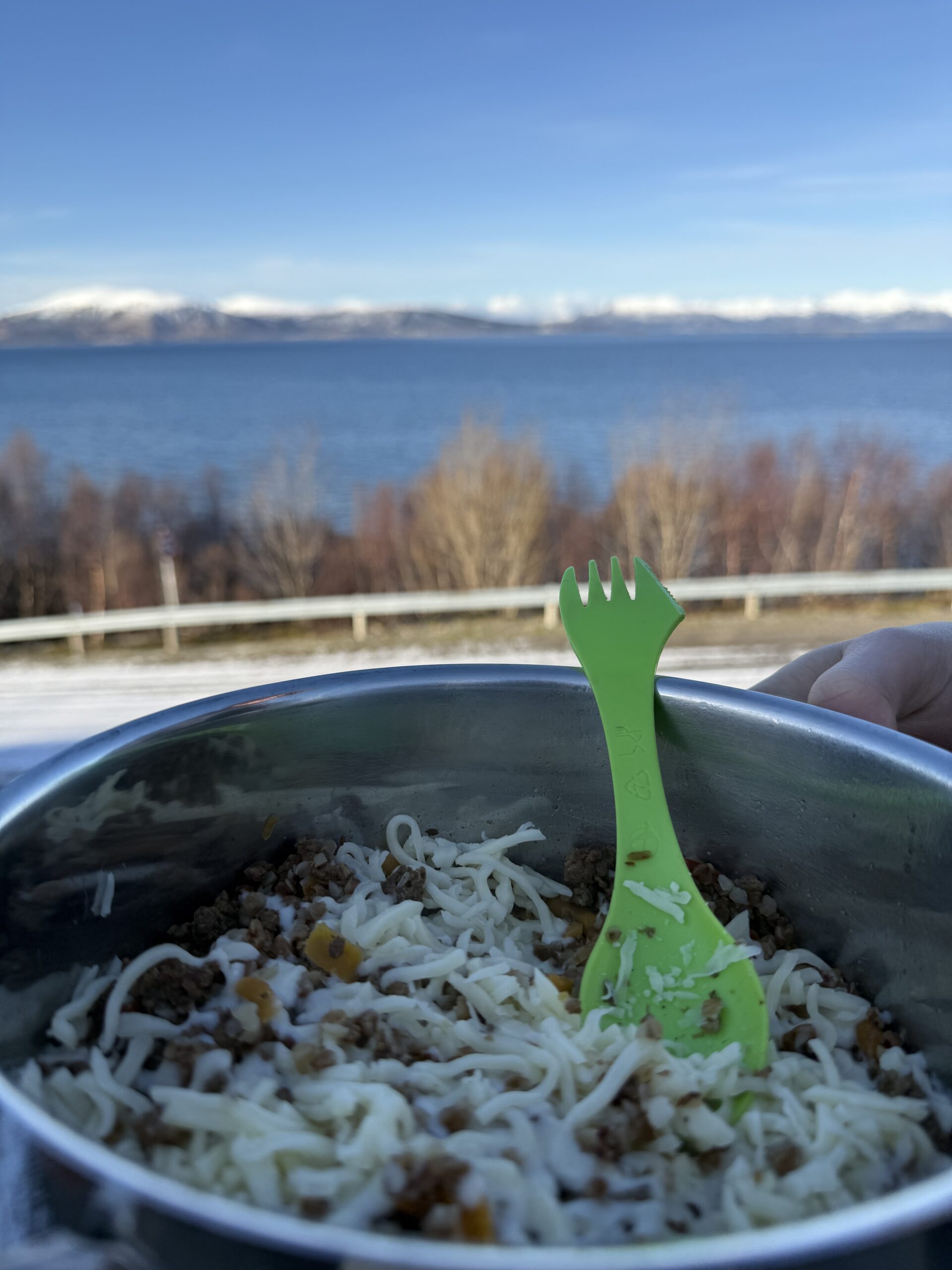
We’ve eaten some extraordinary meals in the middle of nowhere — lakeside pasta in Finnish Lapland at midnight, shakshuka on a Faroe Islands cliff above the Atlantic, pan-fried Arctic char on a Norwegian gravel beach. And some truly terrible ones. What separates a good road-trip kitchen from a miserable one isn’t money or equipment. It’s a system.
After years of cooking on the road across Scandinavia, the Baltics, and beyond, we’ve stripped our approach down to something any traveler can replicate — regardless of whether you’re in a campervan, a regular hire car, or wild-camping with a daypack stove.
The key to cooking on the road is a rotating base of 8–10 versatile ingredients, a single reliable heat source, and a 30-minute weekly meal plan you adapt on the fly. Skip elaborate recipes; master five flexible dishes instead. You’ll eat better, spend less, and enjoy the cooking as part of the trip — not a chore between destinations.
Why road-trip cooking is worth the effort
The first question people ask is whether it’s actually worth it. In Scandinavia, the answer is an emphatic yes — eating out in Norway or Iceland for a family or couple can easily cost €60–€100 per day. Cooking your own meals cuts that to €10–€20 with ingredients that are genuinely better: fresh local produce, good quality local dairy, ingredients you chose yourself.
But beyond cost, there’s something else. Some of our best travel memories are meals we cooked — not restaurants. There’s a particular freedom in pulling over at a Norwegian fjord viewpoint, setting up a small stove, and making coffee while the world sits still around you. That moment costs almost nothing and is completely unreproducible from a restaurant seat.
What “cooking on the road” actually means
We’re not talking about gourmet van life content. We mean practical, repeatable meals that require minimal washing-up, work in wind and rain, and don’t require a full kitchen. The bar is: hot food that you actually want to eat, ready in 20–30 minutes, using equipment that fits in a single bag.
Who this system works for
- Campervan or motorhome travelers — you already have a kitchen; this helps you use it efficiently.
- Tent campers with a camp stove — exactly the setup this system was built around.
- Regular car travelers — one portable gas stove and a small cooler transforms any layby into a lunch stop.
- Wild campers — Everyman’s Right in Finland, Norway, and Sweden means you can cook almost anywhere; this system is built for that freedom.
The only gear you actually need
You don’t need a van conversion with a two-burner hob and a sink. We’ve cooked on the road with nothing more than a single-burner gas stove and one good pan, and those trips produced some of our best meals. Here’s what genuinely earns its place.
The non-negotiables
- Single-burner gas stove (MSR PocketRocket or similar) — compact, reliable in cold weather, widely available gas canisters across Scandinavia. Under €50. This is the heart of everything.
- One 24cm non-stick or stainless pan with a lid — a lid turns a pan into a pot; it’s the most underrated piece of kit. We use a GSI stainless pan that doubles as a serving bowl.
- A small cutting board — foldable silicone ones weigh almost nothing and are worth carrying.
- A sharp knife in a protective sheath — don’t underestimate this. A bad knife makes every prep task miserable.
- A 5–10 litre soft cooler bag — soft coolers pack flat when not in use and keep dairy and meat cold for 12–18 hours with a couple of ice packs from any petrol station.
Useful but optional
- A small kettle (saves time for coffee and oats)
- A lightweight 1.5L pot for pasta or soup
- Collapsible silicone bowls (save space vs. hard containers)
- A long-handled spoon and a spatula
Total weight for the essentials: around 1.5 kg. Total cost: under €100 once. It’s the best money we’ve spent on road trips.
Our 8-ingredient rotating pantry
The insight that changed our road-trip cooking was this: don’t plan meals around recipes. Plan recipes around ingredients. Keep a rotating base of 8–10 ingredients that work across multiple dishes, and you never find yourself stranded with mismatched supplies or a complicated shop in a language you don’t speak.
Scrambled, fried, boiled, added to rice or pasta — eggs are the most versatile road-trip ingredient in existence. A 10-pack fits in the top of any bag, lasts 10 days unrefrigerated in cool Nordic climates, and costs almost nothing.
12-minute cook time, zero refrigeration needed, pairs with almost anything. We carry 2–3 bags and rotate based on what’s cheapest at the next shop.
The one ingredient that makes everything taste better. Transfer a good olive oil into a small 200ml squeezable bottle from home. Don’t buy the overpriced tourist-shop version.
In Scandinavia, canned fish is cheap, delicious, and available everywhere. Norwegian mackerel in tomato sauce is a pantry hero — it’s a complete meal mixed with pasta in under 15 minutes.
Overnight oats need no cooking at all. Hot porridge takes 5 minutes. Add local berries in Finland or Sweden (picked yourself — they’re free and everywhere in summer) and breakfast becomes a highlight of the trip.
Salt, black pepper, garlic powder, smoked paprika, dried oregano. Five small containers that transform basic ingredients into something worth eating. We keep ours in a tiny canvas pouch.
Snacks that keep you out of expensive petrol-station food traps. A bag of mixed nuts and some dried apricots or cranberries costs €3–€4 and lasts days.
Finnish näkkileipä (rye crispbread) is one of the great road-trip foods: it’s essentially indestructible, pairs with cheese or canned fish, and a packet lasts a week. In Norway, look for Wasa or similar.
With these eight items you can make breakfast, lunch, and dinner indefinitely. Supplement with fresh vegetables, local cheese, or whatever looks good at each supermarket — that’s where the trip-specific flavour comes in.
The five flexible dishes that run our kitchen
Instead of planning specific meals for specific nights, we’ve settled on five dishes that can be adapted to whatever ingredients we have. These are not recipes — they’re frameworks. Once you know them, you don’t need to think much; you just cook.
The five frameworks
- The one-pan scramble — eggs + whatever vegetables or canned fish you have, finished with spices and served with crispbread. Breakfast, lunch, or dinner. Ready in 10 minutes.
- Pasta with a tin — any pasta, any tinned protein (fish, legumes, tomato), olive oil, and spices. The most reliable 15-minute meal in the world. Hard to get wrong.
- Porridge, two ways — hot with honey and berries (5 minutes), or overnight oats left in a container from the night before (zero minutes in the morning).
- Soup from scraps — when you have vegetable ends, leftover cooked pasta, or broth cubes: one pot, boiling water, everything in, simmer 10 minutes. Surprisingly good on cold Nordic evenings.
- The assembled plate — when you’re too tired or the wind is too strong to cook: crispbread, cheese, canned fish, raw vegetables, nuts. No heat required. This has saved our sanity more times than we can count.
That’s it. Five frameworks, infinite variations. You will not get bored of these faster than you’ll get bored of the landscapes.
How to shop smart on the road
Shopping in an unfamiliar country is one of the low-key pleasures of road travel — but it can also eat time and budget if you’re not deliberate about it. Here’s what we’ve learned from shopping in over a dozen European countries.
The weekly shopping strategy
- Do one big shop every 3–4 days at a proper supermarket (Lidl, S-Market, or similar), not at tourist shops or petrol stations. Price difference: 40–60%.
- Buy local staples, not imported comfort food. Finnish dairy is fantastic and cheap. Norwegian salmon is cheaper in Norway than anywhere else in the world. Greek olive oil in Greece. Buy what the country does well.
- Stock the pantry first, then add fresh. Fill your non-perishables before you buy fresh vegetables or dairy — that way you’re never without a meal even if fresh items run out faster than expected.
- Learn the word for “reduced to clear.” In Finland: tarjous. In Norway: tilbud. In Sweden: rea. Supermarkets reduce perishables to clear by 5–7 pm. We’ve eaten extremely well from the reduced section.
Nordic supermarket cheat sheet
- Finland: S-Market and K-Market are everywhere, even in small towns. Lidl for budget pantry items. K-Citymarket for big shops.
- Norway: Rema 1000 and Kiwi are the budget chains. MENY for better quality. Avoid Circle K/Shell shops — food is marked up 40%+.
- Sweden: ICA and Coop are widespread. Lidl in cities. Netto for budget.
- Faroe Islands / Iceland: Bonus (Iceland) and SMS (Faroe Islands) are your best budget options. Supplies are limited on remote islands — stock up before ferries.
Cooking in different conditions
The Nordic outdoors is not always cooperative. We’ve cooked in horizontal Faroe Islands rain, Finnish forest wind at −10°C, and blazing midnight sun where everything felt easy. Here’s how to adapt:
Wind
Wind is the enemy of gas stoves. A small windshield (most stove kits include one, or make one from foil) cuts cooking time by 40% in moderate wind. Always position your stove downwind of the car or a rock. Never cook inside a closed tent or car — carbon monoxide is a real risk.
Cold
Gas canisters lose pressure below 0°C. Keep the canister in a breast pocket until ready to use, or use a liquid fuel stove (MSR WhisperLite or similar) in deep winter. In practice, for most road-trippers in summer or shoulder season, a standard butane-propane mix canister works fine down to −5°C or so.
Rain
The assembled plate (no cooking required) is your friend. If you must cook in rain, do it under a tarp or the tailgate of your car, never inside. Most Nordic layby spots have a small shelter or at least a picnic table with some overhead protection.
The midnight sun advantage
In Finnish and Norwegian summers, you have light around the clock. This changes everything — you can cook at 11 pm by the lakeside in full daylight. Take advantage of it. Some of our most memorable meals have been late evening cooks when everyone else has gone back to their hotels.
Mistakes we made (so you don’t have to)
- Buying too much fresh food at once. In a small cooler without continuous ice, fresh produce lasts 1–2 days maximum in summer. We’ve thrown away a lot of sad courgettes. Buy fresh in small quantities, every day or two.
- Forgetting a lighter (or two). A waterproof lighter and a backup box of matches is the most important thing in the cooking kit. We carry three fire sources now. It sounds excessive until the first time you have no other way to make dinner.
- Underestimating washing-up logistics. Wild camping means no sink. Carry a small washing-up bowl, biodegradable soap, and do your dishes 50m+ from any water source. In Finland and Norway, environmental rules are strict and courteous camping is the only way to keep these places accessible.
- Cooking complicated meals when tired. After a 10-hour driving day through Norway, you will not want to execute a multi-step recipe. Have a “tired dinner” option always ready: crispbread + cheese + tinned fish + an apple. Never go to bed hungry because you couldn’t face cooking.
- Ignoring fire regulations. In Finland and Norway, open fires are banned in dry periods. Always check current fire restrictions before lighting anything. The fines are significant and the damage to Nordic nature is real.
- Skipping the morning coffee ritual. This is a mistake of a different kind. Take five minutes every morning, wherever you are, to make a proper coffee before you drive. That habit has given us more good travel memories than almost anything else. It costs nothing and sets the whole day’s tone.
Frequently asked questions
Can you cook on the road without a campervan?
Absolutely. A single-burner gas stove, a pan, and a small cooler bag are all you need. We’ve cooked full meals from a regular hire car at countless Norwegian layby spots. The setup takes two minutes and packs away in a duffel bag.
Where can you legally cook outdoors in Scandinavia?
In Finland, Norway, and Sweden, Everyman’s Right (allemansrätten / jokamiehenoikeus) allows you to stop and cook almost anywhere in nature — forest, lakeside, hillside. Denmark has stricter rules; you generally need a designated area or campsite. Always check local fire restrictions in dry periods.
Is it cheaper to cook on the road than eat out in Scandinavia?
Significantly cheaper. A restaurant dinner for two in Norway easily runs €70–€100. Self-catering the equivalent meal costs €10–€15. Over a two-week trip, the difference is hundreds of euros — often enough to cover your fuel costs entirely.
What’s the best stove for road-trip cooking in cold Nordic weather?
For three-season use (spring through autumn), a standard butane-propane canister stove like the MSR PocketRocket works well. For winter road trips at −10°C and below, switch to a liquid fuel stove (MSR WhisperLite) or use an integrated canister stove (Jetboil) which performs better in cold than standard screw-top canisters.
How do you handle food waste when wild camping?
Pack-in, pack-out — always. We carry a dedicated waste bag and take everything to a proper bin at the next town or petrol station. Food scraps (eggshells, vegetable peelings) can go into forest compost piles well away from water, but never into lakes or streams. Nordic nature depends on travelers who take this seriously.
What’s the single most useful piece of cooking kit you carry?
The pan lid. It transforms a single pan into a pot, speeds up boiling by 30%, and keeps food warm while you set up the table. Most camp cooking sets don’t include one — buy it separately. It weighs almost nothing and changes everything.
Joona & Alla
A Finnish-Ukrainian couple living in Rovaniemi, Finland. Joona is a marketing professional in Lapland tourism; Alla is an AI Engineer. Together we’ve visited 25 countries and share honest, locally-grounded travel writing from our home in the Arctic.
Read our full story →