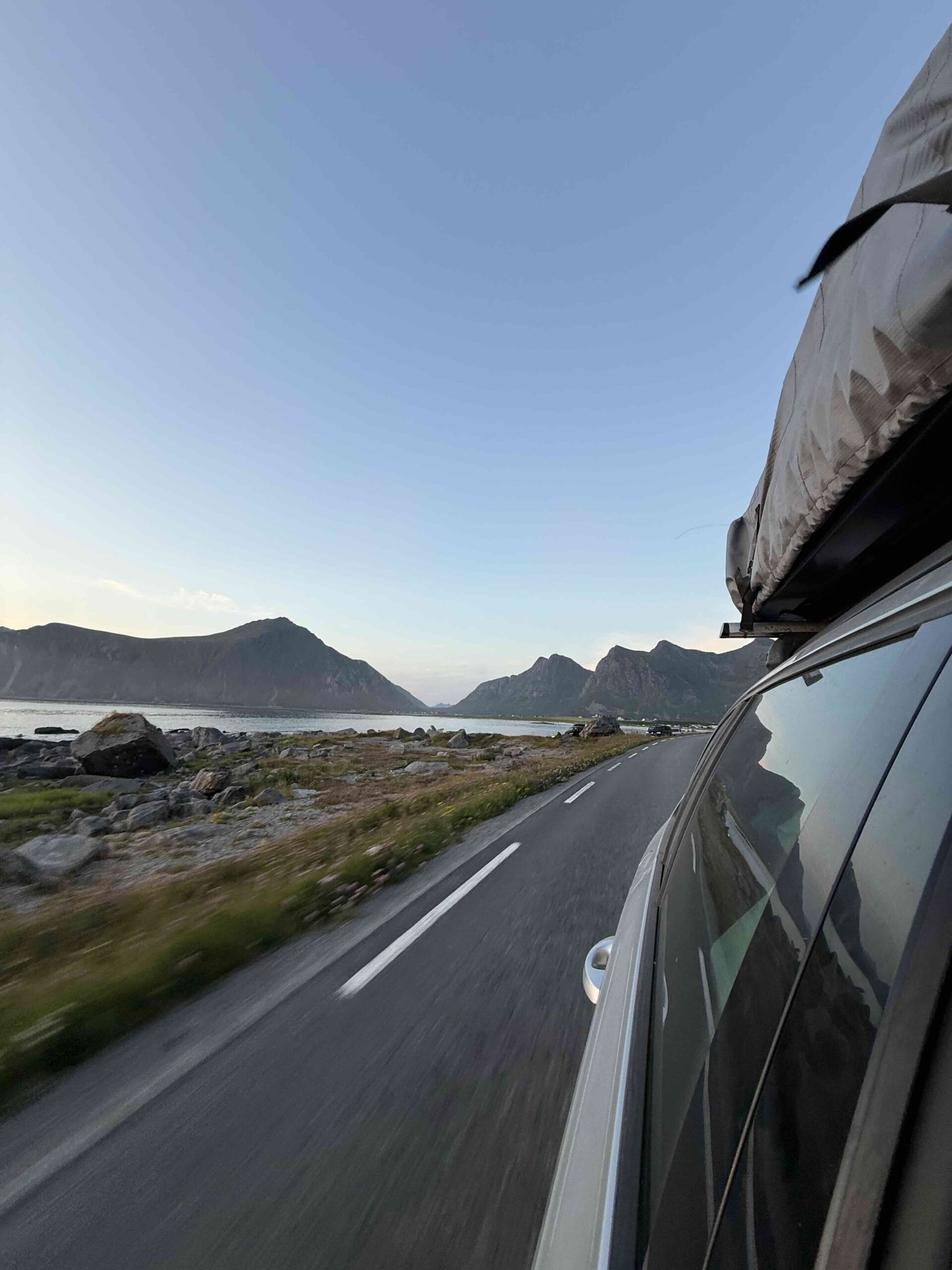
We have driven through 25 countries between us — Finland, Sweden, Iceland, the Faroe Islands, Germany, France, Portugal, Greece — but Norway still surprised us. Not because the roads are difficult (they are, in places), but because there is an unspoken set of rules that Norwegian drivers follow almost instinctively and that no travel blog warned us about.
The target keyword for this post is driving etiquette Norway, and that is exactly what we are going to cover: not laws, not road conditions, but the social contract between drivers that keeps traffic moving on a road network that frequently narrows to a single lane carved into a cliff face above a fjord.
Norwegian driving etiquette centres on three things: using møteplasser (passing places) correctly and without ego, letting faster drivers past without drama, and giving lorries and buses absolute priority on single-track tunnel roads. Master those and you will fit in just fine.
- The møteplass system — Norway’s single-lane lifeline
- Tunnel etiquette — the rules nobody tells you
- A quick-reference cheat sheet for Norwegian roads
- Speed limits and why locals ignore your GPS
- Mountain road and ferry unwritten rules
- Mistakes we made (so you don’t have to)
- Frequently asked questions
- A final word from two Nordics who know better now
The møteplass system — Norway’s single-lane lifeline
A large share of Norway’s road network is single-lane — one carriageway shared in both directions. Møteplasser are the short widened sections cut into the rock or gravel at the road’s edge where one car can pull in to let oncoming traffic pass. They appear every few hundred metres on most routes and they are the entire reason traffic flows at all.
How the right-of-way logic actually works
The written rule is that the vehicle closer to a møteplass should pull into it. In practice, Norwegian drivers operate on a more nuanced system. The car going downhill has better visibility and easier reversing, so it usually yields. The car heading away from a ferry terminal moves first, because it has time and the arriving car does not. Lorries and camper vans always have priority — pulling a møteplass manoeuvre in a 10-tonne vehicle is genuinely hard and locals know it.
- Always slow to a near-stop when you spot an oncoming vehicle. This signals you are reading the situation, not charging through.
- Flash your headlights once if you are giving way. It is the universal signal for “after you” in Norway.
- Do not use the møteplass as a photo stop on a busy road. Pull past it and find a proper layby.
- If you get it wrong — pull into the møteplass anyway, hold up a hand, wave an apology. Norwegian drivers are patient about genuine confusion. They are not patient about arrogance.
We got caught twice on our first Norway road trip by misjudging who should yield. Both times the oncoming driver waited, we sorted ourselves out, and nobody honked. That patience has a limit, but it is a generous one. Don’t abuse it.
Tunnel etiquette — the rules nobody tells you
Norway has more than a thousand road tunnels, including the world’s longest at 24.5 km (the Lærdalstunnel). Some are lit and wide. Many are single-lane with passing places inside — møteplasser carved into the tunnel walls. A few are genuinely dark and narrow enough that your mirrors will brush the rock if you drift.
Single-lane tunnel rules
Inside a single-lane tunnel you follow the same møteplass logic as on an open road, with two important differences. First, you cannot see as far ahead, so speed matters more — locals slow to 50–60 km/h on entry even when the limit is higher. Second, mobile signal disappears, so whatever judgment you make at the entrance is the one you are committed to.
- Check the tunnel entrance sign. Green arrows mean you have right of way; a red cross on the sign means oncoming traffic has priority.
- Turn on your headlights before entering — not just for visibility but because it is legally required in Norway at all times anyway.
- Never overtake in a tunnel unless you can see the full length is clear. Even then, locals generally do not.
- Give lorries the full lane inside tunnels. If a lorry is coming, find the nearest møteplass and wait. This is not optional etiquette — it is self-preservation.
Subsea tunnels
Several of Norway’s fjord crossings use subsea tunnels that dip steeply and then climb out the other side. The descent can hit 8–9% gradient. Trucks slow dramatically on the ascent. Leave triple the following distance you would normally use — braking distances on a 9% slope are not intuitive if you are used to flat Finnish motorways.
A quick-reference cheat sheet for Norwegian roads
- Møteplass logic: downhill car yields; lorry always has priority; one headlight flash = “after you”
- Tunnels: slow on entry, lights on, no overtaking, check the entrance sign for right-of-way arrows
- Ferries: switch off your engine on the car deck — it is mandatory, not a suggestion
- Roundabouts: traffic already in the roundabout always has priority; Norwegians give way without hesitation
- Motorway overtaking: return to the right lane immediately after passing — keeping left is considered rude and illegal
- Pedestrian crossings: yield unconditionally; Norwegian pedestrians step out with full confidence
- Wildlife warnings: moose crossing signs are not decorative — slow down, especially at dawn and dusk in forested areas
- Winter conditions (year-round in mountains): snow tyres are legally required from November 1 to the first Sunday after Easter; many mountain passes stay closed until June
Nordic road trip notes, straight to your inbox
Honest driving guides, quiet routes, and practical tips from two people who live at the top of Europe.
💡 Our campervan tip: prices for the same van vary a lot between rental brands. We compare Norway campervans across 160+ rental companies on CampervanPlanet — and code HUNGRYTRAVELFAMILY5 takes 5% off.
Speed limits and why locals ignore your GPS
Norwegian speed limits are lower than most European visitors expect. The default outside built-up areas is 80 km/h, not 100. In villages and residential zones it drops to 30 or even 20 km/h. Motorways are 110 km/h in some places but 90 km/h in many others. The limits change frequently and the cameras are both fixed and mobile — Norwegians call them fartskamera and they are respected.
The GPS problem
Most rental car GPS units and phone apps (Google Maps included) consistently show outdated speed limits on Norwegian roads. They are often 10–20 km/h too high on mountain routes and rural roads. Locals know this. They read the signs, not the display. Do the same.
- On any road you are not certain of, default to 80 km/h outside towns and 50 km/h inside until you see a sign.
- Fines are proportional to income in Norway. A speeding ticket that costs a tourist €200 at home can be €800 or more in Norway. Budget accordingly or just drive at the limit.
- Do not rely on other traffic as a pacemaker — Norwegians also speed occasionally, but they know the camera locations. You do not.
On the Atlanterhavsvegen (Atlantic Ocean Road) and the Trollstigen, you will want to go slowly anyway — not out of caution but out of sheer joy. Those roads deserve your attention, not your accelerator.
Mountain road and ferry unwritten rules
Norway’s mountain passes and fjord ferry routes each carry their own layer of etiquette that sits on top of the written code. Getting these right is what separates the visitor who blends in from the one who gets pointed at.
Mountain passes
On Trollstigen, Geiranger, and similar switchback routes, the queue discipline going uphill is important. If you stop for a photo on a hairpin bend, you may block a bus that has no alternative line. Passes have designated viewpoint laybys — use them. Norwegian drivers will wait patiently for a photo at a proper layby. They will not wait at all for someone blocking a bend.
- Pull fully into laybys, not halfway.
- Uphill traffic generally has right of way on steep switchbacks because reversing downhill is harder and more dangerous.
- If you see a national tourist route sign (a brown sign with a swooping white road), the road is worth taking slowly. The locals use them too on weekends.
Ferry crossings
Norway’s fjord ferries are part of the public road network — you pay a toll, drive on, and drive off on the other side. The etiquette is short but firm: engine off as soon as you are parked on the car deck; no exceptions even on short crossings. The crew will tell you to if you forget, but once is enough — do not forget twice. You can walk up to the passenger deck. You usually should, because the views are worth it.
- Get in lane early. The queue order is the boarding order and Norwegians queue with Nordic patience — but they expect you to as well.
- Board when directed by the crew, not when there is a gap. The deck crew are directing weight distribution, not running a free-for-all.
- Have your payment method ready. Most ferries now use the AutoPASS system electronically, but some still require payment on board.
Mistakes we made (so you don’t have to)
Three weeks and roughly 3,200 km across Norway taught us things faster than any guidebook. Here are the specific moments where we got it wrong.
- We drove into a møteplass situation without slowing first. We had to reverse 80 metres on a narrow ledge road above Hardangerfjord while a local waited. He waited, but we sweated. Slow down before you need to, not after.
- We trusted the GPS speed limit display on Hardangervidda plateau. The GPS said 90 km/h. The actual sign said 70. We caught it, but only because Alla spotted the sign. Always read the physical signs.
- We left the engine running on a ferry. It took about four seconds for the crew member to knock on the window. Engine off means engine off.
- We stopped in a tunnel to look at the cave-like møteplass cutouts. There is no second time we will do that. The echoes made it impossible to hear oncoming traffic.
- We underestimated driving time on scenic routes. Norwegians drive slowly on their beautiful roads — especially on weekends and in summer. Factor 1.5× the Google Maps time estimate on any route marked as a national tourist route.
- We failed to check if a mountain pass was open. The Sognefjell road (Rv55) closes in winter and some years stays closed until early June. Check vegvesen.no for current road status before planning your route.
Book your Norway campervan
Compare prices across 160+ campervan and motorhome rental brands, get a free 1GB eSIM with every booking — and 5% off with code HUNGRYTRAVELFAMILY5.
Check prices & availability →Frequently asked questions
Is driving in Norway difficult for foreigners?
It is not technically difficult but it is demanding in terms of attention. The møteplass system, single-lane roads, subsea tunnels, and frequent speed limit changes require constant reading of the road. If you are comfortable driving in Scotland or Iceland, Norway will feel familiar. If you only drive on motorways at home, allow a few days to adjust before tackling mountain passes.
Do I need an international driving licence to drive in Norway?
EU and EEA licence holders do not — your standard EU licence is valid. Visitors from most other countries (US, Canada, Australia, UK) can use their national licence for tourist visits. An international driving permit is technically required alongside some licences but is rarely checked. Confirm with your country’s licence authority before travelling.
What does one headlight flash mean from a Norwegian driver?
One brief flash of the high beam means “after you” — the driver is giving way. It is the standard polite signal at a møteplass or a narrow section. Two rapid flashes can mean “there is a speed camera or hazard ahead” — a courtesy locals sometimes extend to oncoming traffic. Neither flash is aggressive in tone.
Can I drive a campervan on Norwegian roads?
Yes, and many people do. However, campervans and motorhomes are the vehicles that cause the most møteplass friction simply because of their size. Take the single-lane sections slowly, use every available passing place, and never assume you can squeeze past where a car could. Norwegians are generally very patient with campervans — return the favour by not rushing.
Are Norwegian toll roads expensive?
It depends on the route and how many you take. Oslo has a congestion ring that adds up quickly. Tunnels and bridges also have tolls. Most are collected electronically via AutoPASS — rental cars usually have a transponder included, but check the daily fee with your rental company because some charge a significant handling fee per day, not per toll. Budgeting €5–15 per day in tolls for active driving around fjord areas is realistic.
What is the most important thing to know about driving in Norway?
Slow down before you think you need to. Norwegian roads reward patience — almost every beautiful view, safe passing opportunity, and stress-free encounter with oncoming traffic comes from having a little more time in hand than you expected to need. The roads are the destination as much as the destination is. Drive them accordingly.
A final word from two Nordics who know better now
We are Finnish. We live on the Arctic Circle. We thought we knew how northern roads worked. Norway had opinions about that.
The driving etiquette there is genuinely its own thing — shaped by the geography, by a road network that has had to be creative about single-lane solutions, and by a culture that values efficiency without aggression. Norwegians drive well, almost universally. They are also quietly judgmental when visitors do not, less in a confrontational way and more in a long-memory way. The campervan driver who blocked the Trollstigen for twenty minutes because they could not read a møteplass becomes a story that gets told for years.
We have been those people. We have improved. You can too — and faster, because you have just read this guide.
If you are planning a Norway road trip and want specific route advice, drop a comment or reach out via our contact page. We have driven most of the popular routes and a few of the genuinely obscure ones. The obscure ones are usually better.