Is Fishing Really Free in Norway? — What Every Visitor Needs to Know
We’ve fished Norway’s fjords, rivers, and harbour walls across several trips. Here’s the honest answer about what costs money, what’s genuinely free, and what the rules actually say — from two people who’ve had to figure it out from scratch.
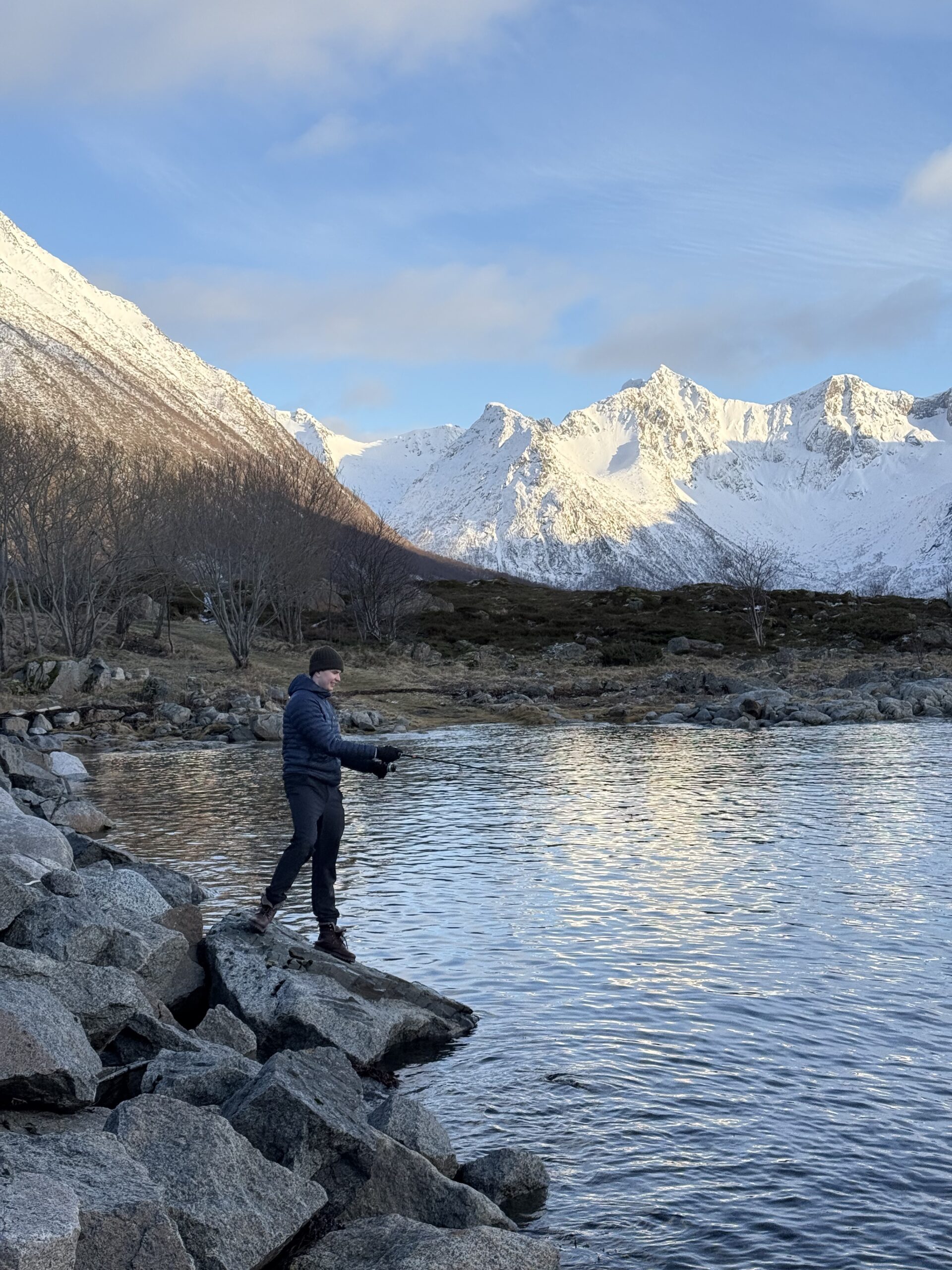
The question “is fishing free in Norway?” sounds simple. The answer is: it depends entirely on where you fish and what you’re fishing for. Get it right and Norway offers some of the best free fishing in the world — cod from harbour walls, saithe off rocky points, mackerel in crystal fjord water. Get it wrong and you’re technically fishing without a required licence in a country that takes its freshwater fishing regulations seriously.
We learned most of this the hard way. On our first Norway road trip we arrived with one rod, a handful of lures, and the vague impression that “fishing is free in Norway.” We were half right. Here’s the full picture — the rules, the costs, and the practical reality of fishing Norway as a visitor who doesn’t want to spend a week reading government PDFs.
Saltwater shore fishing in Norway is completely free for everyone — no licence, no registration, no fee. This covers the sea, fjords, and tidal zones. Freshwater fishing (rivers and lakes) requires a national fishing licence (Fiskeravgift, around EUR 23/year) plus a local fishing card bought from the landowner or fishing club. Salmon fishing costs significantly more. If you stick to the sea and fjords from shore, you pay nothing.
- The free fishing rule — what it actually covers
- When fishing in Norway does cost money
- Quick-reference: free vs paid fishing in Norway
- How to buy the freshwater licence — step by step
- Conservation rules you need to know
- Mistakes we made on our first Norway fishing trip
- Frequently asked questions
- A final word from Rovaniemi
The free fishing rule — what it actually covers
Norway’s saltwater fishing law is remarkably generous. Under the Havressurslova (Marine Resources Act), any person — Norwegian citizen or foreign tourist — may fish in saltwater areas using a rod or hand line at no cost. No registration, no permit, no seasonal restriction. You show up at a fjord, a harbour wall, a coastal rock, or a tidal pier, drop in a line, and fish. Legally.
This applies across the entire Norwegian coastline — from the Oslo Fjord in the south to Svalbard in the Arctic north. The free rule covers:
- The open sea and all connected saltwater areas, including fjords
- Harbour walls, piers, and breakwaters in tidal water
- Rocky shores, beaches, and any point where land meets salt water
- Tidal zones — the stretches of coast that are submerged at high tide
Why Norway allows this
It is not an oversight — it is deliberate policy. Norway has historically treated coastal fishing as a shared right, part of the same tradition that gives everyone the right to walk across private land (allemannsretten, the “everyman’s right”). The sea, like the mountains, is understood as a common resource. For recreational rod fishing from shore in saltwater, the state has simply never introduced a fee, and there is no political appetite to do so.
This also explains why you see Norwegians fishing off harbour walls in city centres — in Tromsø, Bergen, Ålesund, Bodø — as though it is the most ordinary thing in the world. Because for them, it is.
When fishing in Norway does cost money
The free rule has hard edges. Cross them and you need a licence. Here is where the fees begin.
Freshwater fishing — lake and river
Any fishing in a river, lake, or stream (even if that water eventually runs into the sea) is classified as freshwater fishing in Norway and requires two separate things:
- National fishing licence (Fiskeravgift): Purchased annually from the Norwegian government through inatur.no. Currently costs NOK 270 (approximately EUR 23) per year. Valid for all freshwater fishing in Norway.
- Local fishing card (fiskekort): A separate permit sold by the landowner or local fishing association for the specific river or lake you want to fish. These vary widely — from NOK 50 per day for a small mountain lake to several hundred kroner on popular rivers. Many are sold at inatur.no; some are only available locally.
Both are required simultaneously. Having one without the other does not make you legal.
Salmon, sea trout, and Arctic char in rivers
These three species receive special treatment. Even with the national licence and a local card, salmon fishing in Norway’s best rivers can cost thousands of kroner per day. The most sought-after salmon rivers — the Gaula, the Alta, the Laerdal — run fishing auctions and lease systems that are genuinely expensive. Budget for this if salmon is the goal; do not expect it to be affordable on a road-trip budget.
Fixed gear, nets, and commercial-style equipment
The free saltwater rule applies to rods and hand lines only. Nets, fish traps, longlines, or any fixed gear require a separate permit regardless of whether you are fishing salt or freshwater. For a visiting tourist with a travel rod, this is irrelevant — but it is worth knowing the boundary exists.
Quick-reference: free vs paid fishing in Norway
What is free — no licence needed
- Saltwater shore fishing with a rod or hand line — fjords, sea, harbour walls, coastal rocks
- Mackerel fishing from shore anywhere along the Norwegian coast in summer
- Cod, saithe, and pollock from coastal piers in saltwater
- Recreational rod fishing from a boat in saltwater
What costs money — licence required
- Freshwater fishing in any lake, river, or mountain stream — national licence plus local card
- Salmon, sea trout, and Arctic char in any river, including tidal sections
- Freshwater fishing in Svalbard (separate and stricter regulations apply)
- Nets, fish traps, or fixed gear anywhere
The grey zone — tidal river mouths
- River mouths and estuaries are legally classified as freshwater in Norway for licensing purposes, even where the water is brackish or visibly tidal
- If you are fishing where a river meets the sea, the legal question is which side of the tidal limit you are standing on — when in doubt, treat it as freshwater
- Sea trout in particular patrol these zones — but targeting them without a freshwater licence, even from what looks like a beach, is technically illegal
How to buy the freshwater licence — step by step
If you are planning to fish rivers or lakes, here is how the licence system works in practice. We have been through this — it is not complicated once you know where to go.
Step 1: Buy the national fishing licence
Go to inatur.no — Norway’s official outdoor recreation booking portal. The national fishing licence (Fiskeravgift) is listed there. You pay by card online, receive a digital receipt, and that is your national licence. It is valid for the calendar year (January to December), not 12 months from purchase. If you are visiting in December, it is usually not worth buying — the January licence will be available shortly.
Step 2: Find and buy the local fishing card
Also on inatur.no, search for the specific lake, river, or fishing zone you want to fish. Most registered waters are listed there. Some smaller private waters are not on the platform — for those, you need to contact the local landowner or fishing association directly. The municipality tourist office can usually point you in the right direction. Buy the local card, download the receipt, fish legally.
Step 3: Know what is included and excluded
- The national licence covers all freshwater fishing in Norway but does not cover Svalbard
- Local cards are water-specific — a card for one lake does not permit fishing in the next lake two kilometres away
- Salmon waters almost always have limited availability — book well in advance if salmon is the plan
- Children under 16 do not need the national fishing licence in most freshwater situations
Conservation rules you need to know
Fishing may be free in saltwater, but that does not mean anything goes. Norway takes conservation seriously, and there are rules — some of them surprising — that every angler should understand before casting a line.
- Minimum size limits exist for saltwater species. Atlantic halibut must be at least 60 cm to keep. Some cod stocks in certain areas have seasonal restrictions. Check current guidance from the Norwegian Directorate of Fisheries (Fiskeridirektoratet) if you are targeting specific species.
- No transporting live fish between water bodies. This is illegal and can result in serious fines. The reason is biosecurity — Norway’s freshwater fish populations are carefully managed to prevent disease and invasive species spread.
- Catch-and-release is increasingly standard. Many salmon rivers are catch-and-release only, or have strict limits on what you can keep. Check the specific rules for your water before you fish.
- Svalbard has stricter rules throughout. Fishing in Svalbard — salt or fresh — is subject to separate environmental protections. Always check local Svalbard regulations before fishing there.
- Night fishing is generally permitted. There are no blanket restrictions on fishing at night. In summer under the midnight sun, “night” fishing at 1 am is simply fishing in broad daylight — and sometimes the most productive time of day.
- Handle your catch responsibly. Kept fish should be killed humanely and stored properly. Releasing injured fish you have decided you do not want is frowned upon — and in some regulated waters, prohibited.
Mistakes we made on our first Norway fishing trip
- Assuming river mouths were saltwater. On our first Norway trip we fished a tidal estuary on the west coast without a freshwater licence, genuinely thinking we were in the sea. Legally we were in freshwater — and technically in violation. We were lucky no one checked. Learn from this: if a river flows in, assume freshwater rules apply.
- Not checking inatur.no before we left. We wanted to fish a mountain lake along the E10 in Lofoten and planned to buy a card locally. We could not find one on arrival. Some waters genuinely require advance booking through the portal.
- Bringing lures that were too heavy. We arrived with heavy sea jigs suited for 30-metre depths. Norwegian saltwater fish near shore often feed shallow, especially at certain times of day. Lighter lures in the 20–40g range would have worked far better for us in those first sessions.
- Forgetting that mackerel are seasonal. We visited the west coast in April expecting mackerel — they arrive in June at the earliest in most fjords. A basic understanding of the species calendar would have helped us set expectations.
- Not asking locals. The best fishing advice we ever received in Norway came from a stranger on a Tromsø harbour wall who handed us two lures and pointed at a specific rock ledge fifty metres away. Ask at petrol stations, fish stalls, and pier walls — Norwegians are very generous with local knowledge.
- Thinking “free” meant “no rules.” Free fishing does not mean unregulated fishing. Norway’s conservation rules still apply in saltwater — minimum sizes, no live fish transport, responsible handling. The law is generous with access and firm on responsible behaviour.
Frequently asked questions
Is fishing from shore in Norway really free, with no catches?
Yes — for saltwater shore fishing, it is genuinely free and genuinely legal. No licence, no permit, no registration fee. The conditions are that you use a rod or hand line (not nets or fixed gear) and you follow Norway’s conservation rules on minimum sizes and responsible handling. Fishing from a harbour wall or coastal rock into a Norwegian fjord costs nothing at all.
Do I need a licence to fish from a boat in Norwegian saltwater?
No. Recreational boat fishing in saltwater follows the same free-access rule as shore fishing. You do not need a licence to fish from a private or rented boat in Norwegian sea or fjord waters. The free rule covers recreational rod and hand-line fishing whether you are on land or afloat.
Where do I buy the Norwegian freshwater fishing licence?
The national fishing licence (Fiskeravgift) is purchased at inatur.no, Norway’s official outdoor recreation portal. You pay by card online and receive a digital receipt. Local fishing cards for specific rivers and lakes are also available at inatur.no for most registered waters — some smaller private waters require contacting the local landowner directly.
Can tourists fish in Norway without a licence?
In saltwater, yes — the free rule applies to everyone, including all foreign visitors. In freshwater, no — all anglers regardless of nationality need the national fishing licence plus the relevant local card. Norway does not offer tourist-only exemptions for freshwater fishing.
Is fishing in the Norwegian fjords free?
Yes. The fjords are part of Norway’s connected saltwater system and fall entirely within the free-access rule. Fishing from shore, a pier, a boat, or a coastal rock into a Norwegian fjord requires no licence and no fee. This is one reason Norway’s fjords are so popular with travelling anglers — you can stop anywhere along the route and fish legally.
What fish can I realistically catch for free from shore in Norway?
The most accessible species from saltwater shore are saithe (coalfish), cod, pollock, and mackerel (south and west coast, summer). Saithe are reliable, plentiful, and willing to bite almost any lure — they make Norway feel incredibly productive even for beginners. Cod are easiest in Lofoten in winter but catchable year-round at many northern spots. Mackerel arrive reliably on the west coast from June to September.
A final word from Rovaniemi
We have had many travel experiences that cost a fortune for a result that was not quite worth the price. Fishing Norway’s saltwater from shore is the opposite. You park at a fjord village, walk to the end of a harbour wall, drop a line in for free, and see what happens. When the fish are running, you know within ten minutes.
The question “is fishing free in Norway?” turns out to be a gateway into something broader — the understanding that Norway has genuinely preserved a culture of open access to nature. The sea is not fenced. The coast is not ticketed. The right to stand on a rock by the Atlantic and try your luck is simply not up for debate there.
If you are planning a Norway trip and have not considered fishing, consider it. Pack a basic travel rod. Download inatur.no if you plan to fish freshwater. If you only ever fish saltwater from harbour walls — you do not need to do anything at all except show up.
— Joona & Alla, writing from Rovaniemi
Joona & Alla
A Finnish-Ukrainian couple living in Rovaniemi, Finland. Joona is a marketing professional in Lapland tourism; Alla is an AI Engineer. Together we have visited 25 countries and share honest, locally-grounded travel writing from our home in the Arctic.
Read our full story