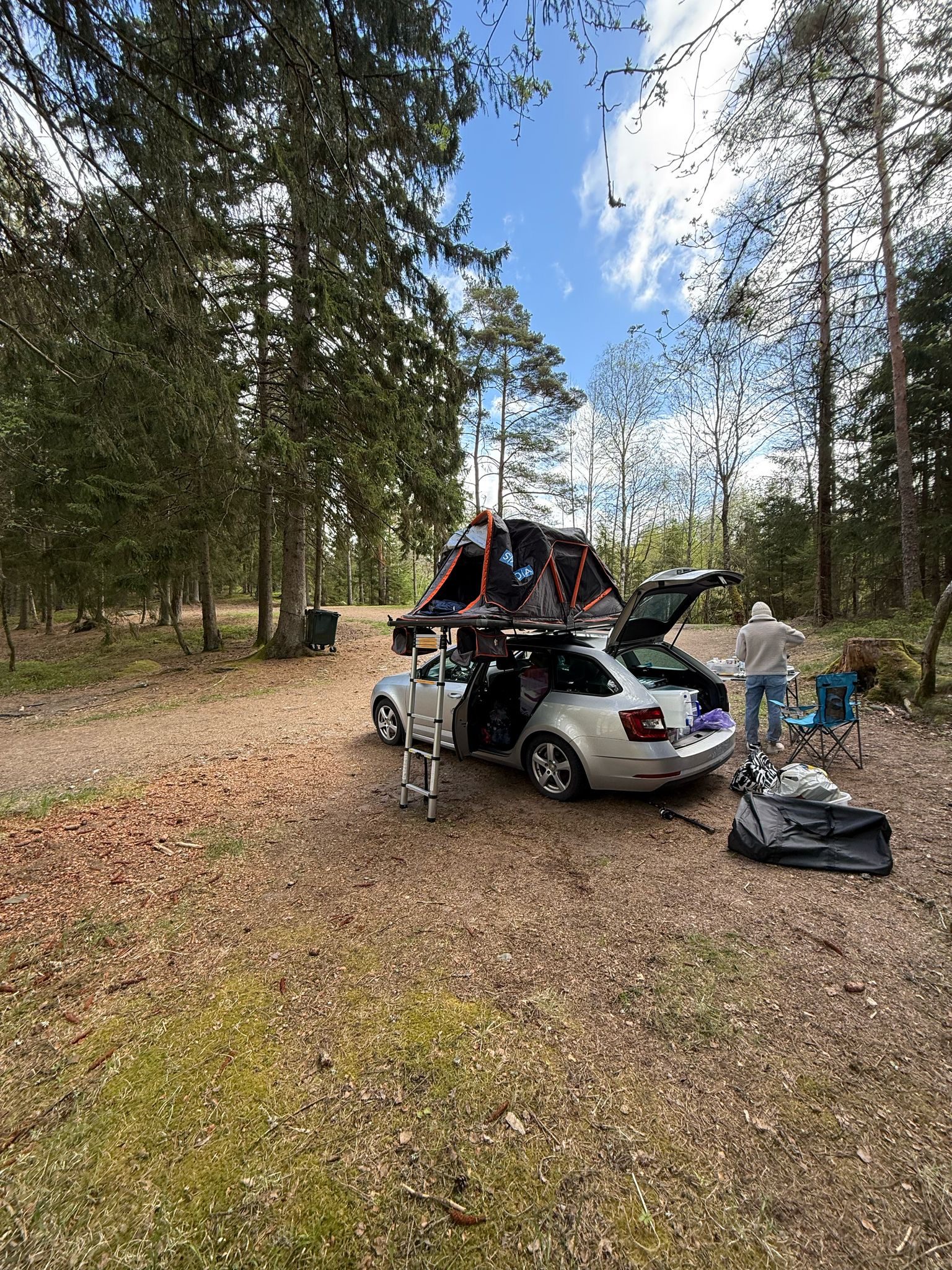
We’ve wild camped across more than a dozen countries — Norway, Finland, Iceland, the Scottish Highlands — but Sweden is the one we keep coming back to for exactly this reason: wild camping in Sweden is legal, simple, and genuinely freeing in a way that few countries can match. The allemansrätten (right of public access) is written into Swedish law and gives everyone — resident or tourist — the right to move through and camp on almost any land in the country.
That said, “almost anywhere” is doing a lot of work in that sentence. There are real rules, a few things that will get you into trouble, and — more importantly — some spots that are far better than others. We’ve put together this guide from our own time in Sweden, combined with what we’ve learned from camping across Scandinavia from our base in Finnish Lapland.
Wild camping in Sweden is legal for everyone under allemansrätten. You can pitch a tent on almost any uncultivated land for 1–2 nights without asking permission, as long as you stay at least 70 metres from the nearest house, leave no trace, and don’t camp in protected nature reserves without checking local rules first. The best regions are Dalarna, Swedish Lapland, Jämtland, and the Bohuslän coast.
What Allemansrätten actually allows
The word allemansrätten translates literally as “every man’s right” — and it’s one of the most genuinely radical ideas in European land law. Unlike in most countries where access to private land is a privilege granted at the landowner’s discretion, in Sweden it is a constitutional right. It covers not just camping but walking, cycling, swimming, berry-picking, and skiing across private land, as long as you behave responsibly.
The legal basis
Allemansrätten is enshrined in the Swedish Environmental Code (Miljöbalken) and referenced in the Swedish Constitution. It predates modern property law and is considered a cornerstone of Swedish outdoor culture — the friluftsliv tradition that Swedes take seriously in a way that surprised us when we first visited.
Practically speaking, it means you can:
- Walk, run, cycle, ski, or ride through forests, fields, and along coastlines — including on private land.
- Pitch a tent on uncultivated land for one or two nights in one spot without asking permission.
- Pick berries, mushrooms, and wildflowers (with exceptions for protected species).
- Light a small campfire where the ground is not under a fire ban, on bare rock or mineral soil.
- Swim or kayak on any body of water, including private lakeshores.
What it does not cover
The flip side is equally important. Allemansrätten is a right that comes with responsibilities — inte störa, inte förstöra (don’t disturb, don’t destroy) is the shorthand Swedes use. It does not give you the right to:
- Camp in the garden, yard, or immediate vicinity of someone’s home.
- Drive a car or motorcycle across private land.
- Leave rubbish or damage the environment.
- Light fires during dry-weather fire bans (check Sweden’s official alert system before every trip).
- Pick protected plants, disturb nesting birds, or trap animals.
The rules you need to know before you pitch your tent
When we first wild camped in Sweden, we made a few unnecessary mistakes — not illegal ones, but things that would have made landowners or other visitors uncomfortable. These are the rules that actually matter in practice.
Distance from houses
There’s no single legally mandated distance, but the widely accepted guideline — and the one the Swedish Environmental Protection Agency (Naturvårdsverket) promotes — is to camp at least 70 metres from the nearest residence. If you can clearly see a house from your tent, you’re too close. This distance is about respecting people’s “private zone” (hemfridszonen), and Swedish landowners are generally very relaxed about camping as long as this is respected.
The one-to-two night rule
You can stay in one spot for one or two nights without permission. If you want to stay longer — say, using a spot as a base camp for several days — you should ask the landowner. In practice, for remote forest or mountain camping in Lapland or Jämtland, there may not be a landowner anywhere near you, and a longer stay causes no issues. In more populated areas closer to Stockholm or the west coast, stick to the two-night limit.
Fire rules
Fire rules are the most variable part. Sweden operates a national fire risk alert system. During dry summer periods — which 2026’s forecasts suggest could be significant across central Sweden — open fires may be banned across entire counties. Always check the county board (länsstyrelsen) website before you go. When fires are allowed, use bare rock or mineral soil, never light on peat, and always have water or sand within arm’s reach.
Protected areas
National parks and some nature reserves have specific rules that override allemansrätten in certain zones. Most Swedish national parks allow camping in designated areas and restrict it in sensitive bird and wildlife zones. Always check the signage at the park entrance, or look up the reserve on the Naturvårdsverket website before your trip.
Quick-reference: what’s allowed and what’s not
After several trips, we made a cheat sheet for ourselves. Here’s the version that fits on a phone screen.
- ✅ Pitch a tent on forest land, open heath, or by a lake — yes, for 1–2 nights
- ✅ Wild swim from any shore — yes, including private lakefronts
- ✅ Pick berries and mushrooms — yes, for personal use
- ✅ Cycle or hike through private farmland — yes, if you don’t damage crops
- ✅ Light a small fire on bare rock — yes, if no fire ban is in force
- ❌ Camp within sight of a house — no, respect the home zone
- ❌ Drive off-road on private land — no, vehicles are not covered
- ❌ Leave rubbish, cut live trees, or dig trenches — no, leave no trace strictly
- ❌ Camp in a fire-ban zone — check daily; bans can appear overnight
- ❌ Enter fenced enclosures with livestock — no, avoid disturbing animals
- ❌ Camp in a national park’s restricted zone — check each park’s specific rules
- ❌ Fly drones over private property — not covered by allemansrätten
- ✅ Kayak and canoe on any river or lake — yes, with no motor
- ✅ Anchor a boat overnight near any shore — yes, offshore anchorage is free
Stories from 21 countries, written in the Arctic
We send one honest travel letter per week — no listicle padding, no sponsored fluff.
Tips for low-impact wild camping — what we actually do
Allemansrätten works because the vast majority of people who use it act responsibly. We take this seriously. Here’s what we do on every wild camping trip in Sweden — and Scandinavia generally.
- Camp on durable surfaces. Bare rock, gravel beaches, and established clearings are far better than meadow grass or sensitive heathland. The more delicate the ground cover, the more damage a tent does — even over one night.
- Use a stove, not a fire, as your default. A gas stove leaves no trace. An open fire, even done right, leaves a scar. Save fires for special evenings with good conditions, not every night.
- Carry out everything you carry in. Sweden’s forests are remarkably clean compared to many countries we’ve camped in. Keep them that way. We bring a small mesh bag for collecting any rubbish we find near our camp, not just our own.
- Bury human waste properly. Dig a cat hole at least 15 cm deep, at least 70 m from any water source or trail. Carry a small trowel — it’s worth the 50 grams.
- Arrive late, leave early in popular areas. If you’re near a popular lake or hiking route in high summer, minimise your footprint by pitching after 7 pm and moving on before 9 am. Less chance of conflict, better experience.
- Check fire risk before every trip. Even if yesterday’s forecast was fine. Conditions can change in 24 hours during Swedish summers.
- Tell someone your route. Sweden’s remote north — Lapland, Jämtland — is genuinely remote. A simple note to a friend with your planned route and return date is cheap insurance.
- Respect wildlife nesting seasons. Mid-April to mid-July is the most sensitive period for ground-nesting birds across Sweden. Keep dogs on leads and avoid wetland areas during this time.
Best regions for wild camping in Sweden
Sweden has roughly 450,000 square kilometres of land, the large majority of which is forest and mountain. You’re genuinely spoilt for choice. But from our trips and the camping we’ve done across the Nordic countries, these are the regions we’d prioritise.
Swedish Lapland — the most remote option
Everything above the Arctic Circle in Sweden — Abisko, Sarek, Padjelanta, the Kungsleden trail — is world-class wild camping territory. The terrain is genuinely wild, the population density is among the lowest in Europe, and the midnight sun in June and July means you have more light than you can reasonably use. We’ve found that Swedish Lapland feels slightly more accessible than Norwegian Finnmark — the trails are better marked, the huts are well-maintained, and the towns are slightly more tourist-ready as bases.
- Abisko National Park: stunning canyon, easy train access from Kiruna, the Kungsleden starts here. Some camping zones are restricted — check the rules at the park office.
- Sarek National Park: no marked trails, no facilities, no mobile signal in most of it. This is for experienced wilderness campers only. One of the most beautiful places we’ve ever stood.
- Kebnekaise valley: Sweden’s highest mountain, a mountain station with services, and wild camping on the approach routes. Good for multi-day expeditions.
Jämtland — Sweden’s outdoor heartland
Jämtland, in west-central Sweden, is where a lot of Swedes go to camp. The Jämtlandsfjällen mountains, Storsjön lake, and the Sylarna massif offer multi-day routes with both wilderness camping and a network of STF (Swedish Tourist Association) mountain huts. We did a section here in late August and it was one of our favourite camping experiences in any country — the light, the relative solitude, and the quality of the terrain were all exceptional.
Dalarna — accessible nature, culture included
Dalarna is more approachable than Lapland and Jämtland, easier to reach from Stockholm by train, and full of classic Swedish scenery — red wooden cottages by birch-fringed lakes, hiking trails through pine forest, and small towns with excellent bakeries for a post-camping morning. Siljan lake and the hills around Sälen are popular but rarely crowded by western European standards.
Bohuslän coast — sea camping
The Bohuslän archipelago on Sweden’s west coast, north of Gothenburg, offers a completely different experience: island hopping, sea kayaking, and camping on granite skerries. The right to anchor and camp extends to the sea, and the archipelago has thousands of small islands, most of them uninhabited. The high summer crowds peak at Smögen and Grebbestad but disperse quickly once you’re out on the water.
Skåne — the south, for softer starts
If you’re new to wild camping or travelling with children, Skåne (Sweden’s southernmost region) is gentler — flatter, warmer, with more marked trails and shorter distances between towns. The Söderåsen and Stenshuvud national parks have designated wild camping zones that are perfect for first-timers.
Mistakes we made on our first Swedish wild camping trip
We’ve learned most of what we know by getting things slightly wrong first. Here’s the honest version.
- We ignored the fire risk rating. We planned a fire on our first night in Dalarna without checking the county board’s alert status. The rating was moderate — not banned, but we were over-confident and set up on slightly peaty ground. No disaster, but sloppy. Check every time.
- We camped too close to a trail junction. Woke up to hikers walking past the tent at 6 am. Not illegal, not dangerous, but not restful either. Scout your spot in the afternoon, not when you’re exhausted and it’s getting dark.
- We underestimated Swedish mosquitoes in July. Swedish Lapland in early July is extremely good camping and extremely good mosquito territory. We had head nets but didn’t bring chemical repellent. Get both.
- We brought too much food and too little water treatment. Sweden’s streams and lakes are generally very clean, but still filter or treat before drinking. We ran out of iodine tablets mid-route in Jämtland and spent a nervous day rationing. A Sawyer Squeeze filter now comes on every trip.
- We pitched on a slight depression. It didn’t look like it would collect water. It did. Check your ground when the sun is still up, not by headtorch in the rain.
- We forgot to account for light pollution from nearby farms. In mid-summer at 64°N, it barely gets dark anyway — but in Dalarna in late August, we set up what we thought was a dark camp only to have farmstead lights shining through the tent until midnight. Scout for artificial light sources before committing to a spot.
Frequently asked questions
Is wild camping in Sweden legal for tourists, not just Swedes?
Yes. Allemansrätten applies to everyone, regardless of nationality. You don’t need to be a Swedish resident or citizen. The same rules apply whether you’re from Finland, the UK, the US, or anywhere else.
Do I need to ask permission from the landowner?
Not for a one-to-two night stay on uncultivated land away from houses. This is the whole point of allemansrätten. For longer stays, or if you’re setting up a larger group camp, it’s courteous — and legally advisable — to make contact if there’s a clearly identifiable landowner nearby.
Can I wild camp in Swedish national parks?
In most Swedish national parks, camping is allowed in designated areas and restricted in sensitive zones. Each park has its own rules — check the Naturvårdsverket website or the park’s own signage before you pitch. Sarek is entirely open wilderness; Abisko has more restrictions near the canyon.
Can I light a campfire while wild camping in Sweden?
Yes, when no fire ban is in force. Sweden operates a national fire risk alert system, and bans can be issued county by county, sometimes at short notice during dry summer periods. Always check the county board (länsstyrelsen) website the day of your trip, not the day before.
Is wild camping in Sweden safe as a solo traveller?
Generally yes — Sweden is one of the safest outdoor environments in Europe. The main risks are practical ones: getting lost in remote terrain, weather changes (especially in Lapland), and wildlife (elk and reindeer are common; bears exist in the north but are very rarely a problem for campers). Tell someone your route, carry a map, and have a weather backup plan.
What’s the best time of year for wild camping in Sweden?
Late June to early September is the classic season. The midnight sun peaks around Midsommar (June 19–21) and makes northern Sweden extraordinary. August is slightly less crowded than July and the mosquitoes ease off. September brings autumn colours and cool, crisp camping conditions — our personal favourite for southern and central Sweden.
A final word from Rovaniemi
We live in Finnish Lapland, which has its own version of public access rights — the jokamiehenoikeus. So we came to Sweden already comfortable with the idea of camping freely. What surprised us was how cultural the Swedish relationship with allemansrätten is. It’s not just a legal permission; it’s something Swedes grow up with, talk about, and genuinely use. The forests and mountains are shared — not because the government says so, but because the people have decided they are.
If you’ve never wild camped before and you’re looking for a country where the rules are clear, the landscapes are spectacular, and you’ll rarely feel like you’re doing something wrong, Sweden is the best starting point in Europe. Pick a region, check the fire risk on the day, stay 70 metres from the nearest house, and leave the place exactly as you found it.
That’s it. The rest is just choosing where to go first.
Joona & Alla
A Finnish-Ukrainian couple living in Rovaniemi, Finland. Joona is a marketing professional in Lapland tourism; Alla is an AI Engineer. Together we’ve visited 21 countries and share honest, locally-grounded travel writing from our home in the Arctic.
Read our full story →