A Local Guide to Riisitunturi National Park
We live 90 km away and have hiked Riisitunturi in every season. Here is everything a first-time visitor — and a returning one — needs to know about one of Lapland’s least-crowded national parks.
J&A Joona & AllaRovaniemi, Finland · May 7, 2026 · 11 min read · Updated seasonally
Riisitunturi National Park does not appear in many “best of Lapland” listicles. That is precisely why we keep going back. Located near the small municipality of Posio, roughly 90 kilometres southeast of Rovaniemi, it protects one of the most intact old-growth spruce forest landscapes in all of Finland — a place where the trees wear ice-cloaked “tykky” snow sculptures in winter and the fell plateau opens up to a 360-degree Arctic horizon in summer. We have hiked here in August sun, February deep freeze, and the strange amber light of October. Every single time it has delivered.
This guide is a local perspective, not a travel-agency brochure. We cover the trails, the seasons, the practical logistics, and a few things the Finnish parks authority website quietly forgets to mention.
Short answerRiisitunturi is a compact, well-maintained national park in Posio, northern Finland, best known for its ancient old-growth spruce forests, spectacular tykky snow formations in winter, and open fell ridges with panoramic views in summer. The most popular trail — the Aarrevaara loop — is roughly 15 km and can be done in one long day. Visit in January–March for winter scenery or June–August for hiking and midnight sun. Facilities are modest: two free wilderness huts, basic parking, no visitor centre on site.
In this guide- What makes Riisitunturi special
- When to visit: season by season
- Trails and routes
- Practical information: getting there and gear
- The wilderness huts
- Wildlife and nature highlights
- Mistakes we made
- FAQ
What makes Riisitunturi different from other Lapland national parks
Finland has 41 national parks. Riisitunturi — established in 1982, covering 77 square kilometres — is one of the smaller ones. But size is not the point here. What the park protects is atmosphere: an unusually intact example of the boreal old-growth forest that once covered much of northern Finland before modern logging.
The old-growth spruce landscape
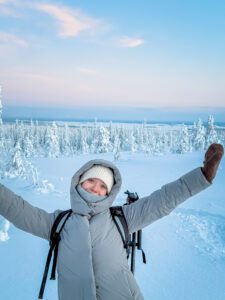
The spruces of Riisitunturi are slow-growing and ancient. Many of the trees you walk past are 200–300 years old. In winter, the heavily laden branches catch and hold snow in extraordinary shapes — the Finnish word tykky describes this phenomenon, and Riisitunturi is widely considered one of the best places in Finland to experience it. The trees transform into white sculptures that can stand two or three metres tall, and the silence in among them is total.
The open fell plateau
Above the treeline, the terrain opens into a classic Finnish fell — rocky, lichen-covered, with uninterrupted views. On a clear day from the highest point (486 metres above sea level), you can see the fells of Russia to the east. The contrast between the intimate enclosed forest below and the vast open horizon above is what makes a day at Riisitunturi feel genuinely complete. Most visitors experience both in a single loop.
When to visit Riisitunturi: a season-by-season guide
We have been to Riisitunturi in four different seasons and the experience changes dramatically. Here is our honest take on each.
Winter (January–March) — the tykky season
- Best for: the famous snow-laden spruce sculptures, snowshoeing, cross-country skiing, complete silence
- Conditions: temperatures between −10 °C and −30 °C, full polar night in January, increasing daylight through February and March
- Trails: most summer trails can be done on snowshoes or skis; the park maintains marked ski tracks
- Daylight: short in January (4–5 hours), improving fast in February and March — plan a late-morning start
- Gear essential: snowshoes or XC ski gear, multiple warm layers, thermos, waterproof gaiters
- Our verdict: the single most visually spectacular time. Cold requires real preparation, but the payoff is extraordinary
Spring (April–May) — the melt
- Best for: fewer people, soft light, early bird activity, dramatic snow-melt streams
- Conditions: unpredictable — can be cold crust snow one week and muddy the next
- Trails: wet and difficult underfoot in May; April can still feel wintery on the fell
- Our verdict: beautiful but physically demanding. Not our first recommendation for a first visit
Summer (June–August) — midnight sun and wildflowers
- Best for: day hiking, berry picking (late July and August), midnight sun on the fell, photography
- Conditions: warm (15–22 °C), very long days, mosquitoes in June and July near boggy sections
- Trails: all marked trails fully open and mostly dry
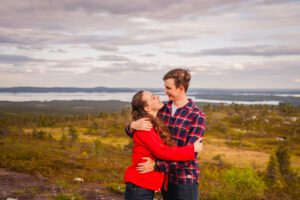
- Our verdict: the most accessible and comfortable season; the fell in midnight sun is something we come back for repeatedly
Autumn (September–October) — ruska
- Best for: the spectacular Finnish autumn colour change (ruska), low crowds, crisp air, lingonberry and mushroom picking
- Conditions: cooling fast, first frosts by late September, dramatic reds and oranges across the fell
- Our verdict: September is probably the best all-round time to visit for photographers. Colour, emptiness, and comfortable temperatures combine perfectly
Trails and routes in Riisitunturi
The trail network in Riisitunturi is deliberately modest — the park is not designed for high-volume throughput. Here are the key options, ordered from most to least popular.
Aarrevaara loop (15 km, full day)
The main trail and the one most visitors do. It starts from the Riisinvuoma parking area, climbs through old-growth spruce forest to the open fell plateau, crosses the highest ridgeline, and returns through more forest. Total ascent is gentle by mountain standards — Riisitunturi is a fell, not a mountain — but the full loop takes 4–6 hours depending on pace and conditions. We always stop on the fell for at least 30 minutes. The view earns it.
Shorter fell summit walk (6–8 km, half day)
If you take the same trail but turn back from the fell summit rather than completing the full loop, you get a satisfying half-day outing. Good for families or anyone who wants the panoramic views without committing to a full day in winter conditions.
Ski and snowshoe trails (winter only)
- The park maintains approximately 20 km of marked ski tracks in winter
- Snowshoe routes shadow the summer trails and are marked with orange ribbons
- Equipment rental is available in Posio village (about 20 km from the trailhead)
- The Aarrevaara loop in snowshoes takes most people 5–7 hours in good winter conditions
- In deep cold, ski touring is faster and warmer than snowshoeing
- Ski track grooming frequency is weather-dependent — check the Metsähallitus Luontoon.fi website the morning of your visit
Getting to Riisitunturi and what to bring
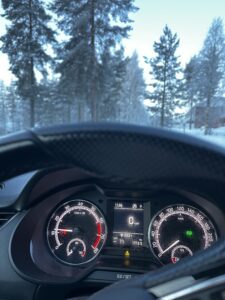
There is no bus service to Riisitunturi. A car is essentially required, and this is part of why the park stays quiet.
Getting there from Rovaniemi
- Distance: approximately 90 km, via Route 82 and then local roads through Posio — allow 1h 15min to 1h 30min
- Parking: free at the Riisinvuoma trailhead; a smaller pullout near the Oivanginjärvi hut also exists
- Winter driving: Route 82 is maintained but the smaller access roads near the park can be unploughed — check road conditions via the Finnish Traffic Agency app (Fintraffic)
- From Kuusamo: about 60 km, roughly 1 hour — Kuusamo airport makes this a convenient base for international visitors
What to bring — summer
- Sturdy waterproof hiking boots (boggy sections even in dry summers)
- Insect repellent — June and July mosquitoes are not trivial
- Layers — fell temperatures drop fast even in July
- Trekking poles help on the steeper fell sections
- Lunch and extra water — no services on the trail
- A fully charged phone with offline maps downloaded (maps.me or AllTrails work)
What to bring — winter
- Wool base layer, down or synthetic mid layer, wind-blocking shell
- Insulated waterproof boots rated to at least −25 °C
- Hand warmers, a thermos with hot drink, high-calorie snacks
- Snowshoes or XC skis — the terrain is not passable in standard boots after heavy snowfall
- Headtorch — daylight is short in January and February
- Tell someone your plan before you go
The northern view, once a month
We share honest travel notes from Finnish Lapland — what we’re hiking, what’s changing, and the places we’d only tell a friend.
The wilderness huts — what to expect
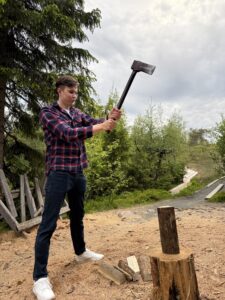
Riisitunturi has two free-to-use wilderness huts maintained by Metsähallitus (Finland’s parks authority). These are lean-tos and open huts, not staffed cottages.
- Oivanginjärvi hut: near the lake on the park’s southern edge, accessible in summer by a short trail from the road; basic shelter, fireplace, outdoor pit toilet. Sleeps 6–8 on wooden bunks. A popular overnight starting point for longer winter ski tours.
- Fell summit shelter: a small wind shelter near the top of the Aarrevaara fell; no bunks, no fire, just a windbreak — but the views from it are exceptional. Useful for a hot drink stop in any season.
- Firewood: available at Oivanginjärvi (chopped, covered pile); bring your own fire-starting kit — lighters can fail at −20 °C
- Water: stream water at Oivanginjärvi is drinkable after boiling; carry your own for day trips
- No booking required — Finnish wilderness huts are first-come, first-served; in shoulder seasons you will almost certainly have them to yourself
- Overnight rules: maximum two nights per hut under Everyman’s Rights; pack out all rubbish
Wildlife and nature to watch for
Riisitunturi is not a wildlife spectacle in the way that, say, a safari is. The animals are here, but the forest is dense and the fell wide. You watch for signs, not guaranteed sightings.
- Reindeer: semi-domestic reindeer roam freely through the park and are the most reliably visible large animal — especially on the open fell in autumn. Give them space; they are owned by local herders.
- Siberian jay (Perisoreus infaustus): the classic old-growth spruce bird of Finnish Lapland. Curious, bold, will land near you. Their presence is a sign the forest is truly intact.
- Brown bear: present in the area but almost never seen; fresh tracks in spring mud are common near the huts
- Pine marten and stoat: visible as dark flashes through deep winter snow, often following the hut periphery
- Cloudberries and lingonberries: on the open mire sections from late July; under Finnish Everyman’s Rights, picking for personal consumption is permitted
- Lichen: the reindeer lichen carpeting the fell is some of the finest in Finland — it grows less than a millimetre per year and is ecologically crucial; stay on the marked trail to avoid crushing it
Mistakes we made at Riisitunturi
- Underestimating winter road conditions. On our first winter visit we drove to the trailhead in a standard two-wheel-drive rental car after overnight snowfall. We made it, barely. Use a 4WD or SUV in winter, or call ahead to check whether the access track has been ploughed.
- Starting the loop too late in January. With only five hours of usable daylight, a 10 am start for a 15 km loop means finishing the fell section in dim blue light. Start by 9 am at the latest in deep winter, or do the shorter out-and-back instead.
- Ignoring mosquitoes in June. The fell is breezy and largely mosquito-free, but the forest sections are not. We did a June visit in just a T-shirt and paid for it. Long sleeves plus repellent on skin and clothing.
- Expecting marked signs every 100 metres. Finnish trail marking is confident but sparse. The trail is clear if you pay attention, but the markers assume you have a map. Download an offline version of the Luontoon.fi trail map before you leave phone coverage.
- Skipping the hut stop. On our first visit we were moving fast and walked past Oivanginjärvi hut without stopping. In hindsight — the hut fireplace, 20 minutes of warmth, and the lake view were exactly the kind of unhurried moment Riisitunturi is actually for.
- Not checking the Metsähallitus webcam. There is a weather webcam near the fell summit, updated regularly on the Luontoon.fi site. On a two-hour drive from Rovaniemi, checking this the morning of saves a wasted trip when cloud is sitting on the fell.
Frequently asked questions about Riisitunturi
How do I get to Riisitunturi National Park without a car?
You essentially cannot, at least not reliably. There is no public bus to the trailhead. The closest town with any services is Posio, roughly 20 km away, and taxis from there are expensive. The most practical option is to rent a car in Rovaniemi or Kuusamo. Some wilderness tour operators in Rovaniemi run day trips to Riisitunturi in winter — search for “Riisitunturi snowshoe tour” for current offerings.
Is Riisitunturi suitable for children?
Yes, with some planning. The shorter out-and-back route to the fell summit (6–8 km) is very doable for children aged 7–8 and up in summer. In winter the snowshoe loop is harder — the fell section can be exhausting in deep snow. A kicksled or pulk for smaller children makes winter visits much more enjoyable. The terrain is not technical; the main challenges are distance and cold.
What is tykky, and when is the best time to see it at Riisitunturi?
Tykky is the Finnish word for snow and ice that accumulates on tree branches — particularly the heavy crowns of spruce trees — building up into dramatic sculptural forms. At Riisitunturi, the old-growth spruce create some of the most striking tykky formations in Finland. The best window is roughly late January through mid-March, after a good snowfall period and before the spring melt starts. Early morning light makes for the best photography.
Can you camp in Riisitunturi National Park?
Overnight camping is permitted under Finnish Everyman’s Rights, though you must use a tent (no fires except in designated spots) or stay in the free wilderness huts. There are no designated campsite pitches — you can pitch a tent anywhere on the fell or forest for up to two nights. Leave no trace rules apply strictly. In winter, camping in a tent at −20 °C requires serious cold-weather gear; the Oivanginjärvi hut is a much safer option for beginners.
How does Riisitunturi compare to Oulanka National Park, which is nearby?
Oulanka, about 60 km northeast, is significantly larger (270 km²), more developed, and busier — especially on the famous Bear’s Ring trail. Riisitunturi is smaller, quieter, less scenic in terms of river gorges and waterfalls, but more rewarding for old-growth forest atmosphere and winter tykky. We suggest Oulanka for a first Lapland national park visit; Riisitunturi for when you want to go somewhere few other tourists will be.
Is there a fee to enter Riisitunturi National Park?
No. Like all Finnish national parks, entry to Riisitunturi is completely free. Parking at the Riisinvuoma trailhead is also free. The wilderness huts are free to use. There is no visitor centre and no ticket booth. Metsähallitus funds the park through the national budget. The only costs you will have are getting there and bringing your own food and gear.
A final word — why a quiet national park matters
We live in Rovaniemi, a city that gets 600,000 tourists a year concentrated into five winter months. We are grateful for what that tourism does for the region. But one of the things we notice most, living here, is how quickly people exhaust the obvious — the reindeer farm, the Santa Village, the husky ride — and wish they had found something a little more real.
Riisitunturi is 90 minutes from our front door and feels like another era. The forest is genuinely old. The fell is genuinely empty. In winter, the silence among the tykky spruces is a kind of silence most people in cities never experience. We have brought visiting friends there, clients planning trips, and our own parents. Nobody has left disappointed.
It is not the most dramatic landscape in Lapland. But it might be the most Finnish one. And that, for us, is the point.
J&A Written byJoona & Alla
A Finnish-Ukrainian couple living in Rovaniemi, Finland. Joona is a marketing professional in Lapland tourism; Alla is an AI engineer and content creator. Together we’ve visited 25 countries and share honest, locally-grounded travel writing from our home in the Arctic.
Read our full story →