Ice Fishing in Finnish Lapland: A First-Timer’s Honest Guide
Joona grew up drilling holes in frozen lakes before he could drive. Here’s everything we wish someone had told us before our first ice fishing trip in Finnish Lapland — gear, etiquette, and what it actually feels like at −25°C.
We’ve planned more than a hundred trips from our home in Finnish Lapland — some for clients, some for weekend road trips across Norway, and more recently a lot of them chasing the aurora across Finnish Lapland. After years of winter chasing a year, we want to share what actually works, what breaks, and the exact prompts we use.
This is not a “10 ways AI will change travel” think-piece. It’s the workflow we use ourselves.
Ice fishing in Finnish Lapland is genuinely accessible for first-timers — you don’t need experience or expensive gear. The season runs roughly December through March, with February and early March giving you the best ice thickness and longest daylight. A guided half-day trip costs €60–120 per person, or you can go fully independent if you’re with someone who knows the ice.
- What ice fishing in Finnish Lapland actually looks like
- Best time to go: season, daylight & ice conditions
- Guided vs independent: which is right for you
- What you’ll catch — and what happens to the fish
- What to wear and bring (from someone who’s done it at −25°C)
- Our honest tips and the mistakes we made
- Frequently asked questions
What ice fishing in Finnish Lapland actually looks like
Most people picture a frozen, barren lake, a small hole, and a lot of waiting. That’s partly right — but the reality is more alive than that. Ice fishing in Lapland happens in landscapes that genuinely take your breath away. Picture a lake the size of a small town, the ice thick enough to drive a snowmobile across, and an almost complete silence broken only by the drill punching down through 50 centimetres of ice.
Joona grew up doing this. His family had a cabin on a lake outside Rovaniemi and from the time he was about seven, winter meant drilling holes and dropping a line. It was never really about the fish — it was about being outside, the cold air in your lungs, and the slow pleasure of waiting for something to happen.
The basic setup is simple: you drill a hole (or several), lower a short jigging rod or a tip-up rig, and wait. Most people bring a thermos of coffee and something to eat. Some bring a portable shelter called a pilkki tent. Others just stand or crouch over the hole, which is fine if you’re properly dressed.
What surprises first-timers most is how social it is. Finnish ice fishing culture is not a solitary, silent affair — at least not always. Out on the lakes near Rovaniemi in February, you’ll often see clusters of locals spaced across the ice, the kind of community you don’t expect to find on a frozen lake in the middle of nowhere. Don’t be shy about approaching — in our experience, locals are happy to chat and often happy to share tips about what’s biting and where.
You don’t need to be physically strong or especially outdoorsy. We’ve seen people in their seventies out there with electric drills, folding chairs, and a sense of complete calm. It’s genuinely one of the most relaxed outdoor activities Lapland offers — and one of the most Finnish.
Best time to go: season, daylight & ice conditions
The ice fishing season in Finnish Lapland typically runs from mid-December through late March or early April, depending on how warm the spring turns. You need at least 10–15 centimetres of solid, clear ice to stand on safely — and in a proper Lapland winter, you’ll often have 50–80 cm by January.
December is the start of the season and conditions can be patchy. The ice is often good in northern Lapland but more variable around Rovaniemi. Daylight is extremely short — just a couple of hours around midday. Not ideal if you want to see anything.
January is cold (often −20 to −30°C), dark, and the ice is thick and reliable. If you’re comfortable in serious cold and want the most atmospheric experience — think blue-dark skies, northern lights overhead while you fish — January is magical. But it’s not ideal for first-timers purely because of the cold and the limited daylight.
February and early March are our honest recommendation for first-timers. The ice is at its thickest and most reliable. Days are getting longer — by late February you have 8+ hours of daylight. Temperatures are still cold (−10 to −20°C is typical) but manageable if you’re dressed correctly. Fish are active. This is also prime time for perch, which are the most common catch and great on a fire.
Late March and April brings longer days, softer light, and snow that’s starting to melt. The fishing can be excellent but you need to be more careful about ice quality, especially near shores and river inflows. Always check with locals or your guide about conditions before going out independently at this time of year.
One thing people overlook: the time of day matters less for ice fishing than it does for other activities. Fish bite throughout the day, though early morning and the hour before sunset tend to be most productive in our experience.

Guided vs independent: which is right for you
This is genuinely a question worth thinking about before you book anything. Both options have real merit, and the right answer depends on your experience, your comfort with cold, and how much you care about catching fish versus just having the experience.
Go guided if:
- This is your first time on lake ice and you’ve never assessed ice safety yourself
- You want equipment provided (rod, bait, drill, shelter, warm drinks) without packing anything
- You want to be taken to the best fishing spots without local knowledge
- You’re travelling with children and want someone responsible for safety
- You want the full package — often including grilling your catch over an open fire
Guided half-day trips around Rovaniemi typically run €60–120 per person, depending on group size and whether meals are included. Most last 3–4 hours. The guides are almost always local Finns who genuinely love fishing — the tours tend to be relaxed and personal, not factory-style.
Go independent if:
- You’re with a local or someone who knows how to read ice
- You’ve got (or can rent) your own gear — drills, rods, and bait are available at fishing shops and some outdoor retailers in Rovaniemi
- You’re confident in the conditions and have checked ice reports
- You want the freedom to stay as long as you like and try different spots
If you go independently, the most important rule is never go alone on ice for the first time. Ice can be unpredictable, especially near river channels, springs, or areas with varying depth. Joona grew up here and he still won’t go on unfamiliar ice without checking thickness in multiple spots. Use an ice chisel or drill to check — anything under 10 cm should be avoided.
There’s no licence required for ice fishing in Finland for basic jig fishing — this is one of the genuine gifts of the Finnish jokamiehenoikeus (everyman’s rights). You can fish most lakes freely, though there are restrictions on certain methods and quantities. Your guide will handle all of this; if going independently, a quick check of Finnish fishing regulations is worth five minutes of your time.
What you’ll catch — and what happens to the fish
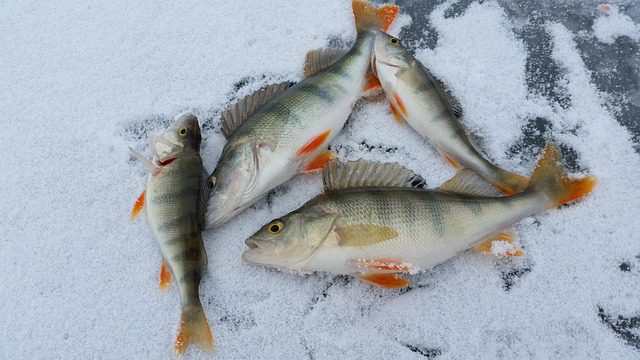
The most common catch in Lapland lakes is perch (ahven in Finnish). They’re plentiful, they bite reliably even in deep winter, and they taste genuinely excellent when pan-fried or grilled over an open fire on the ice. If you’re on a guided trip, this is almost certainly what you’ll be fishing for, and what you’ll eat afterwards.
You might also encounter pike (hauki), which are bigger and require slightly different gear. Pike are more commonly targeted with tip-up rigs using small live or dead bait fish rather than jigging lures. They’re a fantastic catch if you land one — a trophy moment — though they’re less reliable and less beginner-friendly than perch.
Vendace (muikku) are small whitefish that travel in dense schools and are fished with tiny hooks and multiple rigs. They require a bit more finesse but when you find a school the action can be constant. Vendace are delicious smoked or fried whole and are a true Finnish delicacy.
On the question of what happens to the fish: in Finland, catch-and-release is less culturally embedded than it is in some countries. The tradition is more often to keep what you’ll eat and release the rest. On most guided trips, if you catch perch you’ll cook them on the ice — gutted, salted, and grilled over a fire — which is one of the genuinely great experiences of a Lapland winter.
There are size limits and seasonal restrictions on certain species (pike in particular during spawning season), but your guide will handle all of this. If you’re fishing independently, the Finnish fishing regulations are available online and worth a quick read — they’re straightforward and sensibly designed.
One honest note: not every trip produces fish. Ice fishing is not guaranteed. We’ve had sessions where we caught nothing and sessions where we couldn’t stop the perch from biting. The variable nature of it is part of the appeal. Come for the experience and treat the fish as a bonus.
What to wear and bring (from someone who’s done it at −25°C)
This is where most first-timers get it wrong — not catastrophically, but enough to make the experience miserable instead of memorable. Standing still on ice in −20°C is a completely different challenge from moving around in the same temperature. You will get cold faster than you expect, particularly in your feet and hands.
The layering system that actually works:
- Base layer: Merino wool or technical synthetic — NOT cotton. Cotton holds moisture and will make you feel cold very quickly. A long-sleeve top and leggings as your first layer.
- Mid layer: A thick fleece or wool sweater. This is your insulation. Don’t skip it to save packing space.
- Outer layer: A windproof and waterproof jacket and salopettes (ski pants or insulated overtrousers). You may kneel or sit on the ice — your outer layer needs to keep moisture out.
Footwear — the most important thing:
Your feet are in contact with the ice. Regular hiking boots are not enough. You need insulated winter boots rated to at least −30°C, or proper Finnish talvikengät (winter boots). Wool socks underneath. If your feet are cold, no amount of good spirits will save the experience.
Hands and head:
Thin liner gloves under thicker mittens — you can take the mittens off to handle the rod or bait and still have something on your hands. A proper winter hat that covers your ears. A balaclava or neck gaiter for windier days.
What to bring:
- Thermos with hot coffee, tea, or hot chocolate — non-negotiable
- Snacks: energy, warmth, something to do while waiting
- A small ice scoop to clear slush from the hole
- Hand warmers as backup
- On guided trips, most of this is provided — confirm in advance what’s included
Rental gear is available through most guides and some outdoor shops in Rovaniemi. If you’re only going once, renting makes more sense than buying. If you fall in love with it — and some people do — investing in your own gear starts to make sense.
Our honest tips and the mistakes we made
Between Joona’s childhood memories and our more recent trips with friends visiting from abroad, we’ve made most of the mistakes available. Here’s what we’d tell you now.
Don’t underestimate how cold you’ll get standing still. We said this in the gear section and we’ll say it again. Even locals misjudge this. The first time Alla came ice fishing she wore her regular winter jacket — fine for walking around Rovaniemi, completely inadequate for two hours stationary on a frozen lake. If you’re renting from a guide, take their advice on layering seriously.
Drill more than one hole. Fish are not evenly distributed under the ice. If nothing is biting in one spot after 15–20 minutes, move. Experienced ice fishers will drill 5–10 holes across a stretch of lake and work through them. This is not impatience — it’s strategy.
Keep your line moving. Finnish jigging (pilkkiminen) is an active technique. You lift and drop the lure with a short, rhythmic motion. Fish are attracted to movement, especially in winter when they’re slower. Sitting with a completely stationary line produces fewer results than gentle, consistent jigging.
Don’t ignore the locals. If you see a cluster of Finnish anglers having success in one area and you’re getting nothing where you are, it’s perfectly acceptable to move closer. Give reasonable space, but there’s no need to isolate yourself at the far end of the lake when everyone else has found the fish.
Watch the ice colour near shores. Grey or white ice is often less dense and weaker than blue-green clear ice. Near shores, in areas with current, or where there are springs, ice can be significantly thinner than in the open lake. First-timers should always go with someone who can read this — it’s not difficult to learn but it matters.
Don’t expect to catch something every time. We’ve had sessions with thirty perch and sessions with nothing at all. If you go in expecting a guaranteed catch you’ll be disappointed. Go for the experience, the cold air, the fire, and the coffee. The fish are a bonus.
Frequently asked questions
Do I need a fishing licence for ice fishing in Finland?
For basic jigging and hook fishing, no licence is required under Finnish everyman’s rights (jokamiehenoikeus). This applies to most lakes and covers the simple rod-and-lure fishing most people do on ice. You do need a national fishing management fee (about €9 for a week) if you’re using certain methods or fishing in certain managed waters — your guide will handle this automatically. For independent trips, check the official Finnish fishing regulations (kalastusrajoitukset.fi) to confirm.
Is ice fishing safe for beginners and children?
Yes, on a guided trip. The guide checks ice thickness, knows the lake, and carries safety equipment including ice picks and a throw rope. For independent trips with children, always go with an experienced local who can read ice conditions. Never take children on unfamiliar ice without checking thickness first — a general rule is at least 15 cm of solid, clear ice for a group, and more if you’re near river inlets or springs.
How cold does it actually get and is it manageable?
February temperatures around Rovaniemi typically range from −10°C to −25°C, occasionally colder. Manageable for most people if you dress correctly — and we mean properly, not just “wearing a warm jacket.” The key is insulated boots, proper layering, and keeping moving. Most guided trips last 3–4 hours, which is a very reasonable duration for most people in those temperatures. The guides know when enough is enough and the hot drinks help.
What’s the best lake for ice fishing near Rovaniemi?
Most guides operate on lakes within 15–30 km of Rovaniemi, and they pick spots based on current conditions and what’s biting. Popular areas include lakes around the Ounasvaara area and further north towards Sodankylä direction. If you’re going independently, Joona recommends asking at a local fishing shop (there’s one in central Rovaniemi near the market square) — they’ll tell you exactly where fish are biting that week, which beats any generic list.
Can I eat the fish I catch?
Yes, and you should — it’s one of the highlights. Perch caught from clean Lapland lakes are excellent eating. On most guided trips, cooking your catch over an open fire is part of the experience. You gut and clean the fish on the ice (the guide shows you how), then grill them simply with salt. With fresh bread and coffee, it’s genuinely one of the best meals you’ll have in Lapland. The water quality in Finnish Lapland lakes is high and the fish are clean.
Do I need to book in advance or can I arrange it on arrival?
We recommend booking at least a few days ahead, especially in February and early March when demand is highest and groups are limited in size. That said, last-minute availability does exist — it’s worth checking directly with guides. If you’re going independently, no booking is needed at all. Just check ice conditions, get your gear, and go. The lakes are public and accessible.