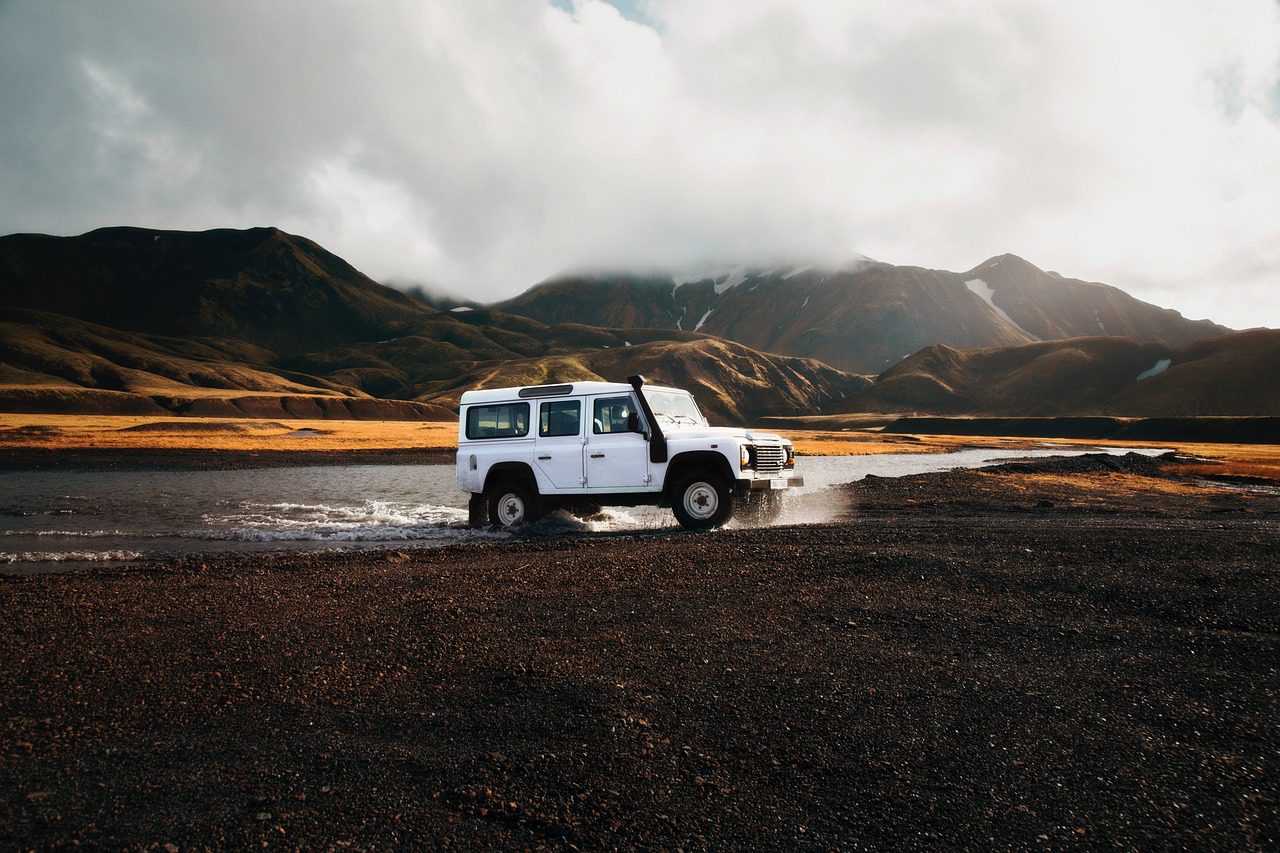
We drove Iceland’s Ring Road in a standard rental car, and we drove the Westfjords in a 4WD. We’ve crossed F-roads in July and learned — the hard way, from our rental agreement — exactly what happens if your tires don’t match the terrain. If you’re planning a self-drive Iceland trip and wondering whether you need special tires in Iceland, this is everything we wish we’d known before we landed at Keflavik.
Iceland has tire requirements that are partly legal, partly enforced by rental companies, and partly just common sense. None of it is obvious unless someone who’s been there explains it clearly.
In summer (June–August), standard tires are fine for the Ring Road and paved routes. For F-roads and highland tracks, you legally need a 4WD vehicle — but tire type matters too. In winter (November–March), Icelandic law requires studded or winter tires on all vehicles. Rental companies typically include the correct tires for the season, but always confirm before signing.
Iceland’s tire laws — what’s actually required
Iceland has formal legislation on tires, administered by the Icelandic Transport Authority. It’s not a suggestion. The rules break neatly into two seasons, and understanding them prevents both fines and genuine danger on roads that can turn from dry gravel to black ice in twenty minutes.
The legal framework
Icelandic law requires winter tires — either studded or friction-type (M+S rated) — on all vehicles from 1 November through 15 April. Outside these dates, no specific tire type is mandated by law, but rental agreements often add their own layer of requirements on top.
- Studded tires: allowed from 1 November to 15 April. They provide the best grip on ice and packed snow — the standard for most Icelanders.
- Friction tires (M+S / all-season): a legal alternative to studs in winter. Many rental cars use Nordic all-season or winter tires that meet the M+S standard.
- Summer / standard tires: legal from mid-April through October. Fine for paved roads and good conditions.
- Penalty for non-compliance: fines and, more relevantly, full loss of rental insurance coverage in an accident. That second point is the one that actually bites travellers.
What doesn’t change with season is the restriction on F-roads. You must have a 4WD vehicle to legally drive any road marked with an “F” on Icelandic maps — and those vehicles almost always have appropriate off-road tires as well.
Summer vs winter in Iceland — what actually changes for your tires
Most visitors arrive in summer (June–August), which is when Iceland is most accessible and when tire requirements are most relaxed. But even in summer, Iceland has at least three road surfaces that will surprise you if you’ve only driven in Western Europe or North America.
Summer driving conditions
From June to August, the Ring Road (Route 1) is entirely paved and maintained. Standard tires on a normal passenger car work perfectly. The surprises come when you leave the Ring Road.
- Gravel side roads: many secondary roads are unpaved gravel. Standard tires handle them fine, but go slowly — chips can crack a windscreen at speed, and rental insurance often doesn’t cover that.
- Sand and volcanic ash: in the south near Mýrdalsjökull and the Reykjanes peninsula, roads can have patches of fine black sand. Low-profile summer tires struggle here at speed.
- River crossings on F-roads: these are 4WD-only regardless of season. A standard car with great tires still cannot legally cross a glacial river ford.
- Sudden weather changes: even in July, sleet or hail at higher elevations can briefly make a road slippery. Rare but not impossible.
Winter driving conditions
If you visit between November and April, conditions are fundamentally different. Black ice, compacted snow, and unpredictable precipitation make winter tires not just a legal requirement but a survival tool. We live in Rovaniemi and drive on winter roads all season — what Iceland has is comparable to northern Finland at its worst.
- Black ice: forms overnight on bridges and in valleys. Studded tires are the most effective countermeasure.
- Compacted snow on mountain passes: several Ring Road sections over the east fjords and north coast can be snow-packed for days after a storm.
- Road closure risk: Iceland’s road authority (Vegagerðin) closes routes when conditions are dangerous. Always check road.is before departing.
F-roads, highlands, and the 4WD rule you can’t ignore
The F-road rule is the most misunderstood aspect of Iceland driving. Many people assume F-roads are just rough tracks that a daring driver can manage with any car. This is wrong, and rental companies will not cover any damage if you take a non-4WD onto an F-road.
What makes an F-road different
- River crossings (fords): unbridged glacial rivers that require ground clearance and power distribution only a 4WD offers. The water can be fast and cold.
- Loose volcanic terrain: soft pumice, deep sand, and unstable gravel that will swallow a 2WD’s driven axle.
- Remoteness: if your car gets stuck on the Kjölur or Sprengisandur route, the nearest tow is hours away and will cost hundreds of euros — all out of pocket if you weren’t in a 4WD.
For F-roads, what matters isn’t just the tire — it’s the whole vehicle. A 4WD with good all-terrain tires is the minimum. If you rent a Dacia Duster or Toyota RAV4 (common highland choices), check that it’s specifically cleared for F-road use in your rental agreement. Not all 4WDs are contractually approved for all F-roads.
What rental companies actually give you — and what to check
Iceland’s rental market is large and competitive. In our experience, the big players (Hertz, Avis, Europcar, Lotus, Geysir) are reliable about fitting season-appropriate tires. The risk is with smaller, cheaper operators who may be more casual about compliance.
Before you sign anything
Ask these questions explicitly — don’t assume:
- “Are the tires winter-certified for the current date?” (if travelling November–April)
- “Is this vehicle approved for F-road use in my rental agreement?” (if you plan highland driving)
- “Does your insurance cover gravel-road windscreen chips?” (almost always no — consider adding glass protection)
- “What do I do if I get a flat?” — Iceland’s rental cars often have tyre sealant kits rather than spare tyres. Know what’s in the boot before you leave the lot.
4WD vs 2WD: the practical cost difference
In summer, a 2WD compact is genuinely sufficient for Ring Road travel and most coastal roads. Upgrading to a 4WD in summer adds cost without real benefit unless you want highland access. In winter, a 4WD is worth every extra euro — not just for legal compliance but for confidence on mountain passes.
Quick-reference checklist before you drive in Iceland
- ✓ Check the date: 1 Nov–15 Apr = winter tires legally required. Confirm with the rental company.
- ✓ Confirm F-road eligibility: your contract must say “4WD approved for F-roads” if you plan highland driving.
- ✓ Photograph the tires: take a picture of each tire at pick-up. Rental companies sometimes dispute existing wear as new damage.
- ✓ Check the tire pressure: Iceland’s temperature swings can drop pressure overnight. A gauge is cheap; a flat on a remote track is expensive.
- ✓ Download road.is: Iceland’s official road status app. Check it every morning for closures, F-road openings, and weather warnings.
- ✓ Buy the glass/gravel protection: standard rental insurance often excludes gravel damage. The extra cover is usually €10–15/day.
- ✓ Know your spare: open the boot and check whether you have a full spare, a space-saver, or a sealant kit.
- ✓ Note the tire chain rules: chains are rarely needed but legal. In the shoulder season (October, April), ask if the rental has chains available.
Honest travel notes from the Arctic Circle
No algorithm, no sponsored filler — just what we actually learned on the road. One email, twice a month.
Tips and warnings for driving in Iceland
- Never drive off marked roads: it’s illegal and causes permanent damage to fragile moss and lichen that takes decades to recover.
- Wind is the hidden danger: Iceland’s wind can physically push a car sideways on exposed causeways. Slow down before bridged sections in high wind.
- Sheep on roads: especially in summer, sheep graze freely and wander onto roads. A sheep at 90 km/h is a serious accident.
- Don’t trust Google Maps for F-roads: it will sometimes route you onto F-roads without flagging them as 4WD-only. Use road.is for route verification.
- Fill up more often than you think: petrol stations in the highlands are far apart and sometimes card-only at unstaffed pumps. Fill up whenever you’re below half a tank.
- Temperature vs ice: at 2°C and raining, roads can be more treacherous than at −10°C and snowing. Ice forms around freezing, not well below it. Winter tires are designed for this range.
Summer tires vs winter tires in Iceland — side-by-side
- Dry paved road (summer): both fine ✓
- Wet paved road: both fine ✓
- Black ice: summer tires ✗ dangerous | studded or friction winter tires ✓
- Snow-compacted mountain passes: summer tires ✗ | winter tires ✓
- Gravel side roads (summer): both fine ✓
- F-road performance: vehicle type (4WD) matters more than tire type — all-terrain on 4WD is best for highlands
- Legal requirement Nov–Apr: summer tires ✗ not permitted | winter tires ✓ required
- Legal requirement May–Oct: both legal ✓
- Typical rental fitment in winter: winter tires included automatically by major companies
- Noise and fuel economy: studded tires are slightly noisier and marginally less fuel-efficient on clear dry roads
Mistakes we made — and watched other travellers make
- Not reading the rental agreement before driving. The F-road exclusion is buried in the small print. We nearly took our first rental onto an F-road in the Westfjords before a guesthouse host stopped us and asked which car we had. Read the contract at the counter, not at the trailhead.
- Assuming “4WD” means “approved for all F-roads.” Some rental 4WDs are only approved for gravel secondary roads, not submerged river fords. The distinction is contract-specific.
- Ignoring the road.is app. On our first Iceland trip we drove south from Akureyri toward a mountain pass that had been closed since the previous evening. A 45-minute detour, no harm done — but checking road.is takes 30 seconds.
- Not photographing tires at pick-up. A friend got charged for a sidewall scuff on return. He couldn’t prove it was pre-existing. Five seconds with your phone at the rental lot prevents this entirely.
- Trusting sea-level weather for mountain roads. Clear skies in Reykjavik can be blizzard conditions at Öxnadalsheiði. Iceland’s micro-climates are extreme. Always check the mountain forecast specifically.
- Driving too fast on gravel. Small stones become projectiles. We saw three cracked windscreens in one week — all rental cars on the same gravel stretch in the south. Slow down and buy the glass cover.
Frequently asked questions
Are special tires required in Iceland in summer?
Not by law. From mid-April to the end of October, standard summer tires are legal in Iceland. Rental companies fit appropriate tires for the season. The only case where tire type becomes critical in summer is on F-roads and highlands, where the vehicle type (4WD) matters more than the tire anyway.
Does Iceland require winter tires?
Yes. Icelandic law requires winter tires — either studded or M+S-rated friction tires — on all vehicles from 1 November to 15 April. Major rental companies include season-appropriate tires automatically, but it’s worth confirming when you collect your car.
Can I drive Iceland’s Ring Road without a 4WD?
Yes, in summer. The entire Ring Road (Route 1) is paved and a standard 2WD handles it without problems in good conditions. In winter, a 4WD gives significant confidence on snowy mountain passes, though it’s not legally required for the Ring Road itself.
What happens if I drive an F-road in a 2WD rental car?
You void your rental insurance. Any damage — stuck in sand, a broken axle, a river-crossing gone wrong — comes entirely out of your pocket. F-road rescue in the Icelandic highlands can cost €500–1,500 or more. Don’t do it.
Do rental companies in Iceland provide winter tires automatically?
Major rental companies fit winter tires as standard during the legal winter period (November–April). Smaller operators may be less consistent. Always ask explicitly, and check the tires visually — look for the snowflake symbol or M+S marking on the sidewall.
Are studded tires better than friction winter tires in Iceland?
On ice and compacted snow, studded tires have a measurable grip advantage — which is why most Icelanders use them. Friction tires (Nordic all-season or winter) are quieter and still meet the legal requirement. For a first-time visitor staying on the Ring Road, friction winter tires are perfectly adequate.
A final word from Rovaniemi
We drive on winter roads for six months of the year. We understand the strange confidence that comes from good tires — and the sinking feeling when you realise you’re on the wrong ones for the conditions. Iceland is one of the most rewarding self-drive destinations we’ve ever explored, but it rewards people who prepare.
The tire question has a simple answer: let the season and your itinerary decide the vehicle, then trust the rental company to match it — but verify. If you’re going in summer and staying on paved roads, you need nothing special. If you’re going in winter or heading into the highlands, the equipment upgrade is not optional.
Wherever you’re driving from — whether it’s Reykjavik or Rovaniemi — Iceland’s roads reward the same thing: patience, preparation, and the willingness to pull over when conditions turn. Iceland will still be extraordinary tomorrow morning.
Joona & Alla
A Finnish-Ukrainian couple living on the Arctic Circle. Joona is a marketing professional in Lapland tourism; Alla is an AI Engineer. Together we’ve visited 25 countries and share honest, locally-grounded travel writing.
Read our full story →