How to See the Northern Lights in Iceland (Practical Guide)
Iceland is one of the best places on Earth to see the aurora borealis — but only if you know when to go, where to stand, and what to actually look for. We’ve chased the northern lights from Rovaniemi to Reykjavik. Here’s what we’ve learned.
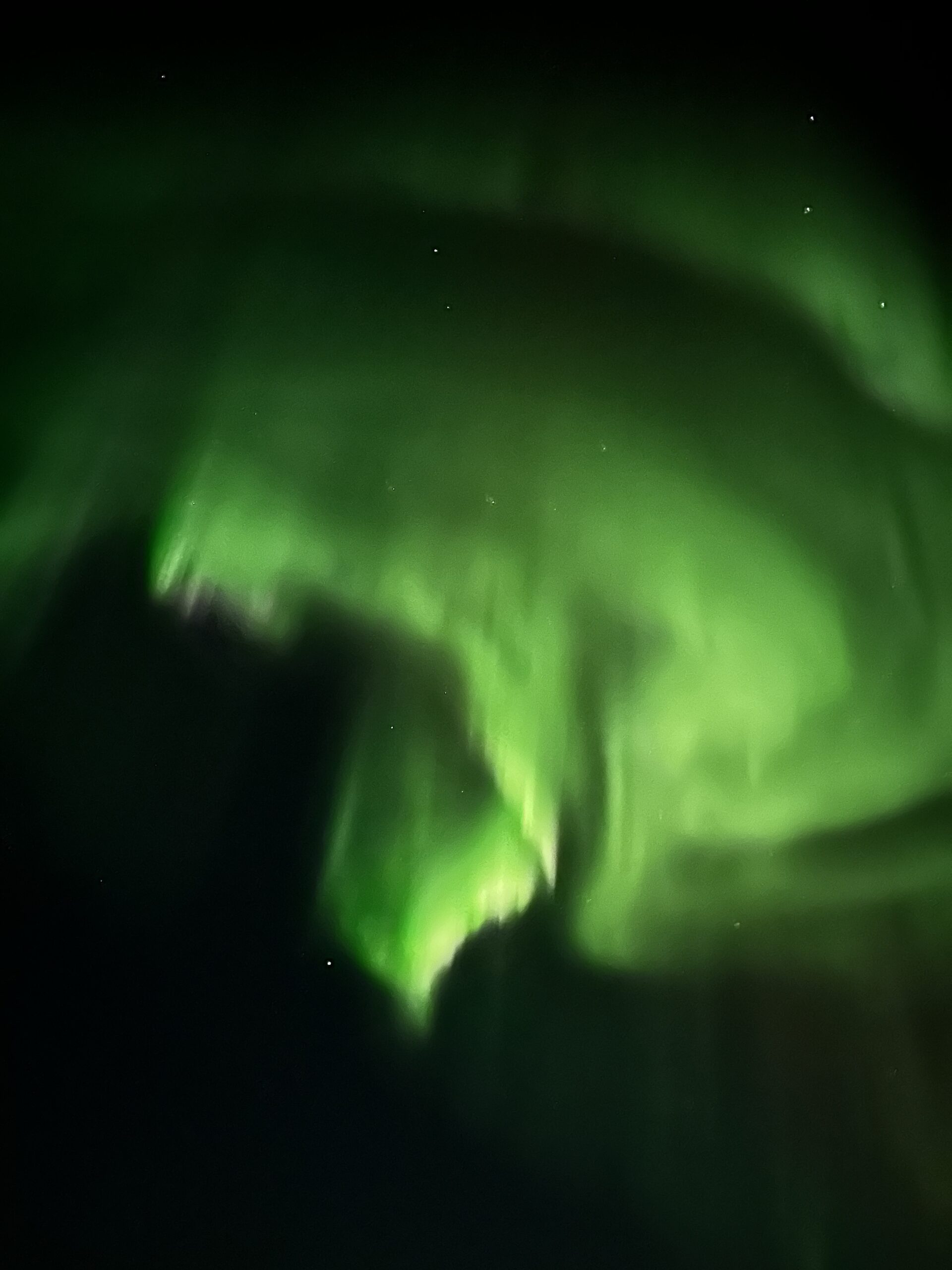
We’ve been chasing the northern lights for years — from our backyard in Rovaniemi, across Norwegian fjords, and into the volcanic darkness of Iceland. Iceland is one of the most accessible and dramatic places on Earth to see the aurora borealis, but there’s a gap between what Instagram shows you and what actually happens when you stand outside at midnight in 3°C wind.
This is our practical guide to seeing the northern lights in Iceland — when to go, where to stand, how to read the forecast, and how to avoid the mistakes we made the first few times.
The northern lights in Iceland are visible from roughly September through March, with peak activity in October–February. You need dark skies (no midnight sun), clear weather (check vedur.is), and a KP index of 2 or higher. Drive at least 20–30 minutes outside Reykjavik, bring a tripod for photos, and give yourself at least 3–4 nights for a realistic chance. Patience beats prediction — some of our best sightings happened on nights the forecast called mediocre.
When to see the northern lights in Iceland
The aurora borealis is visible in Iceland from roughly late August through mid-April, but the realistic window for most travelers is September through March. Here’s why timing matters more than most guides admit.
The darkness factor
Iceland’s midnight sun kills any chance of seeing the aurora from mid-May through late July. Even in August, the sky doesn’t get properly dark until around the 20th. By September, you’re getting 5–6 hours of true darkness, and from November through January, you have 18+ hours of dark sky to work with. More darkness means more windows to catch an active display.
Peak months, honestly ranked
- October & February: Our top picks. Enough darkness for the aurora, roads still drivable, and shoulder-season prices. October has milder weather; February has longer nights.
- November & January: Maximum darkness, but storms roll in frequently. You might get a spectacular display one night and three days of cloud cover after.
- December: Only 4–5 hours of daylight, which is great for aurora but limits daytime sightseeing. Roads in the north and east can be tricky.
- September & March: Shoulder months with pleasant weather but shorter dark windows. Good if you want a balanced trip rather than a pure aurora chase.
How the aurora actually works (the 2-minute version)
Understanding the basics helps you make better decisions in the field. You don’t need a physics degree, but knowing why the lights appear — and why they sometimes don’t — saves hours of pointless waiting.
Solar wind meets magnetic field
The sun constantly throws charged particles into space. When a burst of solar wind reaches Earth’s magnetic field, those particles get funneled toward the poles and collide with atmospheric gases. Oxygen produces green and red; nitrogen gives purple and blue. The stronger the solar wind, the brighter and more widespread the display.
KP index: what it means and what to ignore
The KP index measures geomagnetic activity on a 0–9 scale. In Iceland, which sits just below the auroral oval, you can see the lights at KP 2 or higher. You don’t need a KP 7 storm — some of our most beautiful displays in Iceland happened at KP 3. The KP index tells you intensity, not beauty. A KP 2 with clear skies beats a KP 5 behind clouds every time.
Solar cycle timing
The sun operates on an 11-year activity cycle. Solar Cycle 25 peaked in 2024–2025, and activity remains strong through 2026. This means the coming seasons are still excellent for aurora viewing — you’re catching the tail end of a historically active period.
Best places to see the northern lights
The single most important factor is escaping light pollution. Reykjavik has 230,000 people, streetlights, and a skyline glow that washes out anything below KP 4. Drive 20–30 minutes in any direction and the difference is dramatic.
Near Reykjavik (30–60 minutes)
- Þingvellir National Park: Dark skies, open terrain, easy access from Route 1. The tectonic rift makes a dramatic foreground. Arrive before 22:00 to park safely — the lot isn’t lit.
- Grótta Lighthouse (Seltjarnarnes): Technically within Reykjavik, at the tip of the peninsula. Less ideal than driving out, but works on strong nights (KP 4+). The lighthouse turns off periodically, which helps.
- Kleifarvatn Lake: 30 minutes south of Reykjavik on the Reykjanes Peninsula. Volcanic landscape, almost no one there at night, and the lake reflection doubles the show.
South Coast
- Vik: The black sand beach at Reynisfjara faces south with zero light pollution. Wind can be brutal, but on a calm night the aurora over the Reynisdrangar sea stacks is unforgettable.
- Jökulsárlón Glacier Lagoon: Icebergs reflecting green aurora light. This is the Instagram shot, and it’s real. The drive from Reykjavik is 4.5 hours, so plan to stay overnight in Höfn or the lagoon area.
North Iceland
- Akureyri: Iceland’s northern capital is much smaller than Reykjavik, with darker skies right at the edge of town. Lake Mývatn, 45 minutes east, is even better.
- Mývatn: Volcanic craters, steam vents, and near-total darkness. One of Iceland’s best aurora locations, period. If you’re making the trip north, this is the reward.
The Westfjords
- Ísafjörður: Remote, dark, and stunning. Few tourists venture here in winter, which means you’ll likely have the sky to yourself. Road conditions can be challenging — check road.is before driving.
Honest travel writing, once a month
No spam, no listicle recycling — just one real email per month from our home in Finnish Lapland. Stories from the road, behind-the-scenes of how we plan trips, and the occasional strong opinion about tourist traps.
How to read the forecast and plan your night
Chasing the aurora in Iceland is equal parts science and stubbornness. Here’s the system we use, refined over multiple trips.
Step 1: Check the cloud forecast first
- vedur.is/en/weather/forecasts/cloudcover — Iceland’s Meteorological Office publishes an hourly cloud cover map. This is your most important tool. Green on the map means clear sky. Find the green patch, then drive to it.
- Don’t trust the Reykjavik forecast as representative. Iceland’s weather is hyperlocal — it can be raining in the capital and perfectly clear 40 minutes east at Þingvellir.
Step 2: Check solar activity
- vedur.is/en/weather/forecasts/aurora — Iceland’s own aurora forecast, updated every few hours. It combines KP predictions with local cloud cover.
- NOAA Space Weather Prediction Center (swpc.noaa.gov) — the global standard. Check the 30-minute and 3-day forecasts for KP projections.
- The My Aurora Forecast app gives push notifications when KP spikes — useful but not a substitute for checking the cloud map.
Step 3: Pick your window
- The aurora can appear any time after astronomical darkness begins, but 22:00–02:00 tends to be the most active window. Don’t burn out waiting from 19:00 — eat dinner, rest, then head out at 21:30.
- Give yourself at least 45–60 minutes at your chosen spot. The aurora can vanish for 20 minutes and return stronger. Leaving after 15 minutes of nothing is the number-one rookie mistake.
Step 4: What to bring
- Layers: Standing still outdoors at 0°C for an hour requires merino base layers, a fleece, and a windproof outer shell. Bring a hat and gloves you can actually operate your phone in.
- Tripod: Essential for any photo longer than a snapshot. Phone cameras in night mode need 3–10 seconds of exposure — handheld won’t work.
- Hot drinks: A thermos of coffee or hot chocolate is not optional. It’s the difference between a magical night and a miserable one.
- Headlamp with red mode: White light ruins your night vision and annoys other aurora watchers. Red light preserves your ability to see faint displays.
Iceland vs Rovaniemi for the northern lights
We live in Rovaniemi, Finland, and we’ve seen the aurora from our backyard. We’ve also chased it across Iceland. Both places are excellent, but they offer different experiences.
- Accessibility: Rovaniemi is easier. You can see the aurora from the edge of town without driving far. Iceland usually requires a 20–60 minute drive from wherever you’re staying.
- Scenery: Iceland wins on dramatic backdrops — glaciers, volcanoes, black sand beaches, and waterfalls. Rovaniemi’s scenery is frozen forest and lakes, which is beautiful but less varied.
- Weather reliability: Finnish Lapland has more consistently clear skies in winter than Iceland. Iceland’s Atlantic weather system brings more cloud cover, and you spend more time chasing gaps in the clouds.
- Season overlap: Both work September–March. Rovaniemi gets colder (regularly -20°C in January vs Iceland’s -5°C) but also gets more stable high-pressure systems that produce clear skies.
- Cost: Finnish Lapland is slightly cheaper for accommodation outside ski season. Iceland is expensive year-round, though October and November bring the best deals.
- Our honest take: If the northern lights are your primary reason for traveling, Finnish Lapland is more reliable. If you want the aurora plus a dramatic landscape adventure, Iceland delivers something Lapland can’t match.
Mistakes we made chasing the aurora
We’ve been doing this long enough to have a healthy list of things we got wrong. Hopefully you can skip a few of these.
- Staying in Reykjavik and hoping: Our first trip, we stood on the Reykjavik waterfront for two hours watching a vaguely greenish haze behind streetlights. Drive out. Always drive out. Even 20 minutes makes a difference.
- Trusting one forecast source: The KP index said 4, the sky was supposed to be clear, and we drove an hour east. It was completely overcast. We now cross-reference vedur.is cloud maps, NOAA forecasts, and real-time webcams before committing to a direction.
- Leaving too early: One night at Þingvellir, we waited 45 minutes, saw nothing, and drove back to our guesthouse. The aurora erupted 20 minutes after we left — we saw it in the rearview mirror. Now we commit to at least 90 minutes at a spot.
- Not dressing warm enough: Standing still at 2°C with wind feels like -10°C. On our third trip we finally invested in proper merino base layers and insulated boots, and the experience went from endurance test to actual enjoyment.
- Over-relying on phone apps: Aurora alert apps are useful, but they lag behind real conditions. The best forecasting tool is your own eyes. Let them adjust to the dark for 10 minutes. If you see a pale greenish band on the northern horizon, stay — it often intensifies.
- Forgetting the tripod: Phone night-mode photos of the aurora look incredible — if the phone is on a tripod. Handheld, they’re blurry green smears. A small travel tripod weighs 500g. Just bring it.
Frequently asked questions
Can you see the northern lights from Reykjavik?
Technically yes, during strong displays (KP 4+). But city light pollution washes out most activity. For a proper sighting, drive 20–30 minutes outside the city to places like Þingvellir or Kleifarvatn. The difference is dramatic.
What month is best for northern lights in Iceland?
October and February offer the best balance of dark skies, manageable weather, and reasonable prices. November through January gives more darkness but worse weather. September and March work but have shorter dark windows.
How many nights should I plan for?
At least 3–4 nights gives you a realistic chance, accounting for cloudy nights. If you have only 2 nights, you might get lucky, but you’re gambling against Iceland’s weather. A full week almost guarantees at least one good display.
Do I need a tour or can I go alone?
You can absolutely go independently with a rental car and the vedur.is cloud map. Tours are convenient if you don’t want to drive in the dark, but they go to fixed locations and leave on a schedule. Self-driving lets you chase clear skies in real time, which is a significant advantage.
Can I photograph the northern lights with a phone?
Modern smartphones (iPhone 14+ and recent Samsung Galaxy models) have night modes that capture the aurora surprisingly well. The key is a tripod — you need 3–10 seconds of stability. No tripod, no good photo. Also turn off the flash and set exposure manually if your phone allows it.
Is a KP 7 storm really that much better than KP 3?
Different, not necessarily better. A KP 3 in clear skies produces elegant green bands that dance slowly across the sky. A KP 7 storm fills the entire sky with color and movement — it’s overwhelming. Both are worth seeing. In Iceland, a KP 2–3 with clear weather is more enjoyable than a KP 6 behind clouds.
A final word from Rovaniemi
We see the northern lights from our hometown in Finnish Lapland — sometimes from our kitchen window. And still, every time we catch them in Iceland, it feels completely different. There’s something about standing on a black sand beach at midnight, watching green light ripple across the sky above a glacier, that resets you in a way Lapland’s frozen forests don’t quite replicate.
Iceland isn’t the easiest place to see the aurora — the weather is unpredictable, the drives can be long, and there’s no guarantee on any given night. But when it works, it’s the kind of experience you stop trying to photograph and just watch. That’s the version of Iceland that keeps pulling us back.
Give yourself enough nights, drive away from the city, dress warmer than you think you need to, and be patient. The lights will come.
Joona & Alla
A Finnish-Ukrainian couple living in Rovaniemi, Finland. Joona is a marketing professional in Lapland tourism; Alla is an AI Engineer. Together we’ve visited 25 countries and share honest, locally-grounded travel writing from our home in the Arctic.
Read our full story →