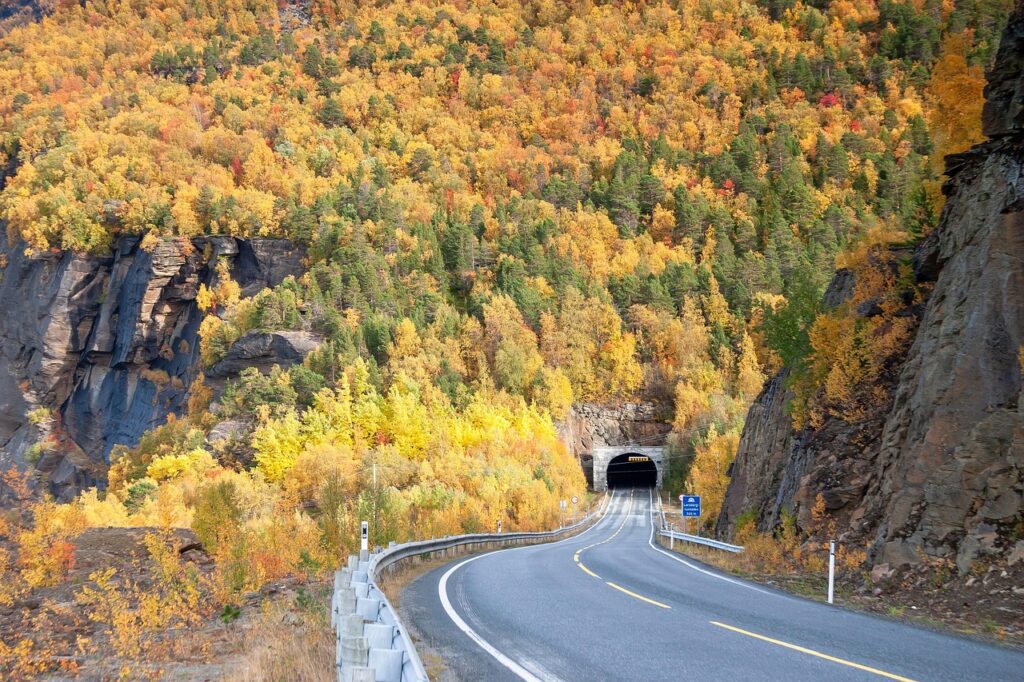
We came to this conclusion slowly, the way most travel truths arrive — not through research but through kilometres. After driving the E10 to Lofoten in February darkness, crossing from Rovaniemi into Norway on a whim in July, and coasting the Finnish archipelago on roads that barely registered on the map, we stopped second-guessing the format. A Scandinavia road trip is not just one way to explore the region. For most travelers, it is the right way.
This is not a sponsored opinion. It is what we have learned from doing this repeatedly across six Nordic countries and trying most of the alternatives.
Road trips are the best way to explore Scandinavia because the region’s greatest landscapes, experiences, and moments of connection are between the cities, not in them. Public transport serves the capitals well but misses the fjords, national parks, remote coastline, and empty roads that make the Nordic countries genuinely different from everywhere else. A car gives you access to all of it, on your schedule, without the gaps.
- Why the best parts of Scandinavia are between the cities
- What a car unlocks that no train or bus can match
- Eight reasons we keep choosing road trips over other formats
- The honest downsides — and how we handle them
- How road trips compare to other ways of travelling Scandinavia
- Mistakes we made on our first Scandinavian road trip
- FAQ
- A final word from Rovaniemi
Why the best parts of Scandinavia are between the cities
Oslo, Stockholm, Helsinki, and Copenhagen are excellent cities. We visit them regularly and genuinely enjoy them. But if you ask us where we have had our most memorable moments in the Nordic countries, almost none of the answers are urban. They are things like:
- Pulling off an empty Norwegian fjord road at midnight in June to watch the sun hover above the water without quite setting.
- Finding a free lakeside camping spot in Finnish Lapland that was not on any list, just visible from the road through the trees.
- Driving through a complete whiteout in northern Sweden and then emerging into bright sun on the other side ten minutes later like nothing happened.
- Stopping at a roadside fish shop in the Lofoten Islands and eating the best cod of our lives out of a paper bag on the bonnet of the car.
These things do not happen on trains. They are not on the itinerary. They are what Scandinavia offers to people who have a car and are willing to follow a road to see where it goes.
The geography is designed for driving
Scandinavia’s landscape is not organized around human convenience. Finland has 188,000 lakes and the public transport network does not reach most of them. Norway’s fjords carve the western coastline into a series of arms and peninsulas that require ferries, tunnels, and mountain passes to navigate — all of which are part of the road trip experience. Sweden’s King’s Trail and the forests of Norrland occupy a northern stretch of the country where trains run infrequently and stop at towns, not wilderness.
A car is not just convenient here. For large parts of these countries, it is the only way to arrive at the thing you came to see.
What a car unlocks that no train or bus can match
We have taken trains in all three countries and appreciate them for what they are: comfortable, reliable connections between cities and larger towns. But the limits become clear quickly when you try to use public transport to do what most Scandinavia travelers actually want to do.
Real-time flexibility
Nordic weather changes fast. The difference between driving and taking public transport often comes down to this: when a storm clears in Lofoten and suddenly the light is extraordinary at 10 pm, you get in the car and drive to the viewpoint. On a bus, you are on the bus schedule. We have pivoted itineraries mid-afternoon, doubled back to a village we passed too quickly, and added an unplanned ferry crossing because we had the car and the ferry was right there. This kind of travel is not possible any other way.
Access to Everyman’s Right
Finland, Sweden, and Norway all have some form of Allemansrätten — the right to access nature freely, camp in the wild, swim in lakes, and walk across private land following certain rules. A car means you can actually use this right. You can stop at a random lake on a forest road, pitch a tent for a night, wake up to silence and bird noise, pack up and drive on. Without a car, Everyman’s Right is mostly theoretical for visitors.
The scenic routes
Norway has 18 designated Scenic Routes — stretches of road curated for their beauty, with viewpoints, architectural installations, and infrastructure designed specifically for drivers who are paying attention. They are not on the InterRail map. Sweden’s Vildmarksvägen and Finland’s archipelago roads offer comparable experiences. These routes exist because the road itself is the destination, and they reward exactly the kind of unhurried, observant driving that a road trip format naturally produces.
Eight reasons we keep choosing road trips over other formats
We have been asked this question enough times that we have started keeping a mental list. Here it is, unfiltered.
- You control the pace completely. An extra hour at a viewpoint does not cascade into missed connections and rebookings. You stay as long as the light is good and leave when you are ready.
- Luggage is not a constraint. Camping gear, hiking boots, photography equipment, a week of groceries bought in bulk at a Finnish hypermarket — none of this requires renegotiating carry-on rules or paying excess baggage fees.
- The cost math often works in your favour. Split between two people and factored against the train and bus tickets you are not buying for every leg, a rental car in Scandinavia is frequently competitive or cheaper. Add the ability to sleep in the car or camp for free, and the savings become significant.
- You see things between the destinations. The reindeer crossing the road north of Rovaniemi. The suddenly visible sea at the top of a Norwegian pass. The roadside stall selling cloudberry jam in July. These do not appear in any guide because they cannot be predicted. They happen to people driving slowly with the windows down.
- Wild camping becomes the accommodation strategy. In Finland and Sweden especially, free camping is legal, clean, and available almost everywhere. We have paid for accommodation in Scandinavia, of course, but our best nights were often in places that cost nothing.
- You can carry the right gear for the season. Summer in Lapland means mosquito nets and sun cream. Autumn in Norway means waterproofs and warm layers. A car makes packing for real conditions possible without penalty.
- The overnight ferry system integrates perfectly. The Helsinki–Stockholm and Tallinn–Helsinki overnight ferries, the Smyril Line to Iceland and the Faroe Islands, and the numerous Norway–Denmark crossings all work beautifully with a car. You sleep on the ferry, wake up in a new country, and drive away. It is one of the great low-effort transitions in European travel.
- It is the format the locals use. Finns drive to their summer cottages. Norwegians road trip the coast. Swedes do Allemansrätten camping by car. If you want to travel a place the way people who live there do, this is it.
More like this, delivered monthly
Practical Nordic travel notes, local updates, and the things we do not publish on the blog — straight from Finnish Lapland.
The honest downsides — and how we handle them
We are not here to oversell this. There are genuine reasons why a road trip is not the right format for every traveler and every trip. Here is our honest take on the friction points.
- Cost of fuel and tolls. Norway in particular has an extensive toll road network (AutoPASS) and fuel is expensive across the region. Budget a minimum of €15–25 per day for fuel on a normal Scandinavian road trip. Toll costs vary by route but Norway can add €30–50 to a long driving day if you are using major routes.
- Winter driving requires real skill. We mentioned this in our safety guide, and we will say it again here: if you have never driven on packed snow and ice, Scandinavia in winter will test you. It is manageable with the right preparation and speed, but it is not trivially easy.
- Solo driving is tiring over long distances. Scandinavia is large. Norway alone stretches 2,500 km from south to north. Without a co-driver, the long-distance legs require discipline about rest stops. We take turns driving everywhere and still build in rest days after heavy driving days.
- Urban parking is a genuine headache. In Helsinki, Stockholm, and Oslo, parking in the city centre is expensive and logistically complex. Our approach: stay outside the city centre, use public transport for the urban days, and only bring the car in when we need it for onward travel.
- It requires more planning than public transport. You need to think about ferry bookings, road conditions, car return policies, and fuel. None of this is difficult, but it is more active than buying a rail pass and trusting the timetable.
How road trips compare to other ways of travelling Scandinavia
For completeness, here is how we think about the alternatives and when we would choose them.
- Train: excellent for a city-focused trip — Helsinki to Tampere, Stockholm to Gothenburg, Oslo to Bergen. The Bergen Line and Rauma Line are genuinely beautiful. If you are doing a capitals-only trip and not going into the wilderness, trains are fast and comfortable. They miss everything in between.
- Bus: useful as a supplement to a road trip (for reaching a trailhead when you do not want to park, or for a single city leg), less useful as a primary transport strategy. Long-distance buses are comfortable in Scandinavia but the timetables are sparse outside major routes.
- Organized tour: takes the planning off your hands, which is genuinely valuable for some travelers. The trade-off is pace: you move on when the tour moves on, not when you are ready. We have done a few organized experiences (a boat trip in Lofoten, a guided hike in Oulanka) and found them excellent for specific things but not for extended exploration.
- Flying between cities: fast for covering distance but you lose everything in between, which in Scandinavia is the point. Flying Helsinki to Tromsø in 90 minutes means you skip the Finnish lakes, the Swedish forests, the Norwegian border, and 1,500 km of country that the Scandinavians themselves consider the main event.
- Cycling: growing fast as a format, particularly in Denmark and Sweden. A genuinely beautiful way to travel slowly. The distances involved in getting from Norway’s south to its north, or crossing Finland, make cycling a multi-week commitment that most travelers cannot make. Worth considering as a micro-format within a region.
Mistakes we made on our first Scandinavian road trip
- Underestimating distances. Norway looks manageable on a small map. At driving speed, with mountain roads, ferry crossings, and the genuine temptation to stop constantly, it is not. We once planned a two-hour drive that took five hours and was the best five hours of the trip. Plan for this.
- Not booking ferries in advance for summer. On major Norwegian fjord crossings in July, car queues can be long. The Smyril Line to the Faroe Islands and Iceland books out months in advance for summer sailings. We learned this the hard way and now book as early as possible for any ferry that crosses an open body of water.
- Choosing the wrong rental car. We rented a small car once to save money and spent several days genuinely uncomfortable because we could not fit our gear. For a proper Scandinavian road trip, a medium estate or SUV with roof storage is worth the extra cost.
- Not bringing cash at all. Scandinavia is overwhelmingly card-based and you can get through most of the trip without cash. The exceptions are some remote hiking hut systems in Norway, a few rural camping grounds, and small-scale roadside vendors. Keep €50–100 in local cash as a reserve.
- Ignoring the weather forecast for mountain passes. In shoulder seasons especially, Norwegian mountain passes can close without much warning. Check vegvesen.no (Norway) or the Finnish Meteorological Institute before setting out on any mountain route. We got caught out once on a closed pass and lost most of a day backtracking.
- Driving too much each day at first. The temptation to cover ground is real in the early days of a road trip. We burned ourselves out on day three of one trip by driving nine hours and arrived at an excellent location too tired to enjoy it. We now plan maximum six hours of driving on any day, fewer if the scenery looks good.
FAQ
Is it worth renting a car for a Scandinavian trip?
For most travelers planning more than a few days in the region, yes — especially if you want to see anything beyond the capital cities. The Nordic countries’ greatest landscapes, national parks, and experiences are accessible mainly by car. The rental cost, split between two people, is often competitive with multi-leg train and bus tickets, and gives you infinitely more flexibility.
How long should a Scandinavian road trip be?
A meaningful road trip through a single country (Finland, Norway, or Sweden) works well over 10–14 days. Multi-country routes need three weeks minimum if you want to do more than touch the surface. The temptation to cover more ground is always there — we recommend fighting it and spending longer in fewer places. The region rewards slow exploration more than almost anywhere else we have driven.
Can you road trip Scandinavia on a budget?
Yes, with a few strategies. Wild camping (legal in Finland and Sweden under Everyman’s Right, and in Norway under Allemannsretten) eliminates most accommodation costs. Buying groceries and cooking at camp or roadside spots cuts food costs significantly compared to restaurants. Fuel and tolls are unavoidable expenses, but split between two travelers and offset by free camping, a Scandinavian road trip can be done for considerably less than most visitors expect.
What is the best time of year for a Scandinavian road trip?
June to August is peak season for a reason: the midnight sun, all passes and scenic routes open, and the best chances of clear weather. May and September offer fewer crowds, lower prices, and genuinely beautiful light — we prefer May in Finland and September in Norway. Winter road trips are possible and spectacular (northern lights, snow-covered forests) but require winter driving experience and significant preparation.
Do I need an international driving permit for Scandinavia?
EU and most western driving licences are accepted in Finland, Sweden, Norway, Denmark, Iceland, and the Faroe Islands without an IDP. If you hold a licence from outside the EU/EEA or a non-Roman-alphabet country, an International Driving Permit is required. Check with your car rental company before your trip — requirements can vary by rental agency as well as by country.
Is Norway or Finland better for a first Scandinavian road trip?
For dramatic scenery in a concentrated area, Norway edges it — the fjords, mountain passes, and coastal roads are genuinely unlike anywhere else. For a gentler introduction with easier driving conditions, more free camping options, and lower overall costs, Finland is hard to beat. We would suggest Norway if you have three weeks and some driving confidence, Finland if you have ten days and prefer a more relaxed pace. Both are outstanding.
A final word from Rovaniemi
We live 8 km from the Arctic Circle and we still take regular road trips. Not because we are travel bloggers who have to, but because being in a car in the Nordic landscape, moving at road-speed rather than flight-speed, remains the format that most reliably produces the feeling of having actually been somewhere.
Scandinavia is not a collection of cities connected by transport links. It is a landscape interrupted occasionally by cities. The road in between is where most of it lives — the empty stretches, the sudden coastlines, the reindeer on the verge, the pull-offs with no name that turn out to be the best view of the trip. A road trip is not just the best way to explore it. For large parts of these countries, it is the only way to arrive at the thing you actually came to see.
Joona & Alla
A Finnish-Ukrainian couple living in Rovaniemi, Finland. Joona is a marketing professional in Lapland tourism; Alla is an AI Engineer. Together we have visited 25 countries and share honest, locally-grounded travel writing from our home in the Arctic.
Read our full story →