Driving in Finland in Winter: Real Tips From Experience
We live in Rovaniemi and drive Finnish winter roads every year. Here is everything we wish someone had told us before that first ice-road commute — from studded tyres to reindeer to what −35 °C does to a battery.
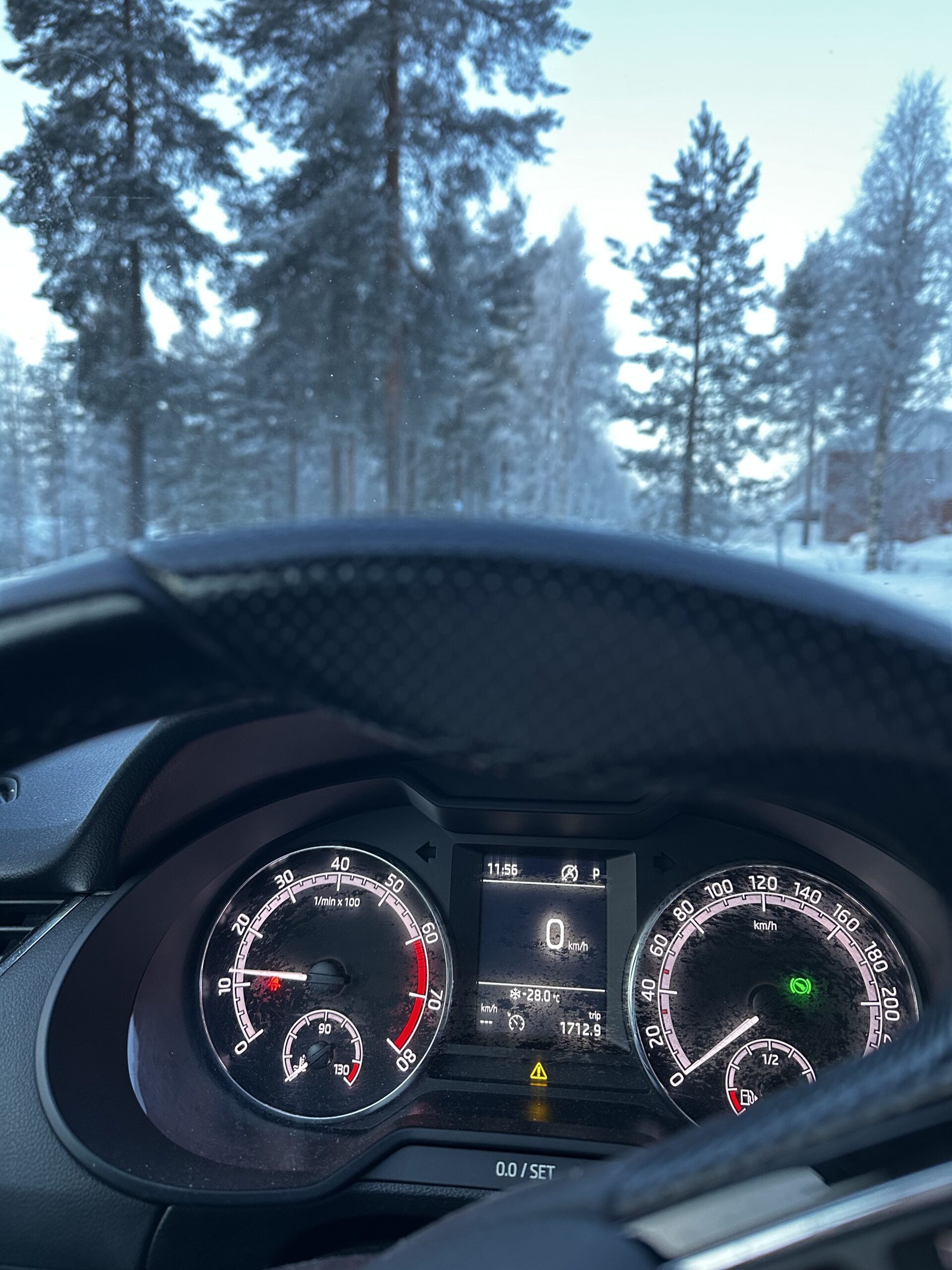
Every winter we get the same message from friends planning a trip to Finnish Lapland: “Is it safe to drive? What do we need to know?” We’ve been driving these roads for years — through polar nights, through whiteout storms, and once at −42 °C when the diesel gelled and we learned why locals keep a can of additive in the boot. This guide is everything we actually know, not the standard rental-car disclaimer.
Driving in Finland in winter is genuinely manageable for anyone who respects the conditions. The roads are well-maintained, the rules are sensible, and the scenery is extraordinary. But there are things that will catch you off guard if nobody warns you first.
Yes, you can drive in Finland in winter — but winter tyres are mandatory by law, roads can change from clear to icy in minutes, reindeer are a genuine hazard in Lapland, and temperatures below −20 °C demand a different mindset behind the wheel. Rent a car with winter tyres already fitted, drive 20–30 km/h below the speed limit on rural roads, and you will be fine.
Winter tyres in Finland: what the law actually requires
Finland’s winter tyre law is stricter and more specific than most visitors expect. Getting it wrong isn’t just dangerous — it can invalidate your rental insurance.
The legal requirement
Winter tyres are mandatory from December 1 through February 28 (or whenever wintry road conditions exist, which in Lapland means October through April). All four tyres must be winter-rated — mixing types is illegal and dangerous on ice.
Studded vs. non-studded (friction) tyres
- Studded tyres: legal from November 1 through the last day of February (extendable if conditions persist). Significantly better grip on ice. The vast majority of Finns use them.
- Friction (Nordic) tyres: legal year-round as winter tyres, softer compound, excellent in snow, but noticeably less grip on bare ice at low temperatures. Still dramatically better than summer rubber.
- For rental cars: almost all Finnish rental companies fit studded tyres for the winter season as standard. Confirm before you pick up the keys.
One thing that surprises visitors: Finnish roads can look bone-dry at midday and be sheet ice by 4 pm when the temperature drops. Studded tyres are not just a legal box to tick — they are the difference between stopping in time and not.
How Finnish winter roads are actually maintained
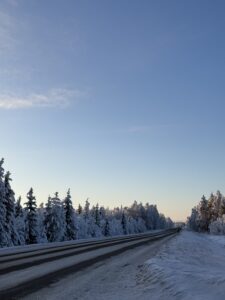
Finns do not expect winter roads to be bare and dry like summer roads. The standard is keliolosuhde — condition-appropriate maintenance — which means ploughing and salting on main highways but a deliberate light layer of compacted snow on lower-classification roads. This gives traction to studded tyres and is actually safer in consistent cold than wet bare tarmac that re-freezes overnight.
Road class and what to expect
The Finnish Transport Infrastructure Agency (Väylävirasto) classifies roads into maintenance priority categories. In brief:
- Main highways (valtatie, e.g. E75 north to Rovaniemi): ploughed quickly, salted, largely bare in most weather. Speed limits reduced from 120 to 100 or 80 in winter.
- Regional roads: ploughed regularly, may have a snow pack on the surface. Drive accordingly — you’re on a winter road, not an airport runway.
- Local roads and forest roads (metsätie): ploughed less frequently. After a heavy overnight snowfall, expect to be the first car through. These are beautiful but require patience.
The Finnish Meteorological Institute (FMI) publishes a real-time road condition map at ilmatieteenlaitos.fi. We check it every morning in winter before any long drive. It shows ice, slush, and black ice warnings by road section.
Arctic life, honest travel, and the roads less driven
Monthly notes from two people who actually live here. No hype, no hotel lists.
Winter driving checklist: before you leave the car park
Pin this or screenshot it. We use a version of this every single time before a long winter drive in Lapland.
- Confirm winter tyres: check at the rental desk. All four, studded if possible.
- Scrape all glass — not just the windscreen: rear window, side mirrors, roof. Snow sliding off the roof onto the car behind you is a fine in Finland.
- Check fluid levels: windscreen washer fluid rated to at least −30 °C. Your rental company should have done this, but verify.
- Download offline maps: Google Maps or Maps.me. Mobile signal in Lapland can disappear for 30–50 km stretches on smaller roads.
- Check road conditions: FMI road weather map. Takes 2 minutes.
- Check fuel: petrol stations are sparse in northern Lapland. Never leave on a long route with less than half a tank.
- Warm the engine: modern cars don’t technically need a long warm-up, but give it 3–5 minutes at −20 °C so the gearbox oil circulates properly.
- Emergency kit in the boot: warm blanket, ice scraper and brush, jump leads or a portable jump starter, a torch, a hi-vis vest, and a small shovel if you’re going off main roads.
Driving tips that actually help on Finnish winter roads
These are the things that separate a confident winter driver from one who ends up in a ditch. We’ve seen both sides.
Speed and following distance
- Drop 20–30 km/h below posted limits on any road that isn’t bare. The posted limit assumes dry summer conditions.
- Triple your following distance. On compacted snow, stopping distances are 3–5× longer than summer.
- On black ice (jäätie), braking is almost useless. Steer gently and let the car slow itself — hard braking spins you.
Visibility and light
- In December–January in Lapland, civil twilight may last only 3–4 hours. Plan longer drives in the light window.
- Snowfall reduces visibility to near zero in minutes. If a whiteout starts, slow to a crawl and find a safe place to pull over — a petrol station, a rest area (levähdysalue), or a wide road shoulder.
- Headlights are legally required at all times in Finland, year-round, day and night.
Handling skids
- Front-wheel-drive cars: if the front slides wide, ease off the accelerator and steer gently in the direction you want to go.
- Rear-wheel-drive and oversteer: opposite lock, ease off the power — you probably won’t need this in a rental car but it happens on unploughed forest roads.
- If you feel any loss of traction, the instinct to brake hard is almost always wrong. Smooth inputs.
Reindeer, moose, and wildlife on Finnish winter roads
This section is not optional reading if you’re driving north of Oulu. We are serious about this.
There are approximately 200,000 reindeer in Finnish Lapland and they share the roads with you. They are not afraid of cars, they do not move predictably, and a collision at 80 km/h will kill the reindeer and cause very serious damage to your vehicle — and potentially to you. The same applies to moose (hirvi), which are larger and less common but more dangerous due to their height: their legs go through the windscreen.
What to actually do
- Slow down significantly when you see reindeer warning signs (poroja/renar). In Lapland, treat every stretch of forest road as a potential reindeer zone regardless of signs.
- If a reindeer is on the road, stop and wait. Do not honk. They will move in their own time, often into the opposite ditch and then back onto the road.
- If you hit a reindeer, you are legally required to report it to the police (call 112) and to the local reindeer herder association. This is Finnish law, not optional.
- Dawn and dusk are highest-risk times. Reindeer cluster near roads for salt in winter and are harder to see in low light.
After seven winters in Rovaniemi, we have had three close calls with reindeer and one collision (slow-speed, nobody hurt). Every time, the conditions were the same: low light, after a snowfall, and we were slightly above the speed that felt comfortable. Slow down before you think you need to.
Cold weather and what it does to your car
Temperatures in Finnish Lapland regularly reach −20 to −35 °C and occasionally dip below −40 °C. At these temperatures, a car behaves differently in ways that matter.
Key cold-weather realities
- Battery: cold kills battery capacity. At −20 °C a standard battery has roughly 60% of its warm-weather capacity. At −40 °C it can struggle to start at all. Rental cars should have adequate batteries, but if you’re driving your own car, test or replace the battery before the season.
- Electric vehicles: range drops dramatically in extreme cold — expect 30–50% range loss at −20 °C. Pre-heating while plugged in is essential. EV charging is possible in Finland but sparse in rural Lapland; plan your route around chargers.
- Diesel fuel: standard summer diesel begins to gel below about −15 °C. Finnish petrol stations sell winter diesel (rated to −32 °C or lower) as standard from November. If you’re in Finland in winter, you’ll automatically get winter diesel at any Finnish pump.
- Tyre pressure: drops roughly 1 PSI per 6 °C temperature fall. After picking up a rental, check the tyre pressure or at minimum drive a few km before any fast road — the tyres will feel sluggish if significantly under-inflated from the cold.
- Doors and locks: frozen door seals are common. Carry a small bottle of silicone spray or de-icer. Don’t use boiling water on frozen locks — it re-freezes inside the mechanism.
Mistakes we made — and watched other visitors make
Seven winters of watching tourists, guests, and our own early errors gives us a fairly thorough catalogue of what goes wrong.
- Assuming “rental car with winter tyres” means studded tyres. Ask specifically. Some companies use friction tyres, which are legal but noticeably worse on glare ice. For Lapland driving, push for studded.
- Ignoring the roof snow. Forgetting to clear the roof is both dangerous and a traffic fine. It takes 90 seconds and it matters.
- Driving at the posted speed limit on compacted snow. The limit is the dry-road maximum. In winter conditions, 60–70 on an 80 road is not timid — it’s correct.
- Not downloading offline maps before leaving cell coverage. In northern Lapland you can drive 30–40 km without a signal. Download the region before you go.
- Stopping the car in an unsafe spot to look at the landscape. The urge is understandable — it’s beautiful. But stopping on a narrow road or a hill crest because of reindeer or a sunset is how you get rear-ended by the next car. Find a proper layby.
- Dressing for the car, not for outside the car. If you break down or slide off the road, you will be standing in −25 °C weather. Dress as if you might need to wait an hour outside.
Frequently asked questions
Is it safe to drive in Finland in winter as a tourist?
Yes, with the right preparation. Finnish roads are well-maintained and the rules are clear. The main requirements are winter tyres (mandatory by law), reduced speed in snowy or icy conditions, and awareness of reindeer in Lapland. Most international visitors drive without incident; the ones who struggle are usually those who underestimate how different ice is from normal road surfaces.
Do I need an international driving licence for Finland?
If your licence is from an EU/EEA country, you do not need an international permit. For non-EU licences, Finland accepts most foreign licences for short stays (up to one year), but carrying an international driving permit alongside your national licence is good practice. Check the current rules for your specific country before travel.
When are winter tyres required in Finland?
Legally, from December 1 to February 28 (or whenever wintry conditions exist). In practice, in Lapland, you should have winter tyres from mid-October through April. All rental cars in Finland will already have winter tyres fitted during the winter season — confirm when you pick up the keys.
What should I do if I slide off the road in Finland?
Stay calm, stay in the car if it’s stable, turn on your hazard lights, and call 112 (pan-European emergency number, free from any phone, works even without signal on most Finnish networks). Move away from the road if you need to exit. Always keep a warm layer in the car for exactly this situation.
Are there petrol stations in Lapland?
Yes, but they are much further apart than in southern Finland. In rural Lapland, gaps of 80–100 km between open stations are common, especially at night. Refuel whenever you reach half a tank. Many small stations in rural areas are unmanned and accept card payment only — bring a card, not just cash.
What happens if I hit a reindeer in Finland?
You must call 112 to report the accident and notify the police. You are also required by law to report the incident to the local reindeer herder association (poromiehet). Your rental car insurance typically covers wildlife collisions, but check your policy beforehand. Never drive away without reporting it.
A final word from Rovaniemi
We genuinely love driving in Finnish Lapland in winter. There is something deeply satisfying about navigating a snow-covered forest road at dusk with studded tyres crunching beneath you, the temperature gauge at −22 °C, and nothing between you and the horizon but birch trees and sky. But it asks something of you that summer roads don’t: attention, patience, and respect for the conditions.
The visitors who have the best experience here are the ones who accept that Finnish winter driving has its own logic. It’s not slower because Finns lack confidence — it’s slower because the physics demand it. Once you internalise that, the roads become a pleasure rather than an anxiety.
Drive well. And watch for the reindeer.
Joona & Alla
A Finnish-Ukrainian couple living in Rovaniemi, Finland. Joona is a marketing professional in Lapland tourism; Alla is an AI Engineer. Together we’ve visited 25 countries and share honest, locally-grounded travel writing from our home in the Arctic.
Read our full story →