Traveling Finland Without a Plan: Why Spontaneous Travel Works Better Here
We live in Rovaniemi and we’ve driven Finland’s empty roads many times without a booking in sight. Here’s why spontaneous travel in Finland is less risky than it sounds — and how to make it work.

We planned our first-ever road trip across Finland in about four hours on a Tuesday evening — a rough list of towns on a napkin, no hotel booked, no itinerary printed. That trip lasted ten days. We slept in a lakeside cabin we spotted from the road, sat in a smoke sauna we heard about from a gas station attendant, and found a forest swim spot that doesn’t appear on any map. It remains one of the best trips we’ve ever taken.
Spontaneous travel in Finland works. Not in spite of the lack of planning but, in many ways, because of it. The country is genuinely set up for it in ways that more-touristed destinations simply aren’t.
Spontaneous travel in Finland is more forgiving than almost anywhere else in Europe. The country is low-crowd, well-signed, digitally connected, and governed by Everyman’s Right — meaning you can sleep in nature legally, swim in any lake you pass, and explore freely. A few loose rules make it work beautifully: know your driving distances, carry a backup offline map, and book the very first night if you’re arriving in peak July.
Why Finland is built for spontaneous travel

Most countries punish you for arriving without a plan. Popular destinations run at full capacity in summer, accommodation runs out, and you end up paying double for whatever’s left. Finland is the exception, and it’s an exception that runs very deep.
Everyman’s Right changes everything
Finland’s jokamiehenoikeus — Everyman’s Right — is one of the most traveler-friendly legal frameworks on the planet. It gives anyone the right to walk, ski, or cycle across private land, camp overnight in nature (one or two nights in the same spot), swim in any body of water, and pick berries and mushrooms freely. This means that “where do we sleep tonight” is rarely a crisis. A good shoreline or forest clearing is always within reach.
Low crowds, even in summer
Finland has fewer international tourists per capita than any of its Nordic neighbors. Outside of Rovaniemi (our home), the main summer hotspots of Saariselkä, and the very center of Helsinki, you will rarely compete for space. A national park that would be gridlocked in Norway or Iceland has half-empty parking in Finland.
How to set up for an unplanned Finland trip
Spontaneous doesn’t mean unprepared. There’s a difference between arriving in a country with zero infrastructure and arriving light but capable. We always do a 30-minute setup before leaving, and it makes everything else smooth.
Step 1 — Download offline maps
Download the Google Maps region for all of Finland before you leave home Wi-Fi. Also download Maps.me or OsmAnd as a backup. Mobile coverage in Finnish Lapland has improved enormously since 2020, but you will still hit dead zones on smaller forest roads and near the Norwegian border. Being lost with no offline map is genuinely stressful; being lost with one is just an adventure.
Step 2 — Build a loose list of anchors, not an itinerary
We pick five or six things we definitely want to see — call them anchors. Not a schedule, just a list: Saariselkä fells, a proper lakeside sauna, a specific national park trail, a town we’ve never stopped in. The anchors give the trip shape without removing the freedom to detour. If we hit three out of six, that’s fine. If we find something better, we replace one.
Step 3 — Book only the first night
This one rule saves every spontaneous trip we’ve done. Arriving somewhere new after dark, tired, without accommodation locked in, is miserable. Book one night. Then spend that first evening looking at the map and deciding where the rest of the trip goes. We use Booking.com or Finn-specific cottage rental site Lömö for cabins.
8 rules we follow when traveling Finland without a plan
These aren’t rigid — they’re the defaults we fall back on when we don’t have a plan and something needs deciding.
In Lapland, petrol stations are between 60 and 120 km apart. Never let the tank go below a quarter. This is not optional in the north.
Finland rewards slowing down. The best lake swim we’ve ever had was at a pull-off with no name on the map. We stopped because the light was right. That’s the whole philosophy.
Gas station attendants, rättä (country store) owners, and hikers at trailheads are your best source of where to sleep and swim. Finns are reserved but helpful when asked directly.
Outside of Rovaniemi, Saariselkä, and the main coastal cities in July, accommodation almost never sells out. Inside those zones in high summer, book before lunch.
Rural Finnish supermarkets close by 20:00, often earlier. If you’re planning to cook dinner at a lakeside cabin, buy groceries before 18:00 or you’re eating gas station pastries (which are actually fine).
You will pass a perfect lake approximately every 20 minutes in summer Finland. If you don’t have a swimsuit within reach, you will regret it every single time.
Lapland is less busy per square kilometer than any other Finnish region. You will rarely compete for a campsite, a trailhead parking spot, or a restaurant table above the Arctic Circle.
Finnish nature spaces are genuinely quiet. The social contract is that you keep them that way. Noise carries across lake water. Early mornings and late evenings are for solitude, and that’s part of what makes Finland magical.
Like this kind of honest travel writing?
One email a month from Joona & Alla — a field-tested guide, a quiet corner of Lapland, and whatever we’re learning about travelling well.
What to expect on the road in Finland
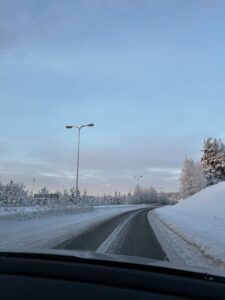
Finland has some characteristics that surprised us when we first drove here and now feel completely normal after years of living here. If this is your first time, here’s what the road actually feels like:
- Long distances between things: Finland is big. The distance between major towns in Lapland can be 150 km of empty road. This is not a bad thing — it’s part of the experience — but budget more driving time than you think you need.
- Midnight sun in summer: From late May to late July, the sun doesn’t set in Lapland and sets very late in southern Finland. This completely changes how you feel about “it’s getting late.” You’ll hike at midnight and it will feel perfectly normal.
- Reindeer on roads: Above the reindeer herding zone (roughly Oulu and north), reindeer walk onto roads freely. Slow down at dusk and dawn. They’re unafraid of cars and entirely unpredictable.
- Very good roads: Finnish roads, even the gravel ones, are generally well-maintained. You don’t need a 4WD in summer except on the most remote forest tracks.
- Sauna culture is practical, not performative: Many camping spots, cottages, and even some motorway service areas have a sauna. Use it. It’s not a luxury here — it’s the way the day ends.
Finland vs other Nordic countries for spontaneous travel
We’ve done unplanned trips in Norway, Sweden, and Iceland too. Here’s the honest comparison:
- Norway: Stunning but expensive, and the most-visited fjord roads in summer are genuinely crowded. Campsites can fill. Spontaneous Norway requires more cash buffer and more flexibility on where to sleep.
- Sweden: Very similar to Finland for Everyman’s Right and crowd levels. Slightly more expensive on food. The Stockholm archipelago rewards unplanned ferry-hopping beautifully.
- Iceland: The Ring Road is well set up for spontaneous driving but accommodation books out fast in July and August. F-roads require permits and a 4WD. Budget roughly double what you’d spend in Finland for the same trip.
- Finland: Our honest verdict is that it’s the most forgiving of the four. Lower crowds, lower prices, Everyman’s Right fully intact, and a infrastructure that quietly makes things work. Perfect for a first spontaneous Nordic trip.
Mistakes we’ve made on unplanned Finland trips
- Underestimating the driving distances in Lapland. We once planned to reach Kilpisjärvi from Rovaniemi as “an afternoon drive.” It’s 4.5 hours each way. Finland is a big country and the scale takes time to internalize.
- Skipping the first-night booking rule. We’ve arrived somewhere beautiful at 22:00 with a full car and no bed, and while it worked out eventually, the two hours of stress weren’t worth it. Book the first night.
- Running out of euros in rural areas. Some very small villages and remote roadside stalls are cash-only. Finland is highly cashless, but not entirely. Carrying 50–100€ in cash is still worthwhile.
- Ignoring the weather window. Finnish summer weather can flip from perfect to cold and rainy in a few hours, especially in Lapland. We check the Met forecast once per day and carry a warm layer no matter what the morning looks like.
Frequently asked questions
Is Finland safe for unplanned solo travel?
Yes, Finland is one of the safest countries in the world. Crime rates are extremely low, the wilderness is well-signposted, and emergency services are reachable across most of the country. The main practical risk is simply getting lost on unmarked forest tracks without an offline map.
Can I camp for free anywhere in Finland?
Under Everyman’s Right, you can camp on most land in Finland for one or two nights without asking permission, as long as you’re not on someone’s private garden or close to a house. National park rules vary slightly by park — some require camping in designated areas. Always check the park’s official page for specifics.
Do I need a car to travel Finland spontaneously?
A car is by far the most flexible option, especially outside Helsinki and Tampere. Train connections exist between major cities, and buses reach most towns, but rural lake regions and most of Lapland are genuinely car-dependent. Renting a car gives you the freedom that makes spontaneous Finland travel so good.
Is English widely spoken in Finland?
English is spoken virtually everywhere in Finland, including small towns and rural areas. Finland consistently ranks among the top countries in Europe for English proficiency. You will rarely need Finnish for day-to-day travel.
What is the best time of year for spontaneous travel in Finland?
Late June through August is the most forgiving: warm, very long days (midnight sun in the north), and Everyman’s Right in full swing. May and September are our personal favorites — fewer tourists, lower prices, and dramatic light. Winter road trips are possible but require more preparation and good winter tires.
How much should I budget per day for an unplanned Finland road trip?
A realistic budget for two people sharing a car is €120–180 per day, including accommodation, food, and petrol. Self-catering in a cottage with your own groceries can bring it closer to €80–100. Finland is not cheap by general European standards, but it’s significantly cheaper than Norway or Iceland.
A final word from Rovaniemi
We’ve planned trips to the millimeter and we’ve left home with nothing but a full tank and a rough direction. The trips we remember most are the unplanned ones, and not because chaos is romantic — but because spontaneous travel in a country like Finland means you’re always ready to say yes when something unexpected appears.
That lake no one told you about. The smoke sauna behind the gas station. The reindeer herder who invited you to see the fells at midnight because the light was doing something strange. None of those go in the itinerary.
If you’re planning a trip to Finland and feeling overwhelmed by the planning, try planning less. Start with a direction, a full tank, and rule number two: stop when it’s beautiful. Everything else is just logistics.
Joona & Alla
A Finnish-Ukrainian couple living in Rovaniemi, Finland. Joona is a marketing professional in Lapland tourism; Alla is an AI Engineer. Together we’ve visited 25 countries and share honest, locally-grounded travel writing from our home in the Arctic.
Read our full story →