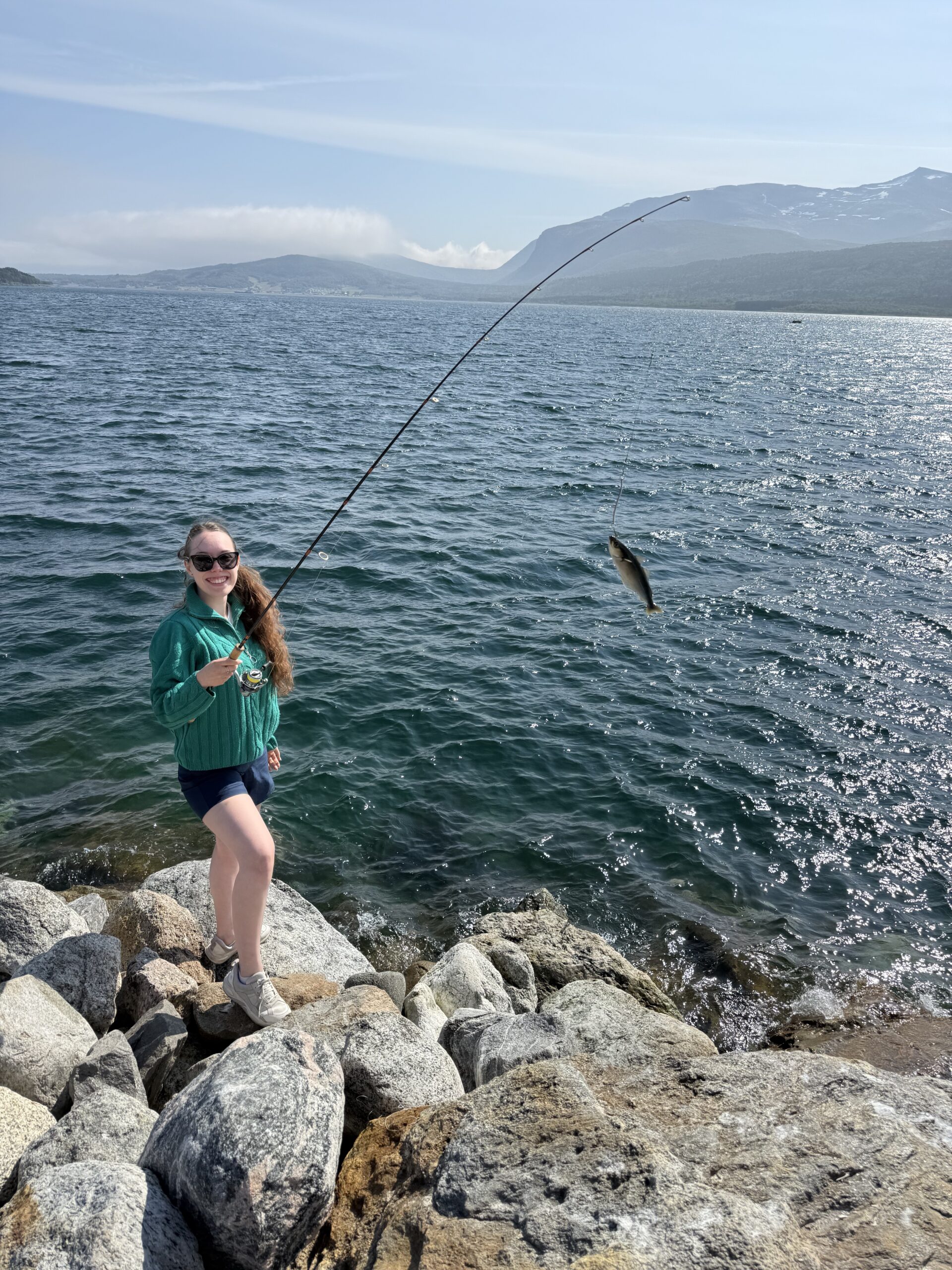
Shore fishing in Norway is one of those travel experiences that sounds niche until you actually try it — and then you can’t imagine visiting without a rod in your bag. We’ve fished Norway’s coasts, rivers, and fjord banks across multiple trips, from Lofoten in winter to Tromsø in summer, pulling cod, saithe, and the occasional massive halibut from rocks and piers that any walker could reach with zero gear beyond a basic rod and reel.
Shore fishing in Norway is also remarkably accessible. In saltwater areas, fishing from shore is free for everyone — no licence required. Freshwater is different (you need a licence), but the sheer scale and diversity of Norway’s coastline means most visitors only ever need a bucket, some bait, and the right spot.
This guide covers the best shore fishing locations we’ve actually stood at, plus the practical knowledge — regulations, species, seasons, gear — that took us several trips to piece together.
The best shore fishing in Norway is on the Lofoten Islands (cod and saithe from any pier), the Tromsø coastline (Arctic species year-round), and the fjord banks around Bergen and Ålesund (pollock, mackerel, and sea trout). Saltwater fishing from shore is free and licence-free throughout Norway. Freshwater fishing requires a national fishing licence (Fiskeravgift) plus a local rod fee.
Why shore fishing in Norway is surprisingly easy
Norway has one of the longest coastlines in the world — over 100,000 km when you count the fjords and islands. A huge proportion of that coastline is accessible to the public under the allemannsretten (everyman’s right), meaning you can walk, camp, and fish along most natural shorelines without needing anyone’s permission.
Combined with the free saltwater fishing rule, this makes Norway unusual in Europe: you can arrive with a travel rod, buy basic tackle at a local petrol station or Biltema hardware store, and be fishing within an hour of landing. No waiting on licences, no complicated regulations for the shore.
What makes Norwegian shore fishing genuinely productive
- Cold, nutrient-rich water means fish populations are dense and healthy — Norwegian cod stocks are among the healthiest in the North Atlantic.
- Deep water close to shore in the fjords and Lofoten archipelago means you don’t need a boat to reach fish. In Lofoten, Atlantic cod congregate in shallow bays within easy casting distance from harbour walls and rocks.
- Midnight sun in summer extends fishing hours effectively — fish feed in low light, and there’s plenty of low-angled summer light after 10 pm.
- Light pressure on shore spots that aren’t well-known to tourists — meaning fish that haven’t been spooked.
The one thing to get right first
Freshwater vs saltwater is the critical distinction for rules. Most shore fishing tourists do in Norway is saltwater — off piers, rocky headlands, harbour walls, and fjord banks. That’s all free and licence-free. The moment your lure lands in a river or lake, you need a licence. Keep this simple division in mind and you’ll avoid any confusion.
The best locations for shore fishing in Norway, region by region
Our Nordic trip planner (PDF)
The one-page planner we use ourselves, plus the HUNGRYTRAVELFAMILY5 5% code and one short email a week with real deals. Unsubscribe any time.
We’ve fished in several of these ourselves; others come from reliable local recommendations and fishing forums we’ve cross-referenced over years of Scandinavian travel. All of these spots are accessible without a boat.
Lofoten Islands — the top pick for most visitors
- Henningsvær harbour walls: The most famous spot in Lofoten for good reason. Atlantic cod come in from January through April during the annual skrei (spawning cod) migration. Cast a simple jig from the harbour wall and you will catch fish. Summer brings pollock and saithe.
- Svolvær pier and breakwater: The main town of Lofoten has easily accessible pier fishing in the harbour. Cod, saithe, and the occasional large halibut from the deeper end of the breakwater.
- Nusfjord: A smaller, quieter village with beautiful rocky banks and very little fishing pressure from tourists. We caught our first Norwegian cod here by accident while eating lunch on the rocks.
- Ramberg beach and Flakstad coastline: The exposed Atlantic-facing beaches on the south side of Lofoten give access to rougher water and different species — sea trout and large pollock in summer.
Tromsø and northern Norway
- Tromsø city harbour: Year-round fishing from the quayside in the centre of the city. Saithe and cod in winter; pollock and mackerel in summer. Accessible, lit at night, and genuinely productive.
- Senja island: Often called “Norway in miniature,” Senja has dramatic fjord banks, rocky headlands, and much lower tourist traffic than Lofoten. Shore fishing here is excellent and largely undiscovered by travellers.
- Hammerfest area: The world’s northernmost town. Cod fishing from shore is excellent in winter; the midnight sun in summer means fishing at 2 am in full daylight is a surreal experience worth having.
Bergen and western fjords
- Bergen’s Bryggen harbour area: Basic harbour fishing right in the city centre. Nothing dramatic, but a fun 20-minute distraction for travellers passing through — pollock and the occasional mackerel in summer.
- Hardangerfjord banks: The long, navigable fjord banks east of Bergen offer accessible shore fishing for sea trout and pollock. The town of Norheimsund has a particularly good public fishing area near the ferry dock.
- Ålesund island channels: The city sits across several islands with natural channels running between them. These channels concentrate fish — pollock and mackerel are easy catches from the rocky banks between islands in summer.
Oslo fjord and southern coast
- Drøbak: A small town on the Oslo Fjord where mackerel literally boil at the surface in July and August. Cast almost anything and you’ll catch. A perfect family shore fishing spot.
- Mandal and the Sørlandet coast: Norway’s southern coast is warmer and calmer than the north — mackerel season is long, and the rocky headlands around Mandal and Lindesnes are very productive in July through September.
Quick-reference: species, seasons, gear, and what to use
Species and best seasons
- Atlantic cod (torsk): Year-round in the north; peak is the winter skrei migration in Lofoten (February–April). Shore-catchable in Tromsø and Lofoten in all seasons.
- Saithe / coalfish (sei): Year-round from northern shores. Fast-moving, fights hard, plentiful. Easiest beginner catch.
- Pollock (lyr): Summer and autumn, especially in western fjords and Ålesund channels.
- Mackerel (makrell): Southern and western coast, June–September. Easiest fish to catch in Norway — they chase anything shiny.
- Sea trout (sjøørret): Spring and autumn in river mouths and exposed beaches. Requires a freshwater licence even in tidal zones — check local rules.
- Halibut (kveite): Rare from shore but possible from deep-water pier ends in Lofoten and Tromsø. Requires strong gear and patience.
Shore fishing gear that works
- Rod: A 2.7–3.3m spinning rod rated 20–80g is versatile for all Norwegian saltwater shore fishing. Telescopic travel rods work fine.
- Reel: A 3000–5000 size spinning reel with 15–25 lb braid is ideal. Monofilament works but braid gives better feel in cold water.
- Lures: Shiny metal jigs (40–80g) for cod and saithe; smaller shrimp/rubber lures for pollock; shiny spinners for mackerel. Buy a small assortment at a Biltema or local fishing shop.
- Bait: Frozen mackerel or squid (available at most petrol stations near coastal towns) is effective for cod when jigging isn’t producing.
Licences, rules, and what you can keep
Norway’s fishing rules are actually simpler than most European countries, but the saltwater/freshwater split catches a lot of travellers off guard. Here’s the full picture.
Saltwater shore fishing — free, no licence
- Fishing from the shore in saltwater (sea, fjords, tidal zones) is free for everyone, including tourists. No licence needed.
- This applies to rods and hand lines only. Nets, traps, and other fixed gear require permits.
- You can keep what you catch for personal consumption. There are no bag limits for recreational shore anglers under Norwegian law for most common species.
- Exception: certain protected species (Atlantic halibut under 60 cm must be released, for example) have minimum size limits. Check current FMI regulations for the season.
Freshwater fishing — licence required
- National fishing licence (Fiskeravgift): Required for all freshwater fishing in Norway, available online at inatur.no. Costs approximately NOK 270 (around €23) per year.
- Local rod fishing card: In addition to the national licence, most rivers and lakes also require a local card sold by the landowner or fishing club. These vary widely in price — from NOK 50 to NOK 500 per day.
- Salmon and sea trout fishing in rivers is strictly regulated and can be expensive — some of Norway’s best salmon rivers charge thousands of kroner per day.
Conservation rules worth knowing
- In Svalbard, all fishing regulations are stricter — check specific local rules.
- Catch-and-release is increasingly expected in salmon rivers — some rivers are catch-and-release only.
- Never transport live fish between water bodies — this is illegal and risks spreading disease.
Shore fishing vs boat fishing in Norway — how to decide
Norway is famous for boat fishing, and some tours charge €300–500 per person for a full day on the water. Shore fishing is free. So which should you choose?
Choose shore fishing when
- You’re travelling without dedicated fishing plans and want to try it opportunistically — a rod in the luggage, a pier at sunset.
- You’re in Lofoten in winter, where cod are so close to shore that boats offer minimal advantage.
- You’re travelling with children or beginners — shore fishing is lower stakes, easier to stop if it’s not working, and safer.
- Budget matters — shore fishing costs almost nothing once you have basic gear.
Choose boat fishing when
- You’re targeting halibut, large cod, or deep-water species that genuinely require more depth than any shore can provide.
- You want to cover multiple spots efficiently — boats access areas a shore angler can never reach.
- You’re an experienced angler who wants to maximise catch quality, not just the experience.
- You’re visiting a dedicated fishing camp in northern Norway where boat fishing is the primary activity.
Our honest take: on most of our Norway trips, we’ve done both — a morning on shore (free, relaxed, usually productive enough to be satisfying) and one dedicated half-day boat trip. The shore sessions have produced some of our most memorable catches.
Shore fishing mistakes we made so you don’t have to
- Assuming any water counts as saltwater. River mouths and estuaries are legally freshwater in Norway for licensing purposes — we didn’t know this on our first trip and technically needed a card we didn’t have.
- Bringing only one type of lure. On our Lofoten trip we brought only heavy jigs. The saithe were feeding on small baitfish near the surface and completely ignored the jigs. A small shrimp lure or spinner would have cleaned up — we had nothing like it.
- Not checking the tide. Norwegian tidal ranges are small by Atlantic standards but still matter. Fishing incoming tide is almost always better than outgoing — we learned this the hard way at Henningsvær.
- Standing on the obvious rock. The most photogenic casting spot isn’t always the productive one. We’ve consistently caught more from low, unremarkable shoreline ledges where fish aren’t spooked than from dramatic high cliffs.
- Underestimating the weather window. Norwegian coastal weather changes fast. We once had a productive cod session interrupted by a squall that built in 20 minutes. Always check the forecast and have a warm layer accessible.
- Not bringing food and water. This sounds obvious but shore fishing sessions have a way of stretching from 30 minutes to three hours. Bring snacks. You will not want to leave when the fish are running.
Frequently asked questions
Do I need a fishing licence to fish from shore in Norway?
For saltwater shore fishing — from the sea, fjords, or tidal waters — no licence is required for anyone, including tourists. For freshwater fishing in rivers or lakes, you need a national fishing licence (Fiskeravgift, available at inatur.no) plus a local fishing card for the specific water.
What is the best time of year for shore fishing in Norway?
It depends on the species and region. For cod in Lofoten, February to April (the skrei migration) is exceptional. For mackerel and pollock on the south and west coast, July to September is peak season. For sea trout, spring and early autumn are best. The north of Norway offers year-round saltwater fishing from shore.
Can I fish from shore in Lofoten without a boat?
Yes — Lofoten is one of the best places in Norway for productive shore fishing precisely because the fjords bring deep, fish-rich water close to land. Harbour walls in Henningsvær, Svolvær, and Nusfjord are all productive without any boat access.
What fish can I catch from shore in Norway?
Cod, saithe, pollock, and mackerel are the most common shore catches. Sea trout are possible in spring and autumn near river mouths. Large halibut are occasionally caught from deep-water pier ends in the north, though this is rare. Expect consistent action from saithe and cod at most northern shore spots.
Where can I buy fishing tackle in Norway without a specialist shop?
Biltema (a Scandinavian hardware chain with stores in most larger Norwegian towns) stocks affordable, reliable fishing gear. Petrol stations near coastal towns often carry basic lures and bait. Local fishing shops in tourist areas like Lofoten stock exactly what works locally and are worth asking for advice.
Is shore fishing in Norway family-friendly?
Very much so. The free saltwater licence, accessible harbours and pier walls, and abundant saithe (which bite readily and fight hard enough to be exciting for children) make Norway’s coastal towns excellent for family fishing. Drøbak on the Oslo Fjord is a particularly good family spot for mackerel in summer.
A final word from Rovaniemi
We came to Norway primarily as road trippers — fjords, villages, midnight sun drives. Fishing wasn’t really part of the plan on our first trip. Then a guy on the Henningsvær harbour wall handed us a spare jig and pointed at the water. Twenty minutes later we’d caught three cod the size of our forearms, standing on a public pier in one of the most beautiful places we’d ever been, for exactly zero euros.
That’s the thing about shore fishing in Norway. You don’t need to plan around it — it’s just there, waiting, on almost every stretch of coastline. A modest travel rod, a handful of jigs, and the knowledge of where to stand is enough. The fish will do the rest.
Whether you’re driving the Lofoten loop, pausing in Tromsø between northern lights tours, or passing through Bergen on a fjord circuit, find a harbour wall, cast out, and see what happens. We’ve never regretted it.
— Joona & Alla, writing from Rovaniemi
Joona & Alla
A Finnish-Ukrainian couple living in Rovaniemi, Finland. Joona is a marketing professional in Lapland tourism; Alla is an AI Engineer. Together we’ve visited 25 countries and share honest, locally-grounded travel writing from our home in the Arctic.
Read our full story →