Antwerp in a Day: Is It Worth a Detour From Brussels?
We made the 45-minute train ride from Brussels on a whim. Here’s what we found — and whether Antwerp is genuinely worth adding to your Belgium plans.
We were already in Brussels when someone mentioned Antwerp was only 45 minutes away by train. We’d been to Belgium before — Ghent, Bruges, Brussels, even the tiny town of Dinant — but Antwerp had somehow always stayed on the “next time” list. This time, we went. And we’re glad we did, because Antwerp worth visiting is a question with a very clear answer: yes, and it’s easier than most people think.
We’re a Finnish-Ukrainian couple based in Rovaniemi, and we’ve now traveled through 25 countries across Europe, Asia, and the Nordics. Belgium is one of the most underrated countries on the continent — and Antwerp might be its most underrated city. Here’s the honest rundown from our one-day trip.
Yes, Antwerp is worth a day trip from Brussels. The city has a stunning Old Town, a genuinely great fashion and design scene, some of Europe’s finest chocolate and beer, and far fewer tourists than Bruges. The train takes 45 minutes, costs under €10, and runs every 15 minutes. One full day gives you everything you need to feel like you really saw it.
Getting to Antwerp from Brussels: faster than you think
The train is shockingly easy
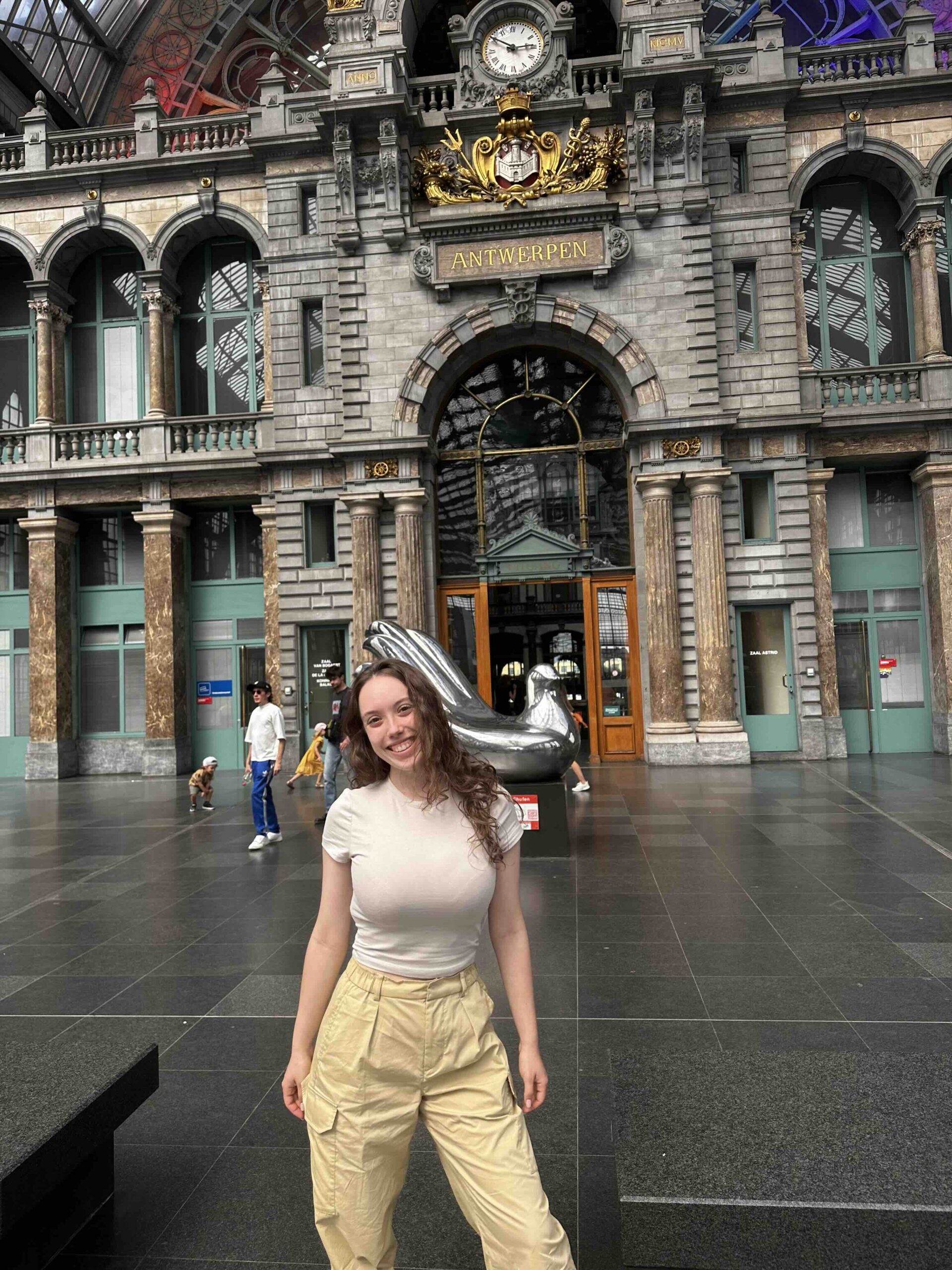
We took the IC direct from Brussels-Central to Antwerp-Centraal. Door to door from our hotel near Grand Place, we were inside one of Europe’s most beautiful train stations in under an hour. That station — Antwerp-Centraal — is itself worth seeing. It’s a cathedral-scale Beaux-Arts building with a soaring glass dome, and it was named the world’s most beautiful train station by Huffington Post at some point. We’re not sure that ranking still holds, but standing inside it, we understood why.
Logistics at a glance
- Trains run: every 15–20 minutes throughout the day from Brussels-Central and Brussels-Midi.
- Journey time: 45–55 minutes depending on which Brussels station you depart from.
- Cost: roughly €8–12 each way with a standard Belgian rail ticket. Book via SNCB (Belgian rail) or just buy at the machine — no advance booking needed for this route.
- Station to Old Town: the historic center is a 15-minute walk from Antwerp-Centraal, or one tram stop (tram 9 or 3, runs frequently).
- If you have a Eurail pass: it covers Belgium, so this train is free on your pass.
What to do in Antwerp in one day: what’s actually worth your time
The Old Town and Grote Markt
The heart of Antwerp is its Grote Markt, a medieval market square ringed by ornate guild houses and anchored by a Baroque-Renaissance City Hall. It’s smaller than Brussels’ Grand Place but feels less overrun. In summer you’ll share it with tourists, but not at the crushing levels you get in Bruges. Sit at one of the terrace cafés, order a beer, and just look. The Brabo Fountain in the center — depicting the legend that gives Antwerp its name — is genuinely beautiful.
Cathedral of Our Lady (Onze-Lieve-Vrouwekathedraal)
This Gothic cathedral took nearly two centuries to build, and it shows. The interior houses four Rubens paintings — including the famous “Descent from the Cross” — which is reason alone to pay the €6 admission. Peter Paul Rubens was born in Antwerp and spent most of his life here, so his work is woven into the city’s identity in a way that goes beyond museum displays. The cathedral spire is the tallest in the Benelux at 123 metres and visible from most of the Old Town.
MAS Museum and the waterfront
The Museum aan de Stroom (MAS) is a striking red sandstone tower on the Scheldt waterfront. Even if you skip the interior, ride the escalators to the roof for a free panoramic view over the city and the port. The waterfront area — called the Eilandje — is Antwerp’s most Instagram-attractive neighborhood: warehouse-era architecture turned into restaurants, breweries, and galleries. It’s a 20-minute walk from the Old Town and absolutely worth including.
The Fashion District and the Meir
Antwerp has a disproportionately influential fashion scene. Six designers from the Royal Academy of Fine Arts — the “Antwerp Six” — transformed global fashion in the 1980s, and the city still buzzes with independent labels and concept stores. The Meir is the main shopping boulevard, but the more interesting shops are in the surrounding streets — particularly around the Nationalestraat. Worth a wander even if you’re not buying.
Our Antwerp day itinerary: what we actually did
Spend 10–15 minutes just looking at the station. Then walk west toward the Old Town — Google Maps will take you through the market area around the Meir, which is a good warm-up.
The cathedral opens at 10:00, so arrive early to walk the square and grab a coffee at one of the terrace spots before the day-trippers arrive. We queued for maybe five minutes at the cathedral; visiting early meant we had the Rubens paintings almost to ourselves.
Rubens’ actual home and studio is a 10-minute walk from the cathedral. If you’re into Baroque painting or architecture, it’s excellent. We skipped it because we’d seen it on a previous trip and wanted to prioritize the waterfront.
Walk north to the waterfront district. Lunch here, then take the MAS elevator to the roof for views. The whole loop takes about 2 hours depending on how long you sit at lunch.
Head back south through the Nationalestraat area. Pop into any concept stores that look interesting. This is the most “local” feeling part of the day.
Antwerp has excellent Belgian beer bars in the Old Town. We landed at Paters Vaetje, a tiny bar near the cathedral. For chocolate, pick up something from one of the smaller chocolatiers rather than the chain shops — the quality difference is real.
Ghent vs Bruges: Which Belgian City to Actually Visit
Can’t decide between Belgium’s two most famous medieval cities? We’ve been to both and have a definitive take on which wins for different types of travelers.
Read the comparison →What to eat and drink in Antwerp: our quick-reference list
- Belgian waffles — get the Liège style. Denser, sweeter, with pearl sugar baked in. The Brussels-style (rectangular, lighter) are fine but less interesting.
- Moules frites. Yes, they’re everywhere in Belgium, but Antwerp does them well. Look for restaurants away from the Grote Markt for better value.
- Bolleke beer. “Bolleke” is the local name for De Koninck, Antwerp’s amber amber ale, served in a round glass. It’s the city’s unofficial beer and the correct order in a traditional brown café.
- Speculaas biscuits. The spiced cookie variety you’ll see in bakery windows is the real thing — not the supermarket version you get at home.
- Chocolate. Skip the touristy chains. Look for smaller chocolatiers in the side streets off the Meir for fresher, better quality product at the same price.
- Friet/frites. Belgian fries from a proper chip shop, served in a paper cone with your choice of sauce. Mayonnaise is correct. Don’t overthink it.
- Jenever (Belgian gin). The local distilled spirit, served in a small tulip glass. The Old Town has bars that specialize in it. More complex and interesting than the London-dry style most people know.
- Stoofvlees (beef stew with beer). The Belgian national comfort dish, best ordered with frites at a classic brasserie. Antwerp does it slightly differently from Brussels — usually heavier, richer.
Get our best travel tips in your inbox
Monthly stories from Rovaniemi — Arctic tips, packing lists, and the places we keep coming back to.
Antwerp vs Bruges vs Ghent: which Belgian city to visit?
We get asked this a lot. Here’s our honest breakdown, having spent time in all three cities on separate trips:
- Antwerp for city life. The most “alive” of the three. Has a functioning modern city around its historic center. The best bars, fashion, nightlife, and contemporary culture. Day trip works well but a night stay feels right.
- Bruges for medieval charm. The prettiest of the three, but also the most tourist-packed. Canals, cobblestones, and brewery tours. Can feel like a theme park in peak summer. Still worth it, but manage expectations.
- Ghent for the sweet spot. Our personal favorite. More compact than Antwerp, far less overrun than Bruges, and arguably the best food scene of the three. If we had to pick just one Belgian city, it’d be Ghent.
- Brussels as a base. Brussels alone is underrated — the Grand Place, the neighborhoods, the food market around Ste-Catherine — but it works brilliantly as a hub for day trips to all three. Train connections to Antwerp (45 min), Ghent (30 min), and Bruges (1 hr) are all excellent.
Brussels, Bruges, and Ghent: A 4-Day Belgian Summer Route
If you have more than a day in Belgium, here’s the route we’d run: what to do, how to split your time, and where to stay in each city.
See the full route →Mistakes we made (and what we’d do differently)
- We arrived too late. We took a mid-morning train and hit the cathedral around 11:30, which is when the day-tripper buses start arriving. Earlier is better. The 8:00 or 8:30 from Brussels-Central drops you in Antwerp for 9:00 — cathedral opens, no crowds.
- We didn’t go inside the Rubenshuis. Not a disaster, but it’s on the list for next time. If Rubens means anything to you, it’s worth the extra hour.
- We underestimated the walk between districts. Antwerp’s sights are spread out more than Ghent or Bruges. The Eilandje waterfront is a solid 20-minute walk from the Grote Markt. Budget time for that, or tram it.
- We only had one Bolleke. Should have had two.
- We skipped the Nationalestraat fashion area. Got tired and went back to the station early. The concept stores there are genuinely interesting even if you’re not a fashion person — next time we’d prioritize it over a second loop around the cathedral square.
- We didn’t book dinner. If you’re staying into the evening (which we’d recommend), book a table at one of the better bistros. The city fills up Thursday–Saturday nights and walk-ins get the worst tables.
Frequently asked questions about visiting Antwerp
Is Antwerp worth visiting for just one day from Brussels?
Yes, absolutely. A single day gives you enough time to see the Grote Markt, Cathedral of Our Lady and its Rubens paintings, the MAS museum waterfront, and the fashion district — plus lunch and a couple of beers. The 45-minute train makes it one of the easiest day trips in Europe.
How much does a day trip to Antwerp from Brussels cost?
The return train ticket costs roughly €16–24 (standard second class). Entry to the Cathedral of Our Lady is around €6. The MAS museum roof terrace is free. Budget €15–25 for lunch and €10–15 for drinks and snacks. All in, a comfortable day trip costs around €60–80 per person, not counting shopping.
Is Antwerp better than Bruges for a day trip?
It depends on what you want. Bruges is prettier and more “medieval fairytale” but extremely crowded in summer. Antwerp has more city energy, a better contemporary culture scene, and fewer tourist crowds in the side streets. If you’re already going to Bruges, Antwerp is a great contrast. If you can only do one, Antwerp feels more like a real city.
What is Antwerp most famous for?
Antwerp is famous for three things above all: diamonds (it’s the world’s leading diamond trading hub), fashion (the “Antwerp Six” designers from the Royal Academy), and Rubens (the Baroque master was born and lived here). It’s also home to one of Europe’s most beautiful train stations and a historic Old Town with genuine medieval architecture.
Do I need to book the Cathedral of Our Lady in advance?
No advance booking is required. You pay at the door (€6 adult as of 2025/2026). Lines are short outside peak hours. Go before 10:30 or after 15:00 to avoid the worst of the coach-tour crowds.
Is one day in Antwerp enough, or should I stay overnight?
One day is genuinely enough to see the highlights, especially if you arrive by 9:00. A night stay adds the evening atmosphere (Antwerp’s bar and restaurant scene really comes alive after 18:00), and lets you explore more of the fashion district and Eilandje area at a more relaxed pace. If your schedule allows it, an overnight is a nice upgrade — but not necessary.
A final word from Rovaniemi: go to Antwerp
We’ve traveled through Belgium several times now, and Antwerp is the city we keep talking about afterward. Not because it’s the most photogenic (that’s Bruges) or the most off-the-beaten-path (that’s Ghent), but because it feels genuinely alive. It’s a city that has its own culture, its own beer, its own fashion movement, its own complicated history — and it wears all of that without trying too hard to sell it to you.
From Rovaniemi, we’ve learned to appreciate cities that have a sense of identity beyond their tourist attractions. Antwerp has that. The Grote Markt is beautiful, the Rubens paintings are worth seeing, the train from Brussels is ridiculously easy — but what we remember most is sitting at a small café near the cathedral, drinking a cold Bolleke while a local tram hummed past. That’s the kind of travel moment you don’t plan for, and Antwerp is full of them.
If you’re building a Belgium trip, don’t treat Antwerp as an afterthought. It deserves better than that — and so does your trip.
Joona & Alla
A Finnish-Ukrainian couple living in Rovaniemi, Finland. Joona is a marketing professional in Lapland tourism; Alla is an AI Engineer. Together we’ve visited 25 countries and share honest, locally-grounded travel writing from our home in the Arctic.
Read our full story →