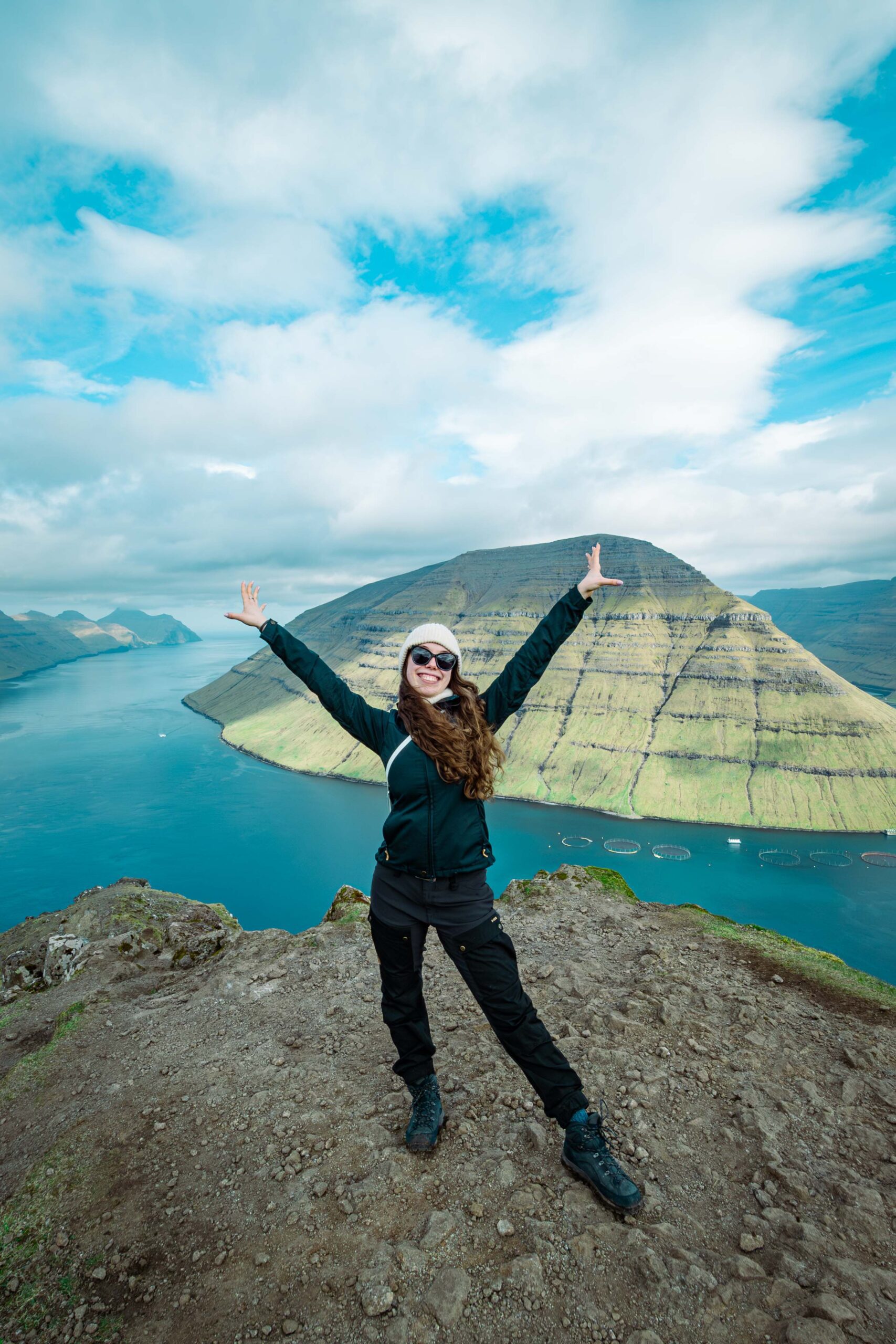
We’d been talking about the Faroe Islands for two years before we finally went. It kept appearing on every “last untouched destination” list, every Instagram feed of people we actually trusted, and every conversation we had with Norwegian friends who treat it like a private secret. When we finally touched down at Vágar Airport — a runway flanked by a fjord on one side and a hillside on the other — we understood immediately why people don’t shut up about it.
This post is not an itinerary. It’s not a packing list. It’s what we actually thought, out loud, during our first days in one of the strangest and most beautiful places we’ve visited in twenty-one countries of travel together. If you’re planning your first trip to the Faroe Islands and want to know what the experience is genuinely like, start here.
First-time visitors to the Faroe Islands are almost always stunned by how small, raw, and uncrowded it feels — eighteen islands, about 55,000 people, and scenery so dramatic it feels slightly unreal. The weather changes every twenty minutes, the tunnel system is extraordinary, and the silence between villages is the kind you only find at the edges of the world. Most people who go once start planning their return before they’ve even left.
The landing — what hits you first
Vágar Airport is one of those airports that already tells you something. The runway ends and the fjord begins. You taxi past sheep on a hillside. The terminal is small enough that baggage claim is a single belt and everyone knows what carousel to stand at because there is only one. It took us about four minutes to be outside in the cold Atlantic wind, staring at a lake on one side and a cliff on the other.
The drive from Vágar sets the tone
We rented a car — which we strongly recommend — and the road from Vágar toward Tórshavn goes through the Vágatunnilin, a 4.9 km underwater tunnel that plunges beneath the fjord and surfaces on the other side like nothing happened. We paid the toll, came up from the darkness into a valley of green hills and waterfalls, and neither of us said anything for a minute.
- The tunnel system is extraordinary. The Faroes have more tunnels per capita than almost anywhere on Earth. Some are single-lane with passing bays. One is a roundabout inside a mountain. None of this feels strange after day one.
- Road signs are in Faroese first. The language is closest to Old Norse — more so than modern Icelandic, which surprised us. Google Maps works perfectly, so navigation isn’t an issue, but reading signs takes a moment.
- The colour palette is genuinely unlike anywhere else. Bright-painted village houses against black basalt cliffs and the deep grey-green sea. It looks like someone turned the saturation up on a Nordic painting.
- Sheep everywhere. About 80,000 sheep for 55,000 people. They wander the road, the cliff edge, the village square. The Faroese word for the island group — Føroyar — literally means Sheep Islands. This is not marketing; it is accurate.
Tórshavn: the world’s smallest capital
The capital has a population of around 22,000. Walking from one end of the old town — Tinganes — to a waterfront café takes about eight minutes at a relaxed pace. The grass-roofed parliament building sits at the tip of a peninsula. It all feels like a very well-kept secret that hasn’t been spoiled yet, which is becoming rarer every year we travel.
The scale of the islands — and why it changes how you travel
Before we arrived, we knew the Faroes were small. What we hadn’t understood was what small means in practice. The 18 islands cover roughly 1,400 km². You can drive from the northernmost island to the southern tip of Suðuroy — which requires a ferry — in under three hours of driving, excluding ferry waits. Most of the main islands are connected by tunnel or bridge.
This changes your planning completely compared to, say, Iceland, which we’d visited before. In Iceland you plan around distances. In the Faroes, you plan around weather windows and what you feel like doing that morning. We made our best decisions by doing almost no advance planning day-to-day and just responding to where the cloud breaks were.
- Day-trip everything from Tórshavn. Almost every famous location — Gásadalur waterfall, Tjørnuvík beach, Saksun, Gjógv — is reachable in under an hour. You don’t need to move accommodation.
- The tunnel roundabout at Hvalba is worth doing just to say you’ve done it. It’s the only undersea roundabout in the world. Signposting is entirely by colour-coded tunnels.
- Suðuroy feels like a different country. The southernmost island requires a 2-hour ferry from Tórshavn. We took it on a whim. Fewer tourists, quieter roads, and views of sea stacks we hadn’t read about anywhere.
- Mykines requires planning even though it’s close. The westernmost island — puffin capital of the Faroes — has restricted visitor numbers and a weather-dependent boat and helicopter service. Book early; cancellations are common.
First-timer facts — the quick version
- Currency: Danish krone (DKK) — Danish notes are accepted, Faroese notes are not accepted outside the islands. Cards work everywhere.
- Language: Faroese (closest living language to Old Norse) and Danish; most locals speak good English, especially anyone under 50.
- Driving: Right-hand traffic, generally easy roads, but mountain roads can be single-lane. Tunnels have a small toll; some require an app or card payment inside the tunnel.
- Puffin season: Mid-May to mid-August. Mykines is the primary site; book the Mykines boat weeks ahead.
- Hiking access: Many trails require online registration and a small fee since 2019 — check VisitFaroeIslands.com before you go.
- Weather: Can cycle through four seasons in a day. Always carry a waterproof, always bring layers, and never assume the morning forecast holds past noon.
- Internet & SIM: Coverage is surprisingly good across the main islands. A Faroese SIM or an eSIM is cheapest; EU roaming also works for EU residents.
- Accommodation: Limited in peak summer. Book your first two nights at minimum well in advance; guesthouses fill up before the bigger hotels.
Our best travel writing, straight to your inbox
Real stories from 21 countries. No spam. No algorithmic fluff. Just honest writing from two people who are genuinely hungry for travel.
We write monthly. Unsubscribe any time.
The weather — what we expected vs. what we got
We’d read about Faroese weather until we thought we understood it. We did not understand it. On our first full day the sky was perfectly clear at 7 am, fully overcast by 9 am, raining horizontally by 10 am, and then clear again with a rainbow by noon. We laughed. There was nothing else to do. The locals call it útisitting — sitting outside — as an aspirational activity, because you take what you get.
- Pack as if it will be cold, wet, and windy every day. Even in summer, temperatures hover between 10°C and 15°C. The wind is the real variable — on the exposed ridges above Gásadalur, a light breeze becomes something that leans you sideways.
- Waterproof trousers are not optional. We watched other tourists in jeans turn back from hikes that we completed comfortably in full waterproofs. This is not about being hardcore; it’s about basic comfort.
- The fog is part of the scenery. Some of our favourite photographs came from days when the mountaintops were invisible. Mist moving through a valley of grass-roofed houses is its own kind of beautiful.
- Weather apps lie more here than anywhere else we’ve been. The microclimate variation between one valley and the next is real. Check the Faroese Meteorological Office (Met.fo) for the best local forecasts.
What genuinely surprised us
We’ve travelled to twenty-one countries between us, and the Faroes produced a list of genuine surprises — things we hadn’t read about, hadn’t expected, and found ourselves talking about for weeks after we got home.
- The silence. Between villages, the only sound is wind and ocean. We pulled over on a road in Eiðis and stood outside the car for five minutes just listening. There are very few places left in Europe where you get that.
- How local it still feels. Despite appearing on every “must visit” list for five years running, the Faroes haven’t been homogenised. The restaurants serve local lamb and local fish. The pubs are local pubs. The souvenir shops sell handmade Faroese knitwear, not mass-produced keyrings.
- The food. We hadn’t expected to eat as well as we did. Ræst — fermented lamb and fish — is an acquired taste, but fresh Atlantic cod, local lamb, and the dairy are excellent. The Koks restaurant has held a Michelin star; we couldn’t get a table but ate very well for much less elsewhere.
- How at ease we felt immediately. The Faroes have a violent-crime rate near zero. You can leave a bag on a car seat with the window cracked. We walked the Tórshavn waterfront at midnight and felt completely comfortable.
- The grass roofs are structural, not decorative. They insulate against wind and rain. Most of the famous grass-roofed buildings in Tórshavn are still in daily use. One houses a law firm.
What we underestimated
Every destination has the gap between expectation and reality. For the Faroes, most of our surprises were positive — but a few things caught us out.
- The cost. The Faroes are expensive — comparable to Iceland or Norway. A sit-down dinner for two with wine will run 600–900 DKK easily. We budgeted like we were going to Denmark and quickly revised upward.
- How much the tunnel system changes routing. We planned a loop that turned out to require going through a one-way timed tunnel at a specific hour. Check current tunnel schedules — some have time-limited single-direction flow.
- The Atlantic coast wind on exposed ridges. We’d hiked in Lapland, Norway, and Iceland. The ridge walk above Trælanípa is not technically hard, but on a windy day it is genuinely exposed. Don’t underestimate it in poor conditions.
- How fast the accommodation fills up. We got lucky with a cancellation for our third night. In July and August, assume everything worth staying in is fully booked months ahead.
- How reluctant we’d be to leave. We booked five days and spent the flight home already looking at return flights. This happens more than we expected to people who visit the Faroes for the first time.
What we’d do differently as first-timers
- Book Mykines the moment flights are confirmed. We left it three weeks before departure and couldn’t get on the boat for our dates. The puffin island is the one thing that requires advance planning.
- Stay at least one night outside Tórshavn. We used the capital as a base, which worked, but one night in a guesthouse in a village like Gjógv or Kirkjubøur would have been a completely different, slower experience.
- Take the Suðuroy ferry even if it’s not on the plan. The spontaneous day spent on the southernmost island — quieter, rawer, without the photo crowds — was one of our best days of travel that year.
- Pack a thermos. Cold coffee from a car flask doesn’t sound romantic, but watching fog roll over a fjord with something warm in your hands on a Tuesday morning in the Faroe Islands is one of the better travel moments we’ve had.
- Check trail registration requirements before arriving. Some of the most iconic walks now require pre-registration. It’s a small thing but easy to get caught out on arrival.
- Allow one full unplanned day. The weather will cancel or reroute something anyway. Build in flexibility and you’ll end up somewhere better than what you planned.
Frequently Asked Questions
Is the Faroe Islands a good destination for first-time visitors to the North Atlantic?
Yes — it’s actually more accessible than Iceland for first-timers in some ways. The islands are small and easy to navigate by car, most locals speak English well, and the main attractions are compact enough that you don’t need to cover huge distances. The main challenges are weather variability and accommodation availability in peak season.
Do I need a visa to visit the Faroe Islands?
The Faroe Islands are not part of the EU or the Schengen Area — they have their own immigration agreement. EU citizens generally don’t need a visa for short stays, and citizens of many other countries (US, UK, Canada, Australia) can visit visa-free for up to 90 days. Check the current rules for your passport before you travel, as the Faroes’ agreements differ from Denmark’s.
What is the best time of year to visit the Faroe Islands for the first time?
June and July offer the best combination of light, puffin season on Mykines, and accessible hiking conditions. May and August are excellent alternatives with slightly fewer crowds. The Faroes are also stunning in autumn (September–October) if you want dramatic light and emptier roads, but puffins will have left.
Is it easy to get around the Faroe Islands without a car?
It’s possible — the islands have a public bus network (Strandfaraskip Landsins) that connects most villages, and ferries run between the islands. However, many of the best viewpoints and hikes are not on bus routes, and some of the most memorable experiences (like chasing a weather window to a remote valley) require flexibility that only a car provides. We strongly recommend renting one.
How expensive are the Faroe Islands compared to Iceland?
Broadly comparable — both sit in the expensive tier of North Atlantic destinations. Accommodation is similarly priced, eating out costs slightly less than Iceland in our experience, and fuel and car rental are in the same range. Budget around €150–200 per person per day for mid-range travel with a rental car and one sit-down meal daily.
What is the one thing first-time visitors most often regret not doing in the Faroe Islands?
Missing Mykines — the westernmost island, famous for its puffin colony and dramatic sea stacks. Access is by a small boat that depends on weather, and spots fill up fast in summer. Almost everyone who doesn’t make it to Mykines says it’s the one thing they’d go back for.
A final word from Rovaniemi
We’ve been travelling long enough to know that the destinations that get inside you are rarely the ones with the most efficient tourist infrastructure. The Faroe Islands are eighteen islands of black basalt and green grass in the middle of the North Atlantic, where the population is smaller than a medium-sized Finnish town and the weather does whatever it likes. It is not convenient, it is not cheap, and it is not always comfortable.
It is also one of the most beautiful places we’ve ever been. Coming from Rovaniemi — a place that also sits at the edge of the familiar world, where nature is louder than people — we felt something we recognise: the particular silence of a place that hasn’t been smoothed down for visitors yet. We hope it stays that way.
If you’re considering your first visit to the Faroe Islands, stop considering and book the flights. Adjust everything else when you land.
Joona & Alla
A Finnish-Ukrainian couple living in Rovaniemi, Finland. Joona is a marketing professional in Lapland tourism; Alla is an AI Engineer. Together we’ve visited 21 countries and share honest, locally-grounded travel writing from our home in the Arctic.
Read our full story →