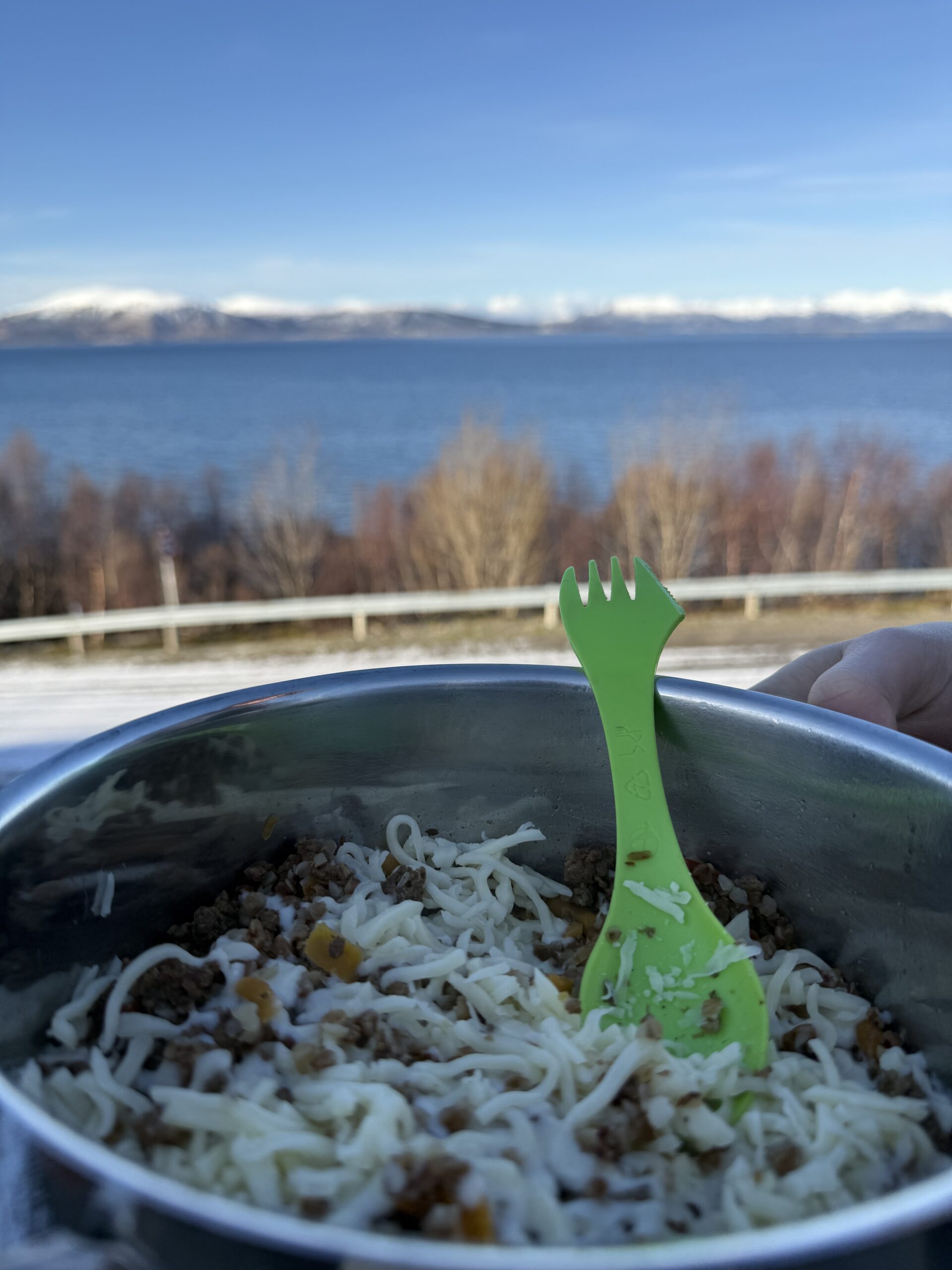
We’ve driven through 21 countries together. Some of those trips were three-day dashes between Nordic capitals. Others were two-week slow-rolls through Norway’s fjord roads with no fixed itinerary and a very small budget. What all of them had in common: we almost never ate at service stations, and we rarely stopped at restaurants for lunch. Preparing food for long road trips has been one of the most consistently money-saving, time-saving habits we’ve built — and it took us years of trial and error to get it right.
This isn’t about survival rations. It’s a real, enjoyable food system we’ve refined across Finland, Norway, Iceland, the Faroe Islands, and a dozen other countries — one that lets us eat well, stay energized, and spend the money we save on experiences instead of service-station sandwiches.
The best food for road trips combines no-cook staples (bread, cheese, cured meat, fruit, nuts) with one proper pre-made warm meal you reheat at camp or at a lakeside stop. Keep it simple, keep it cold with a quality cooler bag, and shop at local supermarkets rather than roadside stops. You’ll eat better and spend less.
Why we stopped relying on restaurants mid-trip
When we first started road-tripping seriously — back when we were still figuring out how to cross the Finland-Norway border efficiently and what to actually pack — we’d stop wherever looked convenient. ABC stations in Finland, Uno-X in Norway, some anonymous roadside grill in the middle of nowhere. The food was always mediocre and the price was always painful.
The real cost of eating on the road without a system
On a recent 10-day Norway road trip, we ran the numbers from an earlier trip where we hadn’t planned ahead. Two people, two meals a day at roadside stops: roughly €25–35 per meal. That’s over €500 for lunches and snacks alone — before a single proper restaurant dinner. When we switched to our current system, that number dropped to under €80 for the same period.
But it’s not just money. There’s the time cost. Pulling off the road, finding parking, queuing, eating somewhere you didn’t choose, getting back on the road — easily 45–60 minutes per stop. When the sun is still up at midnight in Lapland and you’re chasing a particular fjord view, those minutes matter.
What changed when we started preparing properly
- We ate on our schedule, not when a service station appeared.
- We ate better food — proper Finnish rye bread, good cheese, fruit we’d picked up at a local market.
- We stopped arguing about where to eat, which is, genuinely, one of the leading causes of road trip friction.
- We had more budget left for one special dinner per destination.
Our core road trip food system — step by step
The system has three parts: what you pack before you leave, what you replenish along the way, and how you handle the one warm meal per day that makes the difference between camping food and actually eating well.
Part 1 — The base load (pack before you leave)
The night before any road trip, we stock a collapsible cooler bag and a dry-goods tote. The cooler goes in the boot; the tote sits in the back seat for grab-and-go access while driving.
- Bread: Finnish ruisleipä (rye crispbread) travels well for days without going stale. We also pack one fresh sourdough loaf for day one.
- Protein: hard cheese (Oltermanni or similar, keeps well even slightly warm), sliced cured meat, boiled eggs (pre-peeled, in a container).
- Spreads: butter in a small container, one jar of mustard, a small jar of peanut butter.
- Fruit and veg: apples, carrots, and cherry tomatoes — all low-maintenance, no peeling required while driving.
- Snacks: mixed nuts, a bar of dark chocolate, oat biscuits.
- Drinks: a 2-litre thermos of coffee or tea (refillable at accommodation), a reusable water bottle each.
Part 2 — The warm meal (the anchor of the day)
One warm meal per day transforms the experience. We almost always make this ourselves, either at the accommodation the evening before or at a lakeside or fjordside stop using a camp stove. Our go-to options:
- Pasta with olive oil and canned tuna or sardines — takes 12 minutes, packs down to almost nothing.
- Rice and lentils with spices — pre-cooked the night before, reheated in a pot, endlessly customisable.
- Finnish sausages (nakki) grilled over a fire or camp stove — this is peak Nordic road-trip eating, especially in Lapland.
- Instant oat porridge with berries for a warm breakfast — fast, filling, feels like home even in a Norwegian layby.
Part 3 — Restocking on the road
We replenish fresh items every 1–2 days at local supermarkets — K-Market and S-Market in Finland, Rimi in the Baltics, Rema 1000 and Kiwi in Norway. Avoid the motorway shops: the same items cost 40–70% more. We plan our route to pass through a town with a proper supermarket every day or two, which in Scandinavia is almost never a detour.
The master road trip food packing list
This is the exact checklist we work from. Copy it, adapt it, use it. It’s evolved over 21 countries and counting.
No-refrigeration staples (the dry tote)
- Finnish rye crispbread (ruisleipä) — 1–2 packets
- Mixed nuts — 200g bag
- Dark chocolate — 2 bars
- Oat bars or biscuits
- Peanut butter — small jar
- Instant oat porridge — 5 sachets
- Coffee or tea bags
- Salt, pepper, olive oil in small containers
- Mustard sachet or small jar
- Dried pasta or instant noodles (2 portions)
- 2 x canned tuna or sardines
- 1 x canned chickpeas or lentils
Refrigerated items (the cooler bag)
- Hard cheese — 200g block
- Cured meat or salami — 100g
- Butter — small container
- Boiled eggs — 4–6
- Fresh fruit (apples, clementines)
- Cherry tomatoes and carrots
- Yoghurt — 2 portions (eat first)
Equipment (stays in the car permanently)
- Collapsible soft cooler bag (keeps cold for 6–8 hours with an ice pack)
- Lightweight camp stove + gas canister
- One small pot and one lid that doubles as a pan
- Cutting board and folding knife
- 2 x enamel mugs, 2 x sporks, 1 x wooden spoon
- 2-litre thermos
- Paper towels and a small washing-up kit
- Bin bags (leave no trace)
Road-tested tips from the Arctic
We send one letter a month — honest travel notes, Lapland life, and what we’re planning next. No spam, ever.
Tips and warnings from real trips
After a lot of road trips, some lessons came from success and some came from sitting in a Norwegian layby eating a €6 dry croissant and feeling very sorry for ourselves.
What actually works
- Pack the dry tote last. If it’s deep in the boot, you’ll skip snacks and arrive at every stop hungry and grumpy.
- Buy ice packs, not loose ice. Loose ice melts, soaks everything, and turns your cheese into a soggy disaster. Reusable ice packs, refrozen every night at accommodation, keep things cold cleanly.
- Eat before you’re hungry. Hunger on a road trip leads to impulsive stops at overpriced places. We eat our first snack around 10 am regardless of appetite.
- Plan your warm-meal stop around a view. Cooking at a Norwegian fjordside pullout beats any restaurant. Make the stop part of the experience.
- Label everything. In a shared car, unlabelled containers cause arguments. Masking tape and a marker solve this immediately.
What to watch out for
- Don’t overbuy fresh produce. We’ve composted a truly embarrassing amount of wilted spinach over the years. Stick to robust items: apples, carrots, cherry tomatoes, hard cheese.
- In Norway, check if you can use your camp stove. Fire bans apply in forests during dry periods (typically June–August). Gas stoves are usually fine on rocks and gravel.
- Don’t rely on accommodation to have a kitchen. Many Scandinavian hostels and budget hotels don’t. We always carry the camp stove as backup.
- Dairy goes fast. In summer heat, milk goes off in hours without proper refrigeration. UHT mini-cartons are a better bet than fresh milk in warm months.
Nordic-specific food notes — what we’ve learned country by country
Our 21-country experience includes a lot of Nordic-specific supermarket knowledge that took us a while to accumulate. Here’s the shorthand version for road-trippers heading north.
- Finland: K-Market and S-Market are ubiquitous even in small towns. Rye crispbread (Wasa, Fazer), smoked sausages, and silli (pickled herring) are excellent road-trip foods. Lidl in larger cities offers good value. Supermarkets are closed on public holidays — check the calendar before a long stretch.
- Norway: Rema 1000 is the budget choice. Kiwi is slightly pricier but wider selection. Prices are noticeably higher than Finland or Sweden — budget roughly 30–40% more per item. Norwegian brunost (brown cheese) is polarising but incredibly calorie-dense and needs no refrigeration once opened.
- Sweden: ICA and Coop are the main chains. Food prices are between Finland and Norway. Swedish crispbread varieties (Wasa is actually Swedish) are excellent. Pick up filmjölk (cultured milk) if you haven’t tried it — it keeps longer than regular yoghurt.
- Iceland: Bónus is the budget supermarket (look for the pink piggy bank sign). Stock up in Reykjavik before heading to the Ring Road — shops get sparse and pricier in the east. Skyr makes an excellent road-trip protein hit.
- Faroe Islands: SMS and Miklagarður are the main supermarkets in Tórshavn. Selection is smaller and prices are higher than mainland Scandinavia. Faroese dried fish (skerpikjøt) is an acquired taste but travels brilliantly.
Mistakes we made — so you don’t have to
- Packing too much variety. Early on we’d bring six different types of snack “to keep things interesting.” Half of it went uneaten. Now we pack less but better — two or three things we actually love.
- Forgetting a can opener. This happened once in Norway. We found a stone and the edge of a rock. It worked, barely, and we have never forgotten a can opener since.
- Buying a cheap cooler bag. A flimsy insulated bag keeps things cool for about two hours in summer. We invested in a proper soft-sided cooler with good insulation — it made more difference than any single food choice.
- Not accounting for border crossings. Some fresh produce can’t cross certain borders (mainly relevant for non-Schengen or UK crossings). We keep a mental note and eat fresh items before crossing.
- Skipping breakfast to save time. This backfired every single time. A 10-minute breakfast — oat porridge, coffee from the thermos — sets the whole day up better than any alternative.
- Over-relying on gas stations in remote areas. In northern Lapland and parts of Norway, you can drive 100+ km without a petrol station, let alone a food stop. Plan your food supply around fuel range in remote regions.
Frequently asked questions
What is the best food to bring on a long road trip?
The best road trip food is no-cook, easy to eat one-handed, and doesn’t need refrigeration for the first few hours. Our top picks: rye crispbread with cheese and cured meat, apples and carrots, mixed nuts, and a thermos of coffee or tea. For one proper warm meal per day, canned fish with pasta or pre-cooked rice and lentils are both easy and satisfying.
How do you keep food cold on a long road trip without a car fridge?
A quality soft-sided cooler bag with proper insulation and reusable ice packs keeps things cold for 6–8 hours. Refreeze the ice packs overnight at your accommodation. Place the cooler in the coolest part of the car (not in direct sun) and avoid opening it unnecessarily. For trips longer than a week in summer, consider a 12V electric cooler that plugs into the car’s socket — they’ve dropped significantly in price.
How do you avoid eating at motorway services on a road trip?
Have snacks accessible in the car at all times — not buried in the boot. When you feel the urge to stop for food, eat something from the dry tote first. Route your supermarket stops through actual towns every day or two so you can restock cheaply. The urge to stop at a motorway service is almost always about boredom or mild hunger, not genuine need.
Is it worth buying a camp stove for a road trip?
Yes, unambiguously, if you’re doing more than a weekend trip. A basic gas camp stove costs €20–35 and opens up a completely different way of eating on the road. Cooking pasta at a fjord viewpoint or making coffee at a Finnish lakeside stop is one of our favourite parts of road-tripping. The stove pays for itself on the first trip.
How do you manage food waste on a long road trip?
Always carry a bin bag in the car and dispose of waste at petrol stations or campsites — never in nature, especially in protected Nordic areas. We buy only what we’ll eat in 1–2 days of fresh items, and restock regularly rather than over-packing. Compostable fruit peels can go in a separate bag and be disposed of correctly at the next stop.
What should I not bring as road trip food?
Avoid anything that smells strongly when closed in a warm car (certain cheeses, fish-heavy dishes), anything that requires a fridge and won’t stay cold (raw meat, open dairy), and anything too messy to eat while driving or at a quick stop (soups in open containers, anything with lots of sauce). Soft bread also goes stale and squashed quickly — crispbread is a better travel companion.
A final word from Rovaniemi
We’re writing this from Lapland, where the supermarket is 10 minutes from our apartment but the nearest restaurant is further, the roads are long, and the mindset of “I’ll just stop somewhere” doesn’t really work when you’re three hours into an empty Arctic highway. That environment taught us to plan our food for road trips properly, and it’s made every road trip — whether in Finland, Norway, or anywhere else across our 21 countries — easier, cheaper, and honestly more enjoyable.
The system we’ve described isn’t complicated. It’s bread and cheese and a camp stove and a thermos. But the difference between having that system and not having it is the difference between arriving at your destination energized or depleted, €200 richer or poorer, and either having had lunch at a beautiful fjord viewpoint or at a fluorescent-lit motorway service station.
Pack the rye bread. Bring the camp stove. Fill the thermos before you leave.
Joona & Alla
A Finnish-Ukrainian couple living in Rovaniemi, Finland. Joona is a marketing professional in Lapland tourism; Alla is an AI Engineer. Together we’ve visited 21 countries and share honest, locally-grounded travel writing from our home in the Arctic.
Read our full story →