What Gear We Actually Use on the Road — Our Honest Road Trip Gear List
We’ve driven across Finland, Norway, Iceland, the Faroe Islands, and half of Europe with our car. Here’s the road trip gear list that actually made it to every trip — and the stuff we quietly left at home after one try.
We’ve lived out of a car for weeks at a time — crossing the Faroe Islands in a rented 4×4, driving Norway’s fjord roads in November sleet, doing a full loop of Iceland on the Ring Road, and countless overnight drives across Scandinavia from our home base in Rovaniemi. After all of that, our road trip gear list has gotten ruthlessly edited. Everything on it has earned its place. Everything that didn’t make the final cut was either too heavy, too fragile, or something we realised we could borrow, buy locally, or simply go without.
This is not a sponsored gear roundup. It’s the honest road trip gear list we actually pack — the same stuff sitting in our garage in Lapland right now.
The road trip gear list that actually works focuses on navigation, warmth, sleep quality, and kitchen basics. You need a reliable offline maps setup, layers for any weather, a sleep kit you trust, and a way to cook one warm meal a day. Everything else is optional. We’ve done 21 countries with less than you think.
Navigation and connectivity gear
Getting lost on a remote Norwegian mountain road at 11 pm with no signal is not romantic. It’s cold, it’s stressful, and it’s completely avoidable. Navigation is the one category where we’ve never tried to cut corners, and it’s the first thing we pack.
What we use for maps
- Maps.me (offline maps): Free, works entirely offline, and covers even the smallest gravel roads across Scandinavia and Iceland. We download the full country map before we cross any border.
- Google Maps offline areas: We use this as a backup and for reviews. You can save an area for offline use in the app settings — worth doing for any region you’ll be driving.
- OsmAnd (for hiking detours): When we park the car and head into the wilderness, OsmAnd gives better trail detail than Maps.me. Lapland trails are excellent in OsmAnd.
Staying connected on the road
- eSIM (Airalo or Holafly): Our standard setup since 2023. We buy a regional European data eSIM and top it up as needed. No SIM swapping, no roaming fees, works across Schengen countries.
- Power bank (20,000 mAh minimum): One between us, always in the car door pocket. On long driving days this charges both phones twice. We use an Anker model — nothing fancy, just reliable.
- Car phone mount: Magnetic, windscreen-mounted. The cheap suction-cup mounts don’t survive Finnish winter cold. Spend €20 on a decent one.
- 12V car charger with two USB-C ports: Phones, power banks, and occasionally a tablet all charge from the car. A dual USB-C model means no adapter faff.
Sleep and shelter essentials
We’ve slept in a rooftop tent in Lofoten in October, a ground tent in the Faroe Islands during horizontal rain, and budget guesthouses across Eastern Europe. The common thread: when sleep is bad, the whole trip is bad. We invest here.
Our sleep setup
- Rooftop tent: Our primary shelter for Nordic road trips. It takes about 90 seconds to open, keeps you off wet ground, and the mattress is far better than any camping mat. Not cheap, but it’s transformed multi-week trips.
- Sleeping bag rated to −10°C: Even in July, temperatures in Norwegian mountains or Lapland fells can drop to 5°C or below at night. We use a 3-season bag with a fleece liner for the coldest nights.
- Sleeping bag liner (silk or cotton): Adds 3–5°C of warmth and keeps the main bag cleaner on longer trips. Compresses to nothing. Worth it.
- Inflatable pillow: Joona resisted this for two years, then tried one and never went back. The Sea to Summit Aeros is genuinely comfortable and folds to the size of a coffee cup.
- Eye mask and earplugs: Essential for midnight sun camping in Finland and Norway. No blackout curtains in a rooftop tent.
If you’re not using a rooftop tent
- Ground tent (3-season, freestanding): Our Nordisk tent has survived Faroe Islands gales. Freestanding matters — pegs don’t always work in rocky Scandinavian ground.
- Camping mat (self-inflating): The difference between a €20 foam mat and a good self-inflating mat is the difference between waking rested and waking with a bad back. Don’t cheap out on insulation from cold ground.
Get our best travel tips in your inbox
Monthly stories from Rovaniemi — Arctic tips, packing lists, and the places we keep coming back to.
Our full road trip gear checklist
Here’s everything that makes it into the car on a standard Nordic road trip. This is the list we run through the night before we leave Rovaniemi.
- Navigation: Offline maps downloaded, phone mount fitted, power bank charged
- Connectivity: eSIM topped up, car charger in the glovebox, country-specific adapter if needed
- Sleep: Sleeping bag, liner, pillow, eye mask, earplugs, tent or rooftop tent key
- Clothing: Base layer (merino), mid layer (fleece), outer shell (waterproof), warm hat, gloves — even in summer
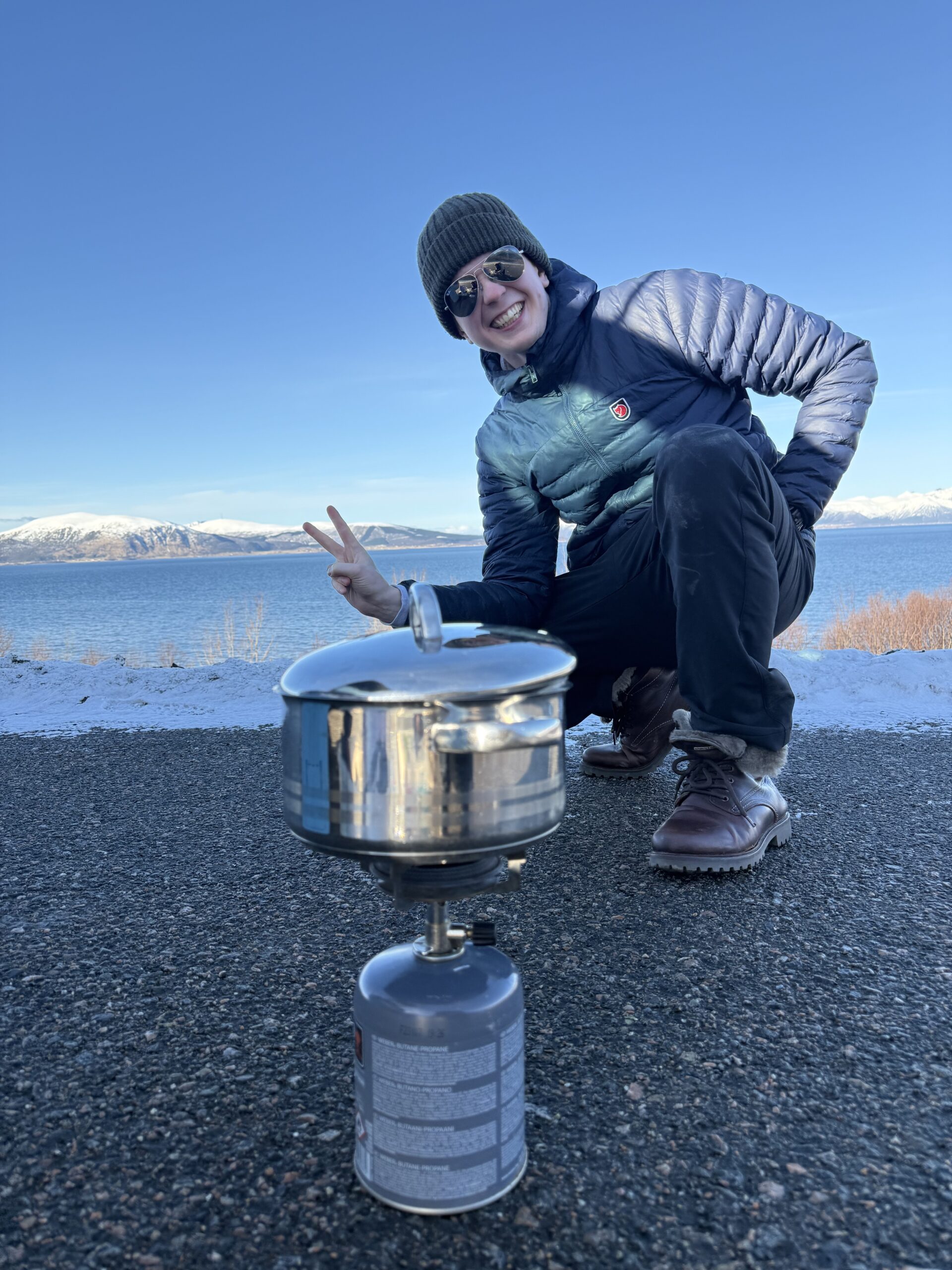
- Kitchen: Camp stove, gas canister, one pot, one pan, spork set, cutting board, travel kettle
- Food basics: Oats, pasta, olive oil, instant coffee, nuts, protein bars, a bag of whatever local produce we grabbed at the last market
- Safety: First aid kit, headlamp (plus spare batteries), reflective vest, jump-start cables or a portable jump starter
- Documents: Car insurance green card, international driving permit if leaving Europe, passport, printed ferry/accommodation confirmations for cellular dead zones
- Hygiene: Biodegradable soap, camp towel, toilet paper, hand sanitiser, trowel (for wilderness stops)
- Comfort extras: Folding camp chairs, a small table if space allows, a deck of cards or small book for weather-in evenings
Clothing and layering for Nordic road trips
The single biggest mistake we see other road trippers make in Scandinavia is packing for one type of weather. A July day in Norway can start at 22°C in a valley and end at 7°C on a mountain plateau. You need to layer.
- Merino wool base layer: Regulates temperature, dries fast, doesn’t smell after three days of wear. We each pack two. Icebreaker and Smartwool are our brands, but supermarket merino works fine too.
- Fleece mid layer: A simple zip-up fleece is our most-reached-for item on Nordic road trips. Goes under a shell in rain, stands alone on calm evenings.
- Waterproof shell: Non-negotiable. The Faroe Islands will soak you in minutes. We use mid-weight shells, not heavyweight ski jackets — they pack smaller and cover 90% of conditions.
- Quick-dry trousers: Not jeans. Ever. Wet denim in a cold car is miserable. Lightweight hiking trousers dry in under an hour.
- Warm hat and gloves: Year-round for us. Even in June at altitude in Norway or on an exposed Faroese headland, you want them.
- Trail runners or lightweight hiking boots: We’ve stopped bringing heavy leather boots. A good trail runner is waterproof enough for day hikes and comfortable enough for city walking.
- Sandals or camp shoes: For the campsite, for beach stops, for driving. Your feet need a break from shoes.
Kitchen and food gear we actually use
Eating out every meal on a long road trip is expensive and, frankly, less fun than cooking a simple pasta on a fjordside viewpoint. Our car kitchen is minimal but covers us for 95% of meals.
- MSR PocketRocket camp stove: Lightweight, works in wind, uses standard threaded gas canisters available across Scandinavia. We’ve had ours for five years.
- One titanium pot (1.3L): Big enough for two portions of pasta or oats. Titanium is light and indestructible.
- Small non-stick pan: For eggs, vegetables, and the occasional pancake. We pack this only on trips longer than a week.
- Spork set and folding cutting board: Both weigh almost nothing. The cutting board doubles as a serving surface for bread and cheese.
- Travel kettle (12V): Plugs into the car’s 12V socket. Boils water for coffee and instant noodles while driving. One of our best gear decisions ever.
- Dry food bag: Oats, pasta, couscous, instant coffee, olive oil in a small squeeze bottle, salt. These live in a resealable bag in the boot and top up from local supermarkets.
- Cooler bag (soft-sided): Not a powered fridge — just an insulated bag with a few ice packs. Keeps dairy and leftovers safe for 12–18 hours in mild weather.
What we stopped bringing
The gear we removed taught us as much as the gear we kept. Here’s what didn’t survive multiple trips:
- Paper guidebooks: Too heavy, go out of date, and everything they contain is on your phone. We haven’t brought one since 2021.
- Full-size towel: A camp towel (microfibre, folds to a fist) does the same job and takes up a tenth of the space.
- Laptop: Unless you’re working remotely, a tablet or large phone screen covers everything you need. Alla edits content on an iPad; Joona uses his phone for everything.
- Multiple pairs of jeans: One pair maximum, and only if the trip has city days. Hiking trousers for everything else.
- Portable solar panel: Sounds great, works poorly in northern Europe where you’re often camping in trees or cloudy weather. The car charges everything we need.
- Camping chairs (on short trips): For trips under five days we skip them. On longer trips they earn their boot space.
- Separate day pack: Our waterproof shells have enough pockets for a day hike. A second bag just becomes a place to lose things.
Frequently asked questions
What’s the single most useful item on your road trip gear list?
The offline maps setup. Nothing else prevents more problems. Download Maps.me, download the country you’re entering, and you’ll navigate confidently even when you have no signal for three hours in a Norwegian fjord valley.
Do we need a rooftop tent, or will a ground tent work?
A ground tent absolutely works — we used one for years before switching. The rooftop tent is faster to set up, keeps you off wet or rocky ground, and the mattress is genuinely more comfortable. It’s a significant investment but it pays off on longer trips.
What’s the minimum road trip gear list for a 3-day trip?
Navigation (offline maps, power bank), sleep (sleeping bag, tent or hotel), clothing (waterproof layer + warm layer + base), and a stove with basic food. You can skip the kitchen if you’re willing to eat out, and skip the tent if you’re using accommodation.
How do we handle laundry on long road trips?
Merino wool base layers every other day, synthetic mid layers every three days. Laundromats every 5–7 days — most Scandinavian towns have them, often in supermarket car parks. We use Sink Suds packets for small items in a campsite sink.
Is there Nordic-specific gear we’d recommend that other lists miss?
Eye mask for midnight sun camping — genuinely life-changing in June and July in Lapland or Norway. And insect repellent: mosquitoes in Finnish and Norwegian wilderness in summer are aggressive in a way that surprises most visitors.
How do we charge electronics off-grid on the road?
Primarily from the car — dual USB-C car charger handles phones and the power bank during drives. The 12V travel kettle runs off the same socket. For longer off-grid stints we plug in at campsites (hook-up is standard at Nordic campsites). We’ve never needed a solar panel.
A final word from Rovaniemi
The best road trip gear list is the shortest one that still covers you. After 21 countries and hundreds of nights sleeping in or next to our car, we’ve landed on a setup that fits in half the boot and covers every situation we’ve actually encountered — from a hailstorm on the Faroe Islands to a 38°C traffic jam in southern Europe.
The pattern is simple: invest in navigation so you’re never truly lost, invest in sleep so you wake up actually rested, bring layers for weather that will definitely surprise you, and keep the kitchen just good enough to make a hot meal when you need one. Everything else is noise.
If you’re planning your first Nordic road trip from Rovaniemi — or using us as inspiration for a longer journey across Europe — we hope this road trip gear list saves you a few expensive mistakes. We’ve already made them so you don’t have to.
Joona & Alla · Rovaniemi, Finland
Joona & Alla
A Finnish-Ukrainian couple living in Rovaniemi, Finland. Joona is a marketing professional in Lapland tourism; Alla is an AI Engineer. Together we’ve visited 21 countries and share honest, locally-grounded travel writing from our home in the Arctic.
Read our full story →