Do You Actually See Reindeer Wild in Rovaniemi? (Yes, and Where): A Local’s Honest Field Notes
Living in Rovaniemi, we’ve spotted reindeer on the roadside, in forests, even wandering through neighbourhoods. But will you see them wild? The answer depends on season, luck, and how much you leave the city. Here’s what we’ve actually observed — and the best way to guarantee the encounter if the forest doesn’t cooperate.
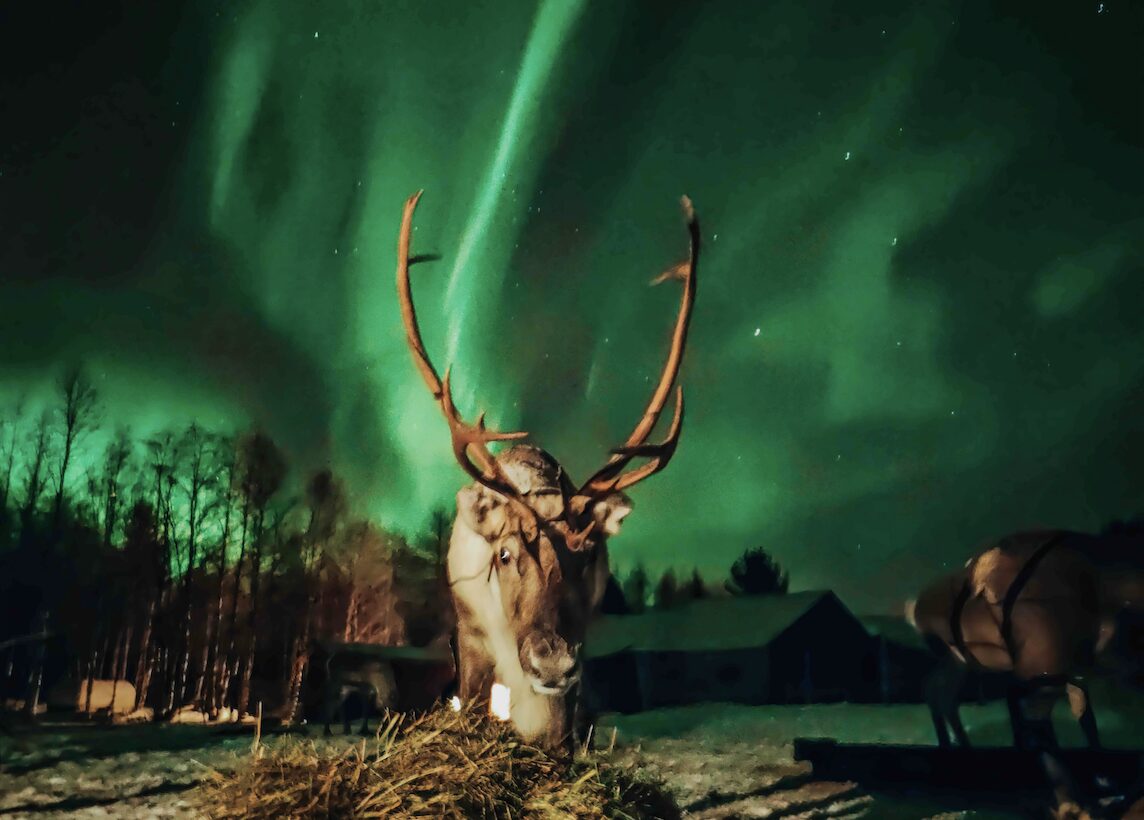
This guide is built from what we have learned living in Rovaniemi and writing about Lapland travel for years. Every detail below is from first-hand experience or from the live StayLapland product pages — never invented.
Yes — wild reindeer genuinely roam across Finnish Lapland, and Rovaniemi residents spot them regularly along roads and in forested areas, especially in early morning or at dusk. That said, sightings aren’t guaranteed, and the best way to make sure your family actually meets reindeer face-to-face is to book a dedicated experience: the Kuoksa Reindeer Adventure5% off · HUNGRYTRAVELFAMILY5 is a 3-hour guided sleigh safari from the city, with a warm teepee, cookies, and a 2–2.5 km ride through snowy forest.
- Do Wild Reindeer Actually Roam Around Rovaniemi?
- Where Are You Most Likely to Spot Them?
- When Is the Best Time of Year to See Wild Reindeer?
- Morning vs Evening: Does Timing Matter?
- Can You Approach a Wild Reindeer?
- What If You Don’t See Any? The Guaranteed Alternative
- What the Reindeer Experience Actually Feels Like
- Frequently Asked Questions
- Final Word: Nature Lottery vs Guided Magic
Do Wild Reindeer Actually Roam Around Rovaniemi?
Short answer: absolutely yes. Finland has roughly 200,000 semi-domesticated reindeer across the reindeer herding districts that cover most of the country north of Oulu — and Rovaniemi sits squarely inside that zone. The reindeer you see aren’t truly “wild” in the sense of being untouched by humans; they’re owned by Finnish herders (poromies) but allowed to range freely across the landscape for most of the year. The result is a place where a reindeer can casually amble across the E75 highway at 7 in the morning, completely unbothered.
We’ve seen reindeer in some genuinely unexpected spots: a small group grazing beside the Ounasvaara ski slope access road, a lone bull standing at the edge of a car park in early December, and a dozen animals moving through pine forest just a kilometre from the city centre on a January walk. The encounters feel surreal precisely because Rovaniemi is a real city, not a national park.
The key thing to understand is that there’s no fence. The reindeer herding landscape is open, and animals move according to food, season, and the herders’ management. In winter, they’re often pushed down from the highlands by deep snow, which is why sightings near Rovaniemi peak between November and March.
Where Are You Most Likely to Spot Them?
The roadsides are your single best bet. The E75 (Road 4) heading north toward Sodanäylä, and the road east toward Saariselkä and the Urho Kekkonen National Park, both pass through prime reindeer territory. If you’re driving, keep your speed down and stay alert — especially in low-light conditions. Reindeer on roads are a real hazard, and locals treat any movement at the edge of the tree line with caution.
Within Rovaniemi itself, the forest belt along the Ounasjoki and Kemijoki river banks occasionally hosts small groups, particularly in early morning before the city wakes up. The Ounasvaara hill area — where many locals ski and hike — is another regular haunt. Reindeer seem largely indifferent to skiing humans, which makes for some of the most photogenic surprise encounters we’ve had.
Further out, the village road toward Kuoksa (roughly 20 km east of the city) runs through actively managed reindeer territory, and this is where most of the organised reindeer experiences operate — for good reason. The animals here are accustomed to people, and their herders (poromies) know where to find them reliably.
When Is the Best Time of Year to See Wild Reindeer?
Winter — specifically November through March — gives you the best odds near Rovaniemi. Several factors work in your favour: reindeer move down from higher terrain as snow accumulates; the bare, leafless forest makes animals easier to spot; and the shorter daylight hours compress their activity into windows you can actually time your drives around.
April and early May can also be productive. The spring migration sees reindeer moving in loose groups toward calving grounds, and the long golden light of a Lapland spring afternoon makes for spectacular photography if you happen across a herd. Late May through August, animals disperse widely across summer grazing land, and dense green vegetation makes spotting much harder even when they’re close.
September and October — the autumn rut — bring the bulls into more visible and dramatic form. Males are restless, more vocal, and move along forest edges at dawn. If you visit for the autumn colours, keep your eyes open around dusk.
Morning vs Evening: Does Timing Matter?
Yes, noticeably. Like most large mammals, reindeer are most active around dawn and dusk. A pre-breakfast drive along the northern roads in winter can yield several sightings in an hour; the same route at noon often yields nothing. In the depths of December, “dawn” means around 10 in the morning and “dusk” around 14:00 — the useful window is short, but the light is beautiful and the animals are moving.
Alla and I have made a habit of taking early morning drives toward Kuoksa or out on Road 78 toward Vikajärvi specifically to look for wildlife. We’ve seen reindeer, foxes, and occasionally hares all in the same outing. It’s become one of our favourite low-cost Lapland rituals — a thermos of coffee, slow speed, and whatever the morning decides to show us.
Worth noting: if it’s been snowing heavily overnight, reindeer often move toward ploughed road shoulders where walking is easier. A fresh snowfall followed by a clear dawn can be the single best setup for roadside sightings.
Can You Approach a Wild Reindeer?
Technically you can get fairly close — reindeer in Finland are used to humans and won’t typically bolt the moment they see you. But there are important caveats. A semi-domesticated reindeer is still a large animal, and bulls during the autumn rut can be unpredictable. Keep a respectful distance of at least 10–15 metres and move slowly and quietly. If the animal’s ears go flat or it starts moving away, back off.
Do not feed wild reindeer. Human food disrupts their digestion (reindeer stomachs are built for lichen and moss, not bread or carrots) and can create animals that approach roads and cars expecting food — dangerous for both the reindeer and drivers.
Photographing reindeer at a respectful distance is absolutely fine and encouraged. A 50–200mm zoom lens is ideal for forest encounters. If a reindeer approaches you out of curiosity (it happens), stay still, avoid direct eye contact, and enjoy the moment. Some of the most memorable close encounters we’ve had were completely animal-initiated.
What If You Don’t See Any? The Guaranteed Alternative
The honest truth is that wild reindeer sightings are a beautiful bonus, not a certainty. If seeing a reindeer is non-negotiable for you — or if you’re travelling with children who would be devastated by a blank morning drive — the right answer is a guided reindeer experience.
The Kuoksa Reindeer Adventure5% off · HUNGRYTRAVELFAMILY5 runs daily at 11:30 from Rovaniemi, takes 3 hours, and includes a 2–2.5 km reindeer sleigh ride through forest, cookies and juice in a warm traditional teepee, and an English-speaking guide who explains reindeer herding culture. Winter clothing (overalls, boots, gloves, socks) is provided. Hotel pickup is included from Postmaster Hotel, Aurora Hill Resort, Rovaniemi City, and Santa Claus Holiday Village. Minimum age is 3 years. Book with at least 12 hours’ notice, free cancellation up to 24 hours before.
This isn’t a tourist-trap experience. The reindeer at Kuoksa are handled by real herders in an active herding landscape, and the forest setting is genuinely beautiful. Use code HUNGRYTRAVELFAMILY5 at checkout for 5% off.
What the Reindeer Experience Actually Feels Like
We’ve done the Kuoksa experience ourselves, and the thing that surprised us most was the pace. There’s no rushing. The guide takes time to introduce the reindeer individually — each animal has a name and a personality — and there’s a genuine softness to the interaction that you don’t find in more performance-oriented tourist experiences. Reindeer are curious, docile, and have this quality of making you feel like time has slowed down.
The sleigh itself is a traditional open pulkka-style sled, and you sit wrapped in blankets as the reindeer moves through snowy forest at a quiet walking pace. The sound is mostly the creak of the harness and the soft compression of snow. If you’ve been in Rovaniemi for a few days of activity — snowmobiles, huskies, aurora chasing — the reindeer experience has a completely different energy. Peaceful rather than exhilarating.
The teepee stop at the end, with open-fire juice and cookies, is when conversations tend to happen. We’ve seen strangers start chatting in a way that rarely happens on other tours. There’s something about sitting around a fire in a Lapland forest that dissolves the usual tourist social barriers.
Frequently Asked Questions
Are there genuinely wild reindeer in Finland, or are they all farmed?
Finland’s reindeer are semi-domesticated — owned by herders but free-ranging across large open territories. They’re not confined to farms. Encountering them on a road or in a forest is a real, unscripted experience.
Is it dangerous to drive when there are reindeer around?
Yes, reindeer-vehicle collisions are a significant road hazard in northern Finland, especially at night and dawn. Slow down in forested areas, watch the road edges, and brake firmly rather than swerving sharply.
What’s the best road to drive for reindeer spotting near Rovaniemi?
Road 4 north toward Sodankylä and Road 78 east toward Vikajärvi are both consistently productive in winter. Early morning after fresh snow is the optimal window.
How long is the Kuoksa Reindeer Adventure and what’s included?
The experience lasts 3 hours, starting at 11:30 daily. It includes a 2–2.5 km guided reindeer sleigh ride through forest, warm teepee with cookies and juice, winter clothing, an English-speaking guide, and hotel pickup from selected Rovaniemi locations.
Can young children join the reindeer experience?
The minimum recommended age is 3 years. Children under 13 must be accompanied by an adult paying the full price. Infants may not sit on laps.
What happens if the weather is too bad for a sleigh ride?
If conditions don’t allow for a reindeer sleigh ride, StayLapland arranges the tour as a reindeer walk instead. The experience continues — it’s just on foot rather than in the sleigh.
Final Word: Nature Lottery vs Guided Magic
Rovaniemi is one of the few places in Europe where spotting a reindeer on your morning walk is a genuine possibility, not a zoo curated experience. That alone makes it special. We’d always recommend trying for a wild sighting — a slow drive on Road 4 at dawn costs nothing and has surprised us with moments we’ll never forget.
But if you want to make sure your Lapland trip includes the full reindeer moment — the sleigh, the forest, the teepee, the animal standing close enough to touch — then booking a guided experience is the sensible move. The two things aren’t in competition; they complement each other beautifully. One is luck. The other is memory you planned for.
Either way, Rovaniemi delivers. It’s just a question of how certain you want to be.
Browse our Rovaniemi picks
Tap a category to see every tour. Code HUNGRYTRAVELFAMILY5 gives you 5% off at checkout.
Code HUNGRYTRAVELFAMILY5 works on every StayLapland activity. We work with StayLapland and may earn a small commission — it does not change your price.
Get our best travel tips in your inbox
Monthly stories from Rovaniemi — Arctic tips, packing lists, and the places we keep coming back to.