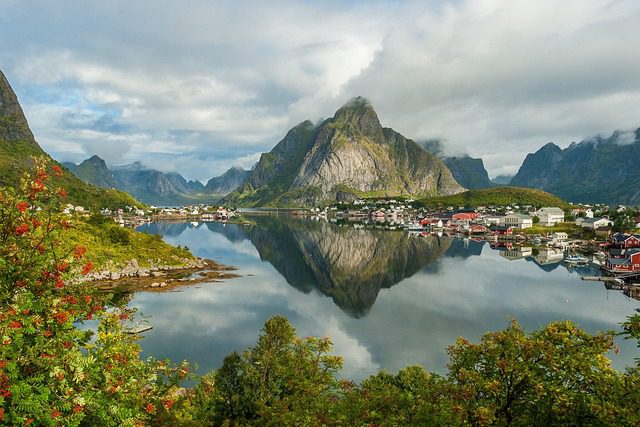
We drove into Geiranger on a Tuesday in late June — winding down the 18 hairpin bends of the Trollstigen road, windows open, a ferry cutting white lines across the fjord far below us. We pulled over and just watched it for a while. We’ve crossed twenty-one countries between us, and few things stop us like a Norwegian ferry doing its slow, inevitable thing through a wall of cliffs.
This guide covers the scenic ferry routes in Norway that are actually worth your time — the ones that aren’t just transportation but the centrepiece of a day, or a detour you’ll still be talking about years later.
The most scenic ferry routes in Norway include the Geirangerfjord crossing, the Nærøyfjord UNESCO route, the Hardangerfjord car ferries, and the legendary Hurtigruten coastal voyage. Most short crossings cost under 150 NOK per person, run year-round, and can be done without a booking — just arrive 20 minutes early.
Why scenic ferries matter in Norway’s travel culture
Norway has more coastline than almost any country on Earth — over 100,000 kilometres once you trace the fjords. The road network is remarkable, but at some point the mountains simply drop into the sea and a ferry is the only way forward. That’s not a problem. It’s the whole point.
Ferries as part of Norwegian daily life
- Functional infrastructure: Most short crossings are operated as public transport — subsidised by the state, priced like a bus ride, running to a timetable. You pay at the terminal or onboard.
- No advance booking needed (usually): On most routes under 45 minutes, you simply arrive. Queuing is orderly — form one lane, follow the crew. On busy summer weekends, arrive 20–30 minutes early.
- Part of National Tourist Routes: Several routes — Geiranger–Hellesylt, Kaupanger–Gudvangen — are officially designated as Norway’s Scenic Routes, meaning the fjordscape is literally the attraction, not just something you happen to cross.
- Dog-friendly and car-friendly: Almost all Norwegian ferries carry vehicles. Dogs travel on the car deck or in enclosed areas. There’s usually a small café onboard for hot coffee.
We’ve used Norwegian ferries to cut inland loops, to reach islands with no road access, and simply to slow down when the fjords demanded it. The key is knowing which routes reward you with something extraordinary, and which are purely functional.
The top scenic ferry routes in Norway by region
We’ve personally covered most of these; for the ones we haven’t, we’ve filtered out the tourist-board fluff and focused on traveller accounts and local knowledge. Here are the routes we’d actually recommend.
Western Fjords — the classics
- Geiranger to Hellesylt (Geirangerfjord): The single most photogenic crossing in Norway. The 65-minute sailing takes you past the Seven Sisters waterfall, the Suitor, and sheer 1,400-metre walls. It runs seasonally (May–October) and costs roughly 170–200 NOK per adult. Arrive early on peak summer mornings — queues form before 8 am.
- Kaupanger to Gudvangen (Nærøyfjord UNESCO): The narrowest fjord in Europe. At some points the cliffs rise 1,800 metres either side of the boat. The route is part of the Norway in a Nutshell trip but works just as well independently by car. About 2 hours.
- Lavik to Oppedal (Sognefjord crossing): The shorter, faster sibling — 15 minutes across the main Sognefjord arm, beautifully clear water, mountains in every direction. Often used to bypass the E39.
- Utne to Kvanndal (Hardangerfjord): One of Norway’s prettier overlooked crossings. Orchard country on both shores, peaking in blossom season (late April to early May). 25 minutes.
Lofoten and the North
- Bodø to Moskenes (Lofoten): The 3.5-hour open-sea crossing to Lofoten. Not a fjord route — you’re in the Norwegian Sea — but the arrival: jagged red peaks erupting from flat grey water, is one of Norway’s great visual moments. Book ahead in summer, especially with a car.
- Svolvær to Skrova: A short island hop through the Vestfjorden, used mostly by locals and serious birdwatchers. Cheap, frequent, wonderfully unhurried.
- Andenes to Bjørnskinn (Andøya ferry): Connects the whale-watching hub of Andenes to the mainland. An underrated crossing through calm water with great chances of spotting sea eagles overhead.
Quick-reference: scenic ferry routes, durations, and rough costs
All prices are approximate adult fares as of 2025–2026. Car rates are additional. Check the operator’s website — Fjord1, Norled, and Torghatten Nord run most of the country’s ferry network.
- Geiranger–Hellesylt: 65 min · ~175 NOK per adult · ~330 NOK per car · seasonal (May–Oct)
- Kaupanger–Gudvangen: 120 min · ~250 NOK per adult · ~480 NOK per car · year-round (fewer sailings in winter)
- Lavik–Oppedal: 15 min · ~60 NOK per adult · ~175 NOK per car · year-round, frequent
- Utne–Kvanndal: 25 min · ~80 NOK per adult · ~185 NOK per car · year-round
- Bodø–Moskenes (Lofoten): 3.5 hrs · ~285 NOK per adult · ~630 NOK per car · year-round, book ahead in summer
- Flåm–Gudvangen (boat only, no cars): 2 hrs · ~450–550 NOK per adult · June–August only · pre-booking strongly recommended
- Bergen–Stavanger (Fjordline): 5.5 hrs · ~600 NOK per adult · year-round · includes overnight cabin option
- Andenes–Bjørnskinn: 35 min · ~95 NOK per adult · ~220 NOK per car · year-round
Tips for getting the most from your scenic ferry crossing
After a lot of crossings — some magical, some involving cold coffee and the wrong side of the boat — here’s what we’d tell you before you board.
Practical tips worth knowing
- Always go up on deck: The inside seating is warm and has coffee, but the view is outside. Even in Norwegian summer drizzle, the deck experience is the whole point. Bring a waterproof layer.
- Position your car deliberately: If the crossing is scenic, drive onto the ferry early and park toward the bow. Then walk to whichever side faces the key waterfall or cliff. On the Geiranger route, port side (left when facing forward) gives you the Seven Sisters waterfall.
- Arrive 20 minutes early in summer: The ferry crew loads cars by queuing order. Miss the first sailing and you could wait an hour for the next. In peak July–August, we aim for 30 minutes early on popular routes.
- Pay by card onboard or at the terminal: Most Norwegian ferries accept Visa and Mastercard. Some routes use an app (AutoPASS ferry) for frequent users. Occasional small crossings are cash-only — worth checking.
- Check the timetable, not just the route: Frequencies vary hugely. The Nærøyfjord boats run 3–5 times daily in summer; a remote island crossing might run twice. Never assume.
- Bring your own coffee for long crossings: Onboard cafés exist, but the queues on busy boats are slow and the coffee is average. For anything over an hour, pack a thermos.
Hurtigruten and the longer coastal voyages
If the short crossings are snacks, Hurtigruten is the full meal. The coastal route runs from Bergen to Kirkenes — 2,500 kilometres, 34 ports, eleven days in each direction. It’s been described as the world’s most beautiful sea voyage, and while that’s the tourist board talking, it’s not wrong.
What Hurtigruten actually is
- A working ship, not a cruise: Unlike most cruise ships, Hurtigruten stops in small fishing towns, loads cargo, picks up locals, and continues. The passenger experience is layered on top of a genuinely functional route.
- Flexible booking: You don’t have to sail the full route. Book just Bergen to Ålesund (20 hours) or Tromsø to Honningsvåg (overnight, for the North Cape). Partial voyages are often the best value.
- Seasonal character: Summer brings midnight sun and birdlife. Winter brings northern lights and dramatic storm light. Both are extraordinary in different ways.
- Alternative operators: Havila Kystruten now runs a competing coastal route on the same ports, with newer hybrid-electric ships. Often slightly cheaper than Hurtigruten for equivalent cabins.
Get our Norway route notes — straight from the road
We send one honest travel letter per week. Ferry timetable updates, route notes, things we’d do differently. No fluff.
How the seasons change the scenic ferry experience
Norway’s ferry routes look and feel completely different depending on when you go. Neither season is wrong — they’re just different experiences.
- June–August (peak summer): Waterfalls are at full volume from snowmelt. Greenery is vivid. Midnight sun means you can cross at 10 pm in full daylight. Crowds are real — popular routes like Geiranger fill quickly. Book car space on Bodø–Moskenes at least a week ahead.
- May and September: Our preferred windows. Fewer people, full timetables on most routes, colours still excellent. Waterfalls in May are even stronger than August.
- October–November: Autumn light on the fjords is genuinely spectacular — golds and reds on the hillsides, lower sun angles. Some seasonal routes (Geiranger–Hellesylt) stop in late October. Check carefully.
- December–March: Most short crossings continue year-round. The fjords in winter are brooding and dramatic. Snow on the cliff faces, ice-blue water, almost no other tourists. Cold on the deck — dress accordingly.
- April: Blossom season along the Hardangerfjord. The Utne–Kvanndal crossing is genuinely beautiful when the apple orchards are in bloom. One of the most underrated windows in all of Norway.
Mistakes we made on Norwegian ferries
A few things we got wrong, so you don’t have to.
- Standing on the wrong side of the boat. On the Geiranger route we were on starboard (right) and missed the Seven Sisters head-on. Ask the crew or look up the route before boarding.
- Assuming the seasonal route ran all year. We planned a crossing in November only to find the Geiranger–Hellesylt route had closed in late October. Always confirm seasonal status before building your itinerary around it.
- Not checking the car ferry timetable for Bodø–Moskenes. We arrived without a reservation in July and waited four hours for a sailing with car space. In summer, pre-book with a car. Full stop.
- Staying inside for the first twenty minutes. Hot coffee won. We missed the most dramatic section of the Nærøyfjord on one crossing because we were queuing at the café. Deck first, coffee second.
- Assuming the AutoPASS ferry app works without Norwegian ID. It mostly does, but occasional routes have issues with foreign cards linked to the app. Have a card ready at the terminal window as backup.
- Underestimating crossing time on the Bodø–Lofoten route. 3.5 hours sounds manageable, but on rough sea days the open-water section is genuinely choppy. If you’re prone to seasickness, take something before you board.
Frequently asked questions about scenic ferries in Norway
Do I need to book in advance for Norwegian ferries?
Most short fjord crossings (under an hour) don’t require advance booking — you queue and pay onboard or at the terminal. The exceptions are longer routes with limited car space, especially Bodø to Moskenes (Lofoten) in summer, and the Flåm–Gudvangen tourist boat. If you’re travelling with a car in July or August, book anything over two hours in advance.
Which is the most scenic ferry route in Norway?
The Geiranger to Hellesylt crossing is widely considered the most photogenic — UNESCO-listed fjord, the Seven Sisters waterfall, vertical cliffs. But the Nærøyfjord route (Kaupanger to Gudvangen) rivals it for pure drama because of how narrow and enclosed it feels. Both are worth doing if your itinerary allows it.
How much do Norwegian ferries cost?
Short crossings (15–30 minutes) run roughly 60–100 NOK per adult and 150–200 NOK for a car. Longer scenic routes like Geiranger–Hellesylt are 170–200 NOK per adult plus car fees. The Bodø–Lofoten crossing is around 285 NOK per adult, 630 NOK for a car. Hurtigruten segments vary widely by season and cabin type — budget at least 1,500–3,000 NOK per person for a short overnight leg.
Can I take my dog on a Norwegian ferry?
Yes, dogs are allowed on virtually all Norwegian ferries. On short car ferries, dogs typically stay in or near the car on the vehicle deck, or in a designated outdoor area. On longer voyages (Hurtigruten, Bodø–Lofoten), dogs must stay in kennels or the car deck — they’re not allowed in passenger cabins. Check the specific operator’s pet policy before you travel.
Is the Geiranger ferry seasonal or does it run year-round?
The Geiranger to Hellesylt route is seasonal — it typically runs from late April or early May through late October. It does not operate in winter. If you’re planning a November-to-March trip to western Norway, use the Kaupanger–Gudvangen Nærøyfjord route instead, which operates year-round with reduced winter timetables.
What’s the difference between Hurtigruten and a regular Norwegian ferry?
A regular ferry is a short, fixed crossing — often 15 minutes to 3 hours, running to a timetable, primarily serving road traffic. Hurtigruten is a multi-day coastal voyage along the full Norwegian coastline, from Bergen to Kirkenes. It’s closer to a small expedition cruise than a commuter ferry, with proper cabins, restaurant dining, and organised shore excursions. Partial segments are available and often excellent value.
Joona & Alla
A Finnish-Ukrainian couple living in Rovaniemi, Finland. Joona is a marketing professional in Lapland tourism; Alla is an AI Engineer. Together we’ve visited 21 countries and share honest, locally-grounded travel writing from our home in the Arctic.
Read our full story →